Calorie-dense per gram, and you eat a lot of grams#
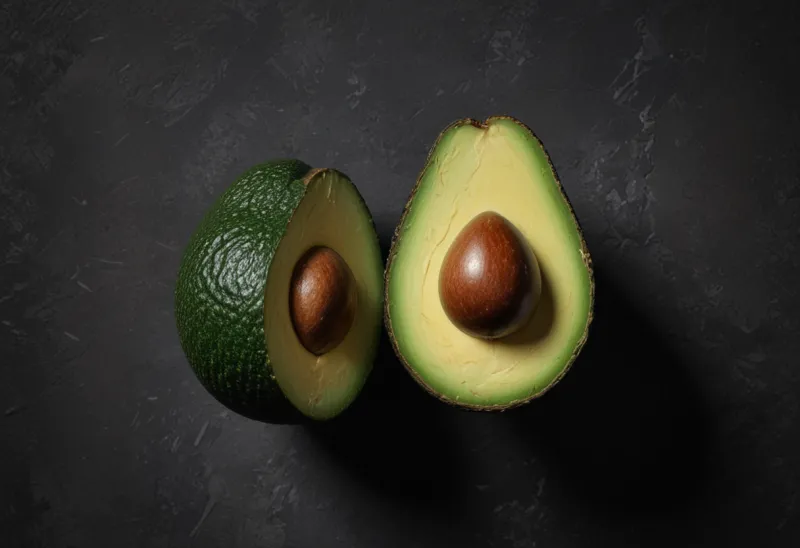
Avocado flesh is roughly 160 calories per 100 grams, about 83% of which arrives as fat — 14.7 grams of it, against 2 grams of protein1. That percentage is my arithmetic on USDA's values. So yes, avocado is calorie-dense: comparable per gram to a fatty cut of meat, several times a banana. The reason it surprises people is that it does not behave like a fat in the mouth — it is mild, cool and vegetal, so nothing about eating it signals what it costs.
But the density is the smaller half of the problem. The larger half is that "an avocado" is a serving unit spanning at least a 60% range, and that USDA's own laboratory analyses of the same flesh disagree by about a third. Where the common-foods reference uses avocado as its one-line example of a food that is not biologically constant, this is what that looks like when you open it up.
Two USDA entries, a third apart#
Start with the disagreement, because it is the most concrete thing here and almost nobody knows about it.
| USDA entry | Energy | Fat | Data type |
|---|---|---|---|
| Avocados, raw, California2 | 167 kcal | 15.4 g | SR Legacy |
| Avocados, raw, all commercial varieties1 | 160 kcal | 14.7 g | SR Legacy |
| Avocado, Hass, peeled, raw4 | 223 kcal | 20.3 g | Foundation, 2024 |
| Avocados, raw, Florida3 | 120 kcal | 10.1 g | SR Legacy |
The first and third rows describe the same fruit. "California" avocados are overwhelmingly Hass, and USDA's newer analytical programme measured Hass flesh at 20.3 grams of fat per 100 grams across eight samples, against the older reference entry's 15.4 — pushing energy from 167 to 223 calories, a 33% increase. Neither number is a mistake. They are separate laboratory campaigns on separately sourced fruit, decades apart, and the newer one carries an explicit sample count where the older does not.
There is a smaller disagreement folded inside the newer entry too. It lists 223 calories using the general Atwater factors and 206 using factors specific to this food — an 8% spread arising purely from which conversion set you apply to the same measured grams of fat, carbohydrate and protein4. The calorie values of the macros are not quite the fixed constants they are usually presented as, and avocado is a food where the choice is visible on the record.
For planning, the practical position is to treat avocado flesh as 160 to 220 calories per 100 grams and stop there. Any app quoting one figure to the calorie has picked a row from this table without telling you which.
"One avocado" is not a unit#
Now the serving. USDA attaches its own fruit weights to these entries, and they do not agree either — because the two commercial varieties are not the same size of object.
| One fruit, flesh only | Weight | Energy density | Whole fruit |
|---|---|---|---|
| California (Hass) | 136 g | 167 kcal/100 g | ~227 kcal |
| Unspecified variety | 201 g | 160 kcal/100 g | ~322 kcal |
| Florida | 304 g | 120 kcal/100 g | ~365 kcal |
Weights and densities are USDA's; the last column is one multiplied by the other.
Read the Florida row against the California row and the intuition most people carry gets inverted. Florida avocados are the lower-calorie fruit by a wide margin — 120 calories per 100 grams against 167, because they are bred for lower oil content and carry more water. And a whole Florida avocado is about 61% more calories than a whole California one, because its flesh weighs more than twice as much. Choosing the leaner variety and eating the whole fruit leaves you further ahead in calories than you started.
This is the specific reason avocado defeats eyeball estimation in a way most produce does not. With an apple, size and calories move together, so misjudging the size gets you a proportional error. With avocado, the two commercial types run in opposite directions on density and size at once, so the error compounds instead of cancelling — the general failure mode described in calorie density estimation, here in an unusually pure form. Half an avocado is a genuinely useful serving to standardize on, and it is 113 calories or 183 depending on which half you are holding.
What the fat actually is#
The composition is the part of avocado's reputation that survives scrutiny cleanly. Of the 14.7 grams of fat per 100 grams, 9.8 grams are monounsaturated and only 2.13 saturated1 — an oleic-dominant profile closer to olive oil than to anything else in the produce aisle, and the fat type that comes out best in the saturated-versus-unsaturated evidence.
The less-quoted number is fiber: 6.7 grams per 100 grams, which makes a whole California avocado about 9 grams of fiber — a third of a day's 25-to-38-gram target from one fruit. That combination of high fat and high fiber is unusual, and it is why avocado's calorie density, while high for a fruit, sits well below what a food that is 83% fat calories would otherwise be: the fiber and the 73 grams of water per 100 are diluting it. Potassium is 485 mg per 100 grams, more than the same weight of banana.
None of this makes the calories not count. It makes them calories worth spending, which is a different claim and the only one the composition supports.
Does the fat actually buy you fullness?#
The usual next argument is that avocado's fat and fiber make a meal more filling, so the extra calories pay for themselves. That has been tested directly, and the result is more interesting than either camp usually reports.
Wien and colleagues ran a randomized three-way crossover in 26 overweight adults, comparing a control lunch against the same lunch with avocado substituted in isocalorically and against the lunch with about 67.5 grams of avocado added on top (+112 calories). Adding the avocado increased self-reported meal satisfaction by 23% over five hours (P = 0.05) and cut desire to eat by 28% (P = 0.04), with larger effects over the first three hours — a 40% reduction in desire to eat (P = 0.01)5.
So the fullness effect is real. But the outcome that decides whether it pays for itself is what people ate afterwards, and there the trial found no significant difference in subsequent energy intake at dinner and evening snacks between conditions (P = 0.37); dietary compensation for the added energy came to 66%. Read plainly: the added avocado calories made people feel meaningfully fuller and were still mostly additive to the day. Feeling less like eating and eating less are separate outcomes, and this study got one of them.
Two caveats worth carrying. The trial had 26 participants and measured appetite over a single afternoon, which supports a direction rather than an effect size. And it was funded by the Hass Avocado Board, with the authors declaring no competing interests — a funder whose product was the intervention. That does not invalidate the measurements, and it is a reason to weight the null on subsequent intake at least as heavily as the positive result on ratings, since the null is the one running against the funder's interest.
The workable conclusion is unglamorous. Avocado is an excellent food and a poor free lunch: if you add half of one to a meal, log the 113 to 183 calories, because the fullness it buys is genuine and will not quietly refund them. What it does refund is the general case for fat in a meal — worth eating, worth counting, and worth counting as a band rather than a figure, given that USDA cannot get closer to itself than 33%.
FAQ#
How many calories are in a whole avocado?#
Roughly 227 for a California (Hass) fruit and 365 for a Florida one, using USDA's own per-fruit flesh weights of 136 g and 304 g against densities of 167 and 120 calories per 100 g (FDC 171706; FDC 171707). For an unspecified supermarket avocado, about 320 is a reasonable middle. If you want one planning habit, count half a Hass avocado as 115 to 155 calories.
Are Florida avocados lower in calories than Hass?#
Per gram, substantially — 120 calories per 100 g against 167, because they carry less oil and more water. Per fruit, no: a Florida avocado's flesh weighs about 304 g against a California fruit's 136 g, which works out to about 365 calories against 227 (FDC 171707; FDC 171706). The leaner variety is the bigger fruit, and eating a whole one costs more, not less.
Does eating avocado help you eat less later?#
It makes people feel fuller without reliably making them eat less. Adding about 67.5 g of avocado to lunch raised meal satisfaction 23% and cut desire to eat 28% over five hours, but subsequent energy intake did not differ significantly from control (P = 0.37) and compensation for the added calories was 66%5. The trial had 26 participants and was funded by the Hass Avocado Board. Treat added avocado as calories you are choosing to spend.
Sources#
- USDA FoodData Central. Avocados, raw, all commercial varieties (FDC 171705, SR Legacy).
- USDA FoodData Central. Avocados, raw, California (FDC 171706, SR Legacy).
- USDA FoodData Central. Avocados, raw, Florida (FDC 171707, SR Legacy).
- USDA FoodData Central. Avocado, Hass, peeled, raw (FDC 2710824, Foundation Foods, released 2024 — analytical data, 8 samples).
- Wien M, Haddad E, Oda K, Sabaté J. A randomized 3x3 crossover study to evaluate the effect of Hass avocado intake on post-ingestive satiety, glucose and insulin levels, and subsequent energy intake in overweight adults. Nutr J. 2013;12:155.