Cooked from dry, a cup of beans is about 225 calories. Out of a can, it is a different measurement#
USDA lists red kidney beans boiled from dry at 127 calories per 100 grams — 8.67 grams of protein, 7.4 grams of fiber, 2 milligrams of sodium — with one cup weighing 177 grams1. Multiply through and a cup of home-cooked kidney beans is about 225 calories, 15.3 grams of protein and 13.1 grams of fiber. Black beans land in the same neighbourhood: 132 calories per 100 grams and a 172-gram cup, so about 227 calories with 15.2 grams of protein and 15.0 grams of fiber3. Those multiplications are mine; the densities and cup weights are USDA's.
Now open a can of the same bean. USDA's canned kidney entry — solids and liquids together, which is what a can contains — reads 81 calories per 100 grams, 5.22 grams of protein, 4.3 grams of fiber and 256 milligrams of sodium, at a cup weight of 256 grams2. Nothing was subtracted from the bean. The entry is 78.0% water against the home-cooked bean's 66.9%, because roughly a third of what you bought is brine. Every per-gram figure in the canned column is the dry-cooked bean divided by that extra water — which is the general lesson of the common-foods reference arriving in its most literal form.
A 15-ounce can carries about a gram of salt, and most of it is in liquid you were going to pour out#
USDA's canned kidney record gives a can weight of 436 grams. Run the density across it — my arithmetic, USDA's inputs — and one can contains roughly 353 calories, 22.8 grams of protein, 18.7 grams of fiber and 1,116 milligrams of sodium. That last figure is close to half the 2,300 milligram daily limit most guidelines use, delivered by a food that contains 2 milligrams when you cook it yourself.
Two things follow. The sodium is genuinely large and genuinely removable, because most of it is dissolved rather than bound in the bean. And the canned entry is not a reliable planning number, because it describes beans plus brine: weigh drained beans, log them against the solids-and-liquids figure of 81 calories per 100 grams, and you will undercount, since the water you poured away carried almost none of the calories and what is left on the sieve is necessarily denser than the entry says.
Draining does the work. The rinse is mostly ceremony#
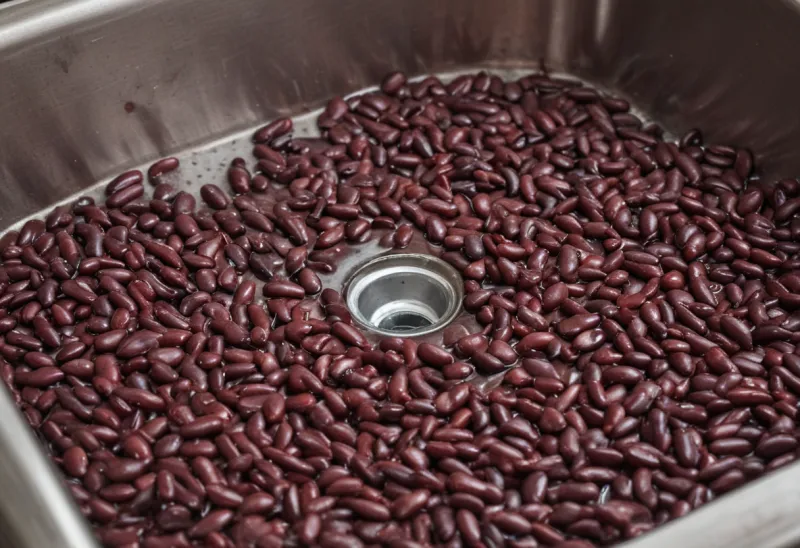
The standard advice is to drain and rinse. Somebody tested whether the second half earns its place.
Five brands each of five canned varieties — red kidney, garbanzo, pinto, black and great northern — were bought at retail, and sodium was measured three ways: beans in their packing liquid, beans drained on a sieve for two minutes, and beans drained then rinsed with 3.5 litres of tap water and drained again. Across all 90 experimental units, sodium per label serving fell from a mean of 503 milligrams to 321 after draining, a 36% reduction, and to 295 after draining and rinsing, a 41% reduction. Draining was significant. The additional five points from rinsing were not (p > 0.05)4.
The per-variety numbers are worth having because they are not uniform. Draining alone removed 42% of the sodium from red kidney beans and 40% from pinto, but only 29% from black beans and 30% from great northern. The authors' explanation is textural: great northern and black beans shed more starch and bean solids during canning, producing a thickened packing liquid that clings to the bean surface and rides out of the sieve with it. If you are going to rinse anything, rinse the beans that come in a cloudy liquid.
Two caveats belong on this result. The authors state plainly that they did not measure what else leaves with the sodium — folate and other water-soluble nutrients sit in that liquid too. And the provenance deserves a note: the paper carries no funding statement I could find, it cites a proprietary consumer survey held by a canned-bean manufacturer, and the copy in circulation is distributed from that manufacturer's website. A lab measurement of sodium is hard to bend. The framing — don't avoid canned beans — is precisely the conclusion a canner would commission.
One more inconsistency worth naming rather than smoothing over. Duyff's retail sample averaged around 500 milligrams of sodium per half-cup serving; USDA's legacy entry works out to about 328 for the same volume of canned kidney beans. That is a 50% disagreement between two competent sources, and the likely explanation is not that either is wrong but that they sampled different products a decade or more apart. Sodium in canned beans is a brand fact, not a bean fact. Read the can in front of you.
Beans carry more soluble fiber than any other pulse — which is also why they ferment#
Measured with the modern integrated method that captures resistant starch and non-digestible oligosaccharides, common beans came out as the highest-fiber of four pulses at 25.8% of dry weight, ahead of dry peas at 24.6%, chickpeas at 21.8% and lentils at 20.0%5.
The composition is more informative than the total.
| Pulse | Total fiber (% dry wt) | Insoluble | Soluble | Oligosaccharides |
|---|---|---|---|---|
| Common bean | 25.8 | 13.9 | 7.7 | 4.2 |
| Dry pea | 24.6 | 16.0 | 3.9 | 4.7 |
| Chickpea | 21.8 | 15.8 | 3.5 | 2.5 |
| Lentil | 20.0 | 13.6 | 3.2 | 3.3 |
Beans are not merely the highest — they are the only one of the four with a large soluble fraction. At 7.7% they carry roughly double the soluble fiber of chickpeas or lentils, and soluble fiber is the fraction that thickens gut contents and gets fermented rather than passing through. That single column explains most of what beans are famous for in both directions: it is the reason they show up in cholesterol trials, the reason they blunt the energy you extract from a meal, and the reason they have a social reputation. Which of those effects follows from solubility and which from viscosity is a distinction worth understanding before you shop on it — soluble vs insoluble fiber unpicks it — and the calorie side of fermentation is quantified in how fiber affects calorie absorption. The disclosure on this one: the analysis was funded in part by the American Pulse Association alongside USDA and NIH grants, and the authors declare no conflict.
The gas is real, front-loaded, and much smaller than the reputation#
Three feeding studies asked the same weekly questionnaire of people eating half a cup of beans a day for eight or twelve weeks. In the first week, 50% of pinto-bean eaters reported increased flatulence, and 47% of baked-bean eaters — against 0 to 3% of people eating the control foods. So the effect is real and nobody should pretend otherwise.
Then it collapsed. By week two the reports had fallen to between 6% and 24% depending on the bean, and across weeks three to eight they ran at 3 to 7%. In the twelve-week arm the figure went from 45% in week one to 15–23% by weeks six through twelve. Over a full eight weeks of daily beans, 72–88% of participants recorded either zero or one incident6.
Note the bean that barely registered: black-eyed peas produced an increase in 19% of people in week one, under half the pinto figure. Whatever the gut adapts to is not identical across species, and someone who wrote off beans on the evidence of one chilli ran a very small experiment on themselves.
The one bean that can actually make you ill, and it is not the fibre#
Raw kidney beans contain phytohemagglutinin, a lectin that survives gentle heat and causes violent vomiting and diarrhoea within one to three hours. As few as four or five raw or under-cooked beans can do it; the toxin remained active after an hour at 85°C, which is why a slow cooker is the wrong appliance and why the standard instruction is to soak for at least 12 hours and then boil vigorously for at least 10 minutes8.
A 2025 analysis put numbers on the gradient. Raw dark red kidney beans measured 223 milligrams of active lectin per gram of dry matter — the highest of the market classes tested, against 144 for white kidney, 94 for commercial pinto and 87 for black beans. Four raw dark red kidney beans, 2.44 grams in total, carry an estimated 544 milligrams of active PHA. Commercially canned beans showed a greater than 99% reduction, at 4.9 micrograms per gram7.
Four raw dark red kidney beans carry about 544 milligrams of active lectin. A whole can of the cooked ones carries about 0.46 — roughly a thousandfold below the amount that makes people ill.
This is the one place where the can is a safety feature rather than a compromise, and it is why the "beans are toxic" corner of the internet is arguing from a real fact applied to the wrong food. The hazard lives in the raw and the barely-cooked; it does not survive a rolling boil, let alone a cannery.
Counting them#
| USDA entry | Per 100 g | Cup weight | So one cup is |
|---|---|---|---|
| Kidney, red, boiled from dry1 | 127 kcal · 8.7 g protein · 7.4 g fiber · 2 mg sodium | 177 g | ~225 kcal |
| Black, boiled from dry3 | 132 kcal · 8.9 g protein · 8.7 g fiber · 1 mg sodium | 172 g | ~227 kcal |
| Kidney, red, canned, solids and liquids2 | 81 kcal · 5.2 g protein · 4.3 g fiber · 256 mg sodium | 256 g | ~207 kcal |
Three habits cover almost all of the error. Weigh dry beans dry, before they meet water, for the same reason you would weigh dry rice dry. Drain canned beans before you weigh them and log them against a drained or home-cooked entry rather than the solids-and-liquids one, because the brine dilutes every figure in the row. And treat the sodium line as a property of the brand rather than of the bean.
For those 225 calories you get 15 grams of protein and 13 to 15 grams of fiber from an ingredient costing a few cents a serving. Priced per gram of protein rather than per bag, beans land alongside eggs and chicken rather than beneath them (cheap high-protein foods does that arithmetic), and they are short on methionine in the same way lentils are — which is why every cuisine that eats a lot of beans also eats a lot of grain, for reasons set out in complete vs incomplete proteins.
FAQ#
Should I rinse canned beans, or is draining enough?#
Draining is doing nearly all the work. Across five varieties and five brands each, draining cut sodium per serving 36% and draining plus rinsing cut it 41% — a difference that was not statistically significant4. Rinsing is most worthwhile for black and great northern beans, which shed starch into a thick packing liquid that clings to them and where draining alone removed only 29–30%.
Are canned beans as good as dried?#
Nutritionally close, once you account for the water. USDA's canned kidney entry reads 81 calories and 4.3 g fiber per 100 g against 127 calories and 7.4 g for the same bean boiled from dry, but that gap is dilution — the canned entry is 78.0% water and includes the packing liquid (FDC 175195; FDC 175194). The real differences are sodium, which you can drain away, and a small loss of water-soluble nutrients into the brine.
Do you stop getting gas from beans if you eat them regularly?#
Largely, and quickly. Half a cup of pinto beans daily produced increased flatulence in 50% of people in week one; by weeks three to eight the figure was 3–7%, and 72–88% of participants logged zero or one incident across the entire eight weeks6. Species matters too — black-eyed peas caused a first-week increase in 19% of people, under half the pinto rate.
Sources#
- USDA FoodData Central. Beans, kidney, red, mature seeds, cooked, boiled, without salt (FDC 175194, SR Legacy).
- USDA FoodData Central. Beans, kidney, red, mature seeds, canned, solids and liquids (FDC 175195, SR Legacy).
- USDA FoodData Central. Beans, black, mature seeds, cooked, boiled, without salt (FDC 173735, SR Legacy).
- Duyff RL, Mount JR, Jones JB. Sodium Reduction in Canned Beans After Draining, Rinsing. J Culin Sci Technol. 2011;9(2):106-112.
- Chen Y, McGee R, Vandemark G, Brick M, Thompson HJ. Dietary Fiber Analysis of Four Pulses Using AOAC 2011.25: Implications for Human Health. Nutrients. 2016;8(12):829. (Funded in part by the American Pulse Association, USDA/NIFA and NIH/NCI; authors declare no conflict.)
- Winham DM, Hutchins AM. Perceptions of flatulence from bean consumption among adults in 3 feeding studies. Nutr J. 2011;10:128.
- Thompson HJ, Neil ES, McGinley JN, Lutsiv T. Toward Standardized Measurement of Active Phytohemagglutinin in Common Bean, Phaseolus vulgaris, L. Foods. 2025;14(24):4247.
- Centre for Food Safety, Hong Kong. Phytohaemagglutinin Poisoning. Food Safety Focus, 208th Issue, November 2023.
Source: BurnWeek — "Beans: protein, fiber, and calorie counts", https://burnweek.fit/blog/calories-and-protein-in-beans/. Licensed CC BY 4.0: free to quote or reuse with a link to this page.