20 to 35 percent of calories — and a floor you can feel below that#
The usable answer to how much dietary fat you should eat is a percentage, not a gram count to memorize: roughly 20 to 35 percent of your calories, which is the acceptable range set by the Institute of Medicine1. On a 2,000-calorie day that works out to about 44 to 78 grams of fat — calories times the percentage, divided by fat's 9 calories per gram, so it is arithmetic on the range rather than a separate measurement. Where you land inside that window is mostly preference.
The number that actually matters, though, is the bottom of the range, not the top. Fat is the one macro most people are trying to eat less of, which makes the more useful question how low you can safely go — and the answer is: not as low as the diet culture of the last forty years implied. Below a floor, you stop covering two fatty acids your body can't make, you stop absorbing the fat-soluble vitamins in the vegetables you are eating, and — in men, and more tentatively — your testosterone drifts down. This piece is about that floor. The basic accounting of fat as a macro (9 calories a gram, why portion errors on oil cost the most) lives in macronutrients explained.
The two fats you actually have to eat#
Strip everything else away and two fatty acids remain non-negotiable, because the human body cannot build them from scratch: linoleic acid, an omega-6, and alpha-linolenic acid, an omega-3. These are the essential fatty acids, and their requirement is the hard biological floor under any fat target. The Institute of Medicine sets Adequate Intakes of about 17 grams of linoleic acid and 1.6 grams of alpha-linolenic acid a day for men, and 12 grams and 1.1 grams for women1. Those are small numbers — a handful of walnuts and a tablespoon of a seed oil clear most of them — but they are the reason a truly fat-free diet is a deficiency waiting to happen.
The two families do different jobs and come from different foods, and the omega-6-to-omega-3 balance is its own long argument — one that belongs to the types of fat rather than the total. For the total, the point is narrower: you cannot drive fat to zero without eventually running short of raw material your cells need.
Fat is how you absorb the vitamins in your salad#
Here is the floor most people have never heard of, and it is the most concrete. Four vitamins — A, D, E, and K — are fat-soluble, along with the carotenoids in vegetables, which means they need dietary fat in the same meal to be absorbed at all. This is not a modest effect. When researchers fed people salads with fat-free, reduced-fat, and full-fat dressing, absorption of carotenoids was essentially zero with the fat-free dressing and climbed steeply as fat was added2. A separate study that added avocado or avocado oil to salad and salsa raised carotenoid absorption by anywhere from 2.6-fold to more than 15-fold, depending on the pigment3.
Eat a salad with fat-free dressing and you absorb almost none of the vitamins you ate the salad for.
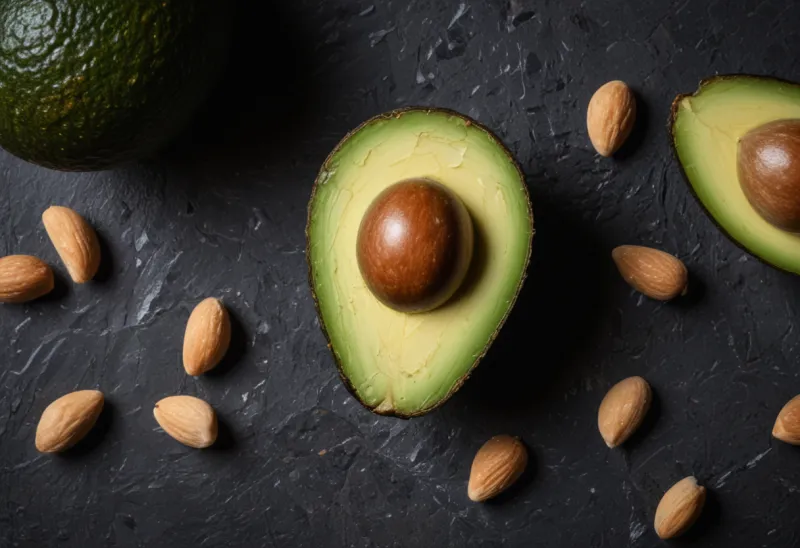
The practical version: the fat you add to vegetables is not a garnish you can cut to save calories — it is the mechanism that lets the vegetables count. A drizzle of olive oil or a few slices of avocado on a salad earns back its calories in nutrients you would otherwise flush.
The hormonal floor: real, modest, and easy to overstate#
The last reason not to crush your fat intake is the one the internet has run furthest with, so it needs the most careful handling. A 2021 meta-analysis pooled six crossover studies — 206 men in total — comparing low-fat diets (around 20% of calories) against higher-fat diets (around 40%), and found that the low-fat periods came with lower testosterone: a standardized effect of −0.38 for total testosterone (95% CI −0.75 to −0.01), with similar drops in free and urinary testosterone4. Taken at face value that is a small-to-moderate effect, and it fits a plausible mechanism: less dietary fat, less raw material for testosterone synthesis in the testes.
Now the caution, because this is where the certainty gets sold past what the data support. The authors themselves are the ones pumping the brakes: with only six small studies, meaningful heterogeneity, and half of them at medium risk of bias, they conclude that "large randomised controlled trials are needed to confirm this review's findings, before practical recommendations can be made." The largest testosterone drops came from two vegetarian low-fat diets that were probably also lower in zinc — a separate cause the design cannot rule out. The result has become a favorite of high-fat and low-carbohydrate advocacy, which is worth knowing when you see it quoted as settled; the paper reports no financial conflicts of interest, but it also carries a 2026 corrigendum and, by its own authors' account, is not yet a basis for a fat prescription. The fair takeaway is narrow: dropping fat very low may nudge testosterone down a little, so don't zero it out — but this is not evidence that piling on more fat helps once you are comfortably above the floor.
So, how much — and how low is too low?#
Put it together into a usable target. For most people, land anywhere in the 20–35% window and choose your spot by preference and by how you would rather spend the rest of your calories — more fat means fewer carbs, and vice versa, the trade covered in how many carbs per day. The grams that implies:
| Daily calories | 20% (floor) | 25% | 35% (ceiling) |
|---|---|---|---|
| 1,600 | ~36 g | ~44 g | ~62 g |
| 2,000 | ~44 g | ~56 g | ~78 g |
| 2,500 | ~56 g | ~69 g | ~97 g |
(Grams = calories × percentage ÷ 9 — arithmetic on the range, not a fourth measurement.)
When you are dieting and calories are tight, the temptation is to cut fat hardest because it is the densest macro — at 9 calories a gram it is where the calories hide, a point the common-foods reference makes with cooking oil. Cutting some is fine. Cutting to the floor — much below 20% of calories — is where you start losing the things fat is actually for: essential fatty acids, vitamin absorption, and, for men, a little hormonal headroom. Keep protein where it belongs (how much protein per day), hold fat around or above that 20% line, and let the calorie deficit come from wherever it is easiest to sustain. And remember the amount is only half the story — which fats you choose matters at least as much, which is the whole of saturated vs unsaturated fat.
FAQ#
How low can I take my fat intake safely?#
Not much below 20% of your calories — roughly 36–56 g a day for most people. The strict biological minimum is the two essential fatty acids (about 17 g of linoleic and 1.6 g of alpha-linolenic acid a day for men; 12 g and 1.1 g for women)1, but you need more than that to absorb fat-soluble vitamins and support hormones, so the practical floor sits above the essential one.
Does eating more fat raise testosterone?#
Only from a low starting point, and modestly. Very-low-fat diets (~20% of calories) were linked to lower testosterone than higher-fat diets in a meta-analysis of six small crossover studies, but the authors say the evidence is not yet strong enough for recommendations4. Above the floor, adding more fat has no proven hormonal benefit.
Do I really need fat to absorb vitamins?#
Yes — for the fat-soluble ones. Vitamins A, D, E, K and vegetable carotenoids need fat in the same meal to be absorbed. Salad eaten with fat-free dressing delivered essentially no carotenoids; adding avocado raised absorption several-fold (Brown et al., 2004; Unlu et al., 2005). A little fat on your vegetables is functional, not indulgent.
Sources#
- Institute of Medicine. Dietary Reference Intakes: macronutrient AMDR and essential fatty acid Adequate Intakes (total fat 20–35% of energy; linoleic and α-linolenic acid AIs). National Academies Press, 2003.
- Brown MJ, Ferruzzi MG, Nguyen ML, et al. Carotenoid bioavailability is higher from salads ingested with full-fat than with fat-reduced salad dressings. Am J Clin Nutr. 2004;80(2):396-403.
- Unlu NZ, Bohn T, Clinton SK, Schwartz SJ. Carotenoid absorption from salad and salsa by humans is enhanced by the addition of avocado or avocado oil. J Nutr. 2005;135(3):431-436.
- Whittaker J, Wu K. Low-fat diets and testosterone in men: systematic review and meta-analysis of intervention studies. J Steroid Biochem Mol Biol. 2021;210:105878. (Corrigendum 2026;255:106880.)
Source: BurnWeek — "How much dietary fat should you eat?", https://burnweek.fit/blog/how-much-fat-per-day/. Licensed CC BY 4.0: free to quote or reuse with a link to this page.