Twenty grams of protein is one fridge item, not a meal#
It's 8 PM. You check what you've eaten today and you're 20 grams short of your protein goal.
Do you need to cook chicken? No. You need to open the fridge and stand there for slightly less time than you usually do.
The table shows what a single no-cook item buys you. Values come from USDA reference data, the portion arithmetic is ours, and brands vary, so trust the label on the tub in your hand.
| No-cook item | Portion | Protein | Calories | Protein per 100 kcal |
|---|---|---|---|---|
| Tuna, white, canned in water, drained | 100 g | 23.6 g | 128 | 18.4 g |
| Greek yogurt, plain, nonfat | 200 g | 20.4 g | 118 | 17.3 g |
| Cottage cheese, 1% fat | 200 g | 24.8 g | 144 | 17.2 g |
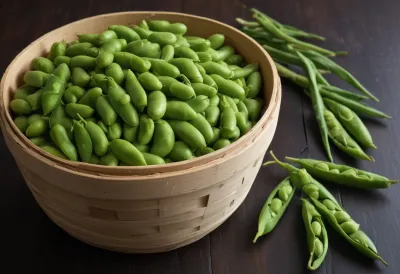
| Edamame, frozen, prepared | 150 g | 17.9 g | 182 | 9.8 g |
| Eggs, hard-boiled | 100 g, about two | 12.6 g | 155 | 8.1 g |
Skyr and high-protein yogurts generally sit in the same territory as the Greek yogurt row, and a protein shake delivers whatever its scoop says. Both are label decisions, so they don't get a row here. For a longer ranking, see the best protein per calorie, and for the portable version, high-protein snacks.
Most gaps turn out to be one of three sizes.
| Short by | Easiest fix | What it adds (our arithmetic) |
|---|---|---|
| About 10 g | 100 g Greek yogurt | 10 g, 59 kcal |
| About 20 g | 200 g Greek yogurt, or 100 g tuna | 20–24 g, 118–128 kcal |
| About 40 g | 200 g cottage cheese plus 100 g tuna | 48 g, 272 kcal |
If you're 40 g short at 8 PM, the fix isn't really a top-up. It's a sign that one of your meals has little protein in it, and that's a better thing to change tomorrow than to chase tonight.
Whether the gap is worth closing tonight#
The gap depends on a target, so it's worth checking that the target is sensible. The allowance of about 0.83 g/kg a day is built to prevent deficiency7. The International Society of Sports Nutrition suggests 1.2 to 1.6 g/kg for the general population losing weight8, and 1.4 to 2.0 g/kg for people who exercise9. Both are from one sports-nutrition society, whose 2026 authors list industry ties.
| Daily target | g/kg | At 60 kg | At 75 kg | At 90 kg |
|---|---|---|---|---|
| Recommended allowance | 0.83 | 50 g | 62 g | 75 g |
| General, losing weight | 1.2–1.6 | 72–96 g | 90–120 g | 108–144 g |
| Exercising regularly | 1.4–2.0 | 84–120 g | 105–150 g | 126–180 g |
These are written per kilogram, not per sex: the main analysis of requirements found no significant difference between men and women, with a hint that women's might run lower. A woman and a man at the same weight start from the same row, and the grams differ only because bodies usually weigh different amounts.
Those ranges are wide on purpose. If you sit inside yours at 8 PM, you're finished. If you're slightly under on a single day, nothing dramatic happens. A target isn't an exam you pass with 100% every night. Total daily protein matters more than exactly how it's spread8, and distribution across the day is a secondary concern after that.
The case for bothering is the pattern. If most days end 20 g short and you're dieting or lifting, you're living below the range that protects lean mass, and the evening top-up is the cheapest repair available.
Sugar cravings don't mean you're short on protein#
You'll see the claim everywhere: sweet cravings, snacking and overeating are your body asking for protein. It's a tidy story, and it deserves more suspicion than it gets.
The closest test points somewhere else. After a short stretch on a low-protein diet, healthy adults ate 13% more protein than they did after a high-protein stretch, and they shifted toward savory high-protein foods. Their total energy intake didn't change10. So low protein showed up as a pull toward savory food, which is roughly the opposite of the popular version.
There is one supportive-looking study. In a pilot among overweight, breakfast-skipping teenage girls, a high-protein breakfast reduced cravings, but a normal-protein breakfast also reduced both sweet and savory cravings compared with skipping11. Eating breakfast did much of that work, and a small pilot in one group can't carry a general claim.
| What's reasonably supported | What isn't established |
|---|---|
| Protein increases fullness in the short term | That craving sweets signals a protein shortfall |
| Enough protein, with training, protects lean mass in a deficit | That more protein reliably reduces sweet cravings |
| Some people find protein-rich meals easier to stop at | That a higher-protein meal lowers intake at the next meal |
That last row comes from a major review, which found a modest satiety effect from higher-protein meals but no support for lower intake at the next eating occasion12. A separate meta-analysis of fullness also warned about extrapolating from short lab studies13. Protein and satiety covers that evidence in depth.
In other words, if you want chocolate, you might just want chocolate. And that's allowed.
Swapping beats adding when calories are tight#
Adding protein to a finished day adds calories. If you're dieting and the numbers are already tight, the better move usually happens earlier, by trading one thing for another.
| Instead of | Try | Calories | Protein |
|---|---|---|---|
| Butter croissant, 60 g | Greek yogurt, 200 g | 244 → 118 | 4.9 g → 20.4 g |
Those are different foods, not nutritional equivalents, and you don't have to ban croissants. If you finish breakfast hungry, adding yogurt beside the croissant is also a perfectly good answer.
Protein doesn't cancel calories. If you're already meeting your target, three extra shakes a day aren't a shortcut to losing fat. People who overate on purpose gained fat at similar rates across low, normal and high protein intakes14.
A high-protein day that leaves no room for fruit, vegetables or whole grains isn't automatically a healthy day either. Fiber, enough total food and regular meals all do part of the job of managing hunger.
Three fine-print items on the fridge list#
Tuna. FDA advice on fish is written for people who are pregnant, breastfeeding or might become pregnant, and for young children. It puts canned light tuna in its "best choices" list and albacore, the white tuna in the table, in "good choices," with one 4-ounce serving a week15. If that's you, rotate rather than leaning on tuna every night.
Cottage cheese. The salt is high, and the idea that it does something special overnight doesn't hold up. Our cottage cheese breakdown has the numbers on both.
Kidneys. If you've been told to limit protein because of kidney disease, your own clinician's number outranks every table here. For people with healthy kidneys, the worry has much less behind it than its reputation suggests.
If you don't know whether you're short at all, a few days of writing down what you eat will tell you, and you won't need to keep doing it forever. Most people find one meal doing no protein work, and that meal is the only one that needs to change. Sometimes the easiest improvement isn't eating less. It's making what you already eat more satisfying.
FAQ#
What can I eat at night to get 20 g of protein without cooking?#
About 200 g of plain nonfat Greek yogurt or 100 g of canned tuna gets you there for roughly 120 to 130 calories, according to USDA reference values. Cottage cheese works too, and 200 g brings closer to 25 g.
Does craving sugar mean I need more protein?#
There's no good evidence for that. In the closest experiment, people on a low-protein diet moved toward savory high-protein foods, not sweet ones.
Is it bad to miss my protein target for one day?#
No. What matters is your typical intake across weeks. If you often come up short, change a regular meal rather than scrambling every evening.
Do men and women need different amounts of protein?#
Per kilogram of body weight, requirements haven't been shown to differ significantly by sex. Total grams differ mainly because body weights differ.
Sources#
- USDA FoodData Central. Fish, tuna, white, canned in water, drained solids (FDC 175158, SR Legacy).
- USDA FoodData Central. Yogurt, Greek, plain, nonfat (FDC 170894, SR Legacy).
- USDA FoodData Central. Cheese, cottage, lowfat, 1% milkfat (FDC 173417, SR Legacy).
- USDA FoodData Central. Edamame, frozen, prepared (FDC 168411, SR Legacy).
- USDA FoodData Central. Egg, whole, cooked, hard-boiled (FDC 173424, SR Legacy).
- USDA FoodData Central. Croissants, butter (FDC 174987, SR Legacy).
- Rand WM, Pellett PL, Young VR. Meta-analysis of nitrogen balance studies for estimating protein requirements in healthy adults. Am J Clin Nutr. 2003;77(1):109-127.
- Aragon AA, Campbell BI, Schoenfeld BJ, et al. International Society of Sports Nutrition position stand: diets for body weight reduction. J Int Soc Sports Nutr. 2026;23(1):2740266.
- Jäger R, Kerksick CM, Campbell BI, et al. International Society of Sports Nutrition Position Stand: protein and exercise. J Int Soc Sports Nutr. 2017;14:20.
- Griffioen-Roose S, Mars M, Siebelink E, et al. Protein status elicits compensatory changes in food intake and food preferences. Am J Clin Nutr. 2012;95(1):32-38.
- Hoertel HA, Will MJ, Leidy HJ. A randomized crossover, pilot study examining the effects of a normal protein vs. high protein breakfast on food cravings and reward signals in overweight/obese "breakfast skipping", late-adolescent girls. Nutr J. 2014;13:80.
- Leidy HJ, Clifton PM, Astrup A, et al. The role of protein in weight loss and maintenance. Am J Clin Nutr. 2015;101(6):1320S-1329S.
- Dhillon J, Craig BA, Leidy HJ, et al. The effects of increased protein intake on fullness: a meta-analysis and its limitations. J Acad Nutr Diet. 2016;116(6):968-983.
- Bray GA, Smith SR, de Jonge L, et al. Effect of dietary protein content on weight gain, energy expenditure, and body composition during overeating: a randomized controlled trial. JAMA. 2012;307(1):47-55.
- U.S. Food and Drug Administration. Advice about eating fish.
Source: BurnWeek — "20 g short at 8 PM: how to close a protein gap without cooking", https://burnweek.fit/blog/close-protein-gap-without-cooking/. Licensed CC BY 4.0: free to quote or reuse with a link to this page.