Dilute the protein and people eat more of everything#
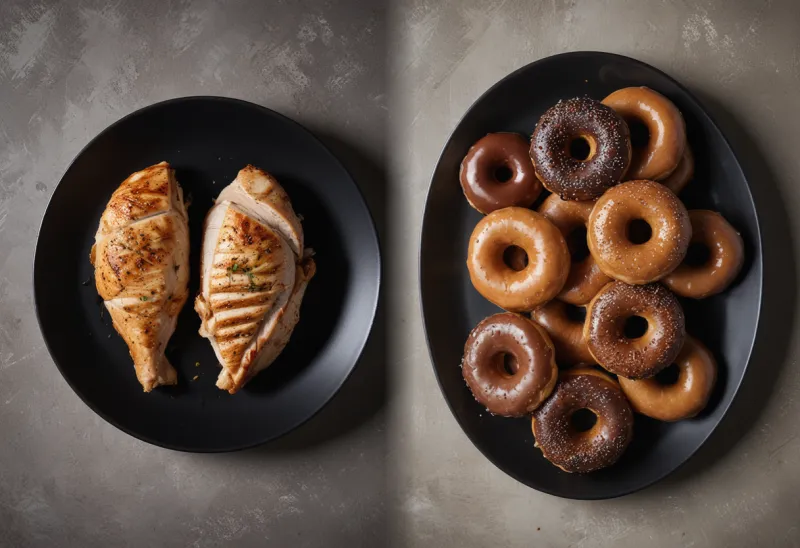
Protein does keep you full longer than the same calories of carbohydrate or fat — that part is well replicated, and you can feel it. But the version of this claim you usually hear operates at the level of one meal: eat the chicken, feel full, eat less. The more consequential finding is that the proportion of protein in your diet quietly sets how much total food you eat, whether or not you notice being hungry. Push protein down as a share of calories and people eat more of everything else to compensate — not because they lack willpower, but because they are still chasing protein.
That is the mechanism worth understanding, because it works on your week rather than your lunch, and it works without ever announcing itself as hunger. The target itself lives in how much protein per day; what follows is about what happens when you quietly drift under it.
The experiment that hid the macros#
The cleanest test disguised the thing being tested. Twenty-two lean adults spent three separate four-day periods living on fixed menus built from 28 foods matched for palatability, variety, and sensory quality, supplying 10%, 15%, or 25% of energy as protein. They could eat as much as they wanted. They could not tell which diet they were on1.
On the 10% protein menu, people ate 4.34 MJ more over the four days than on the 15% menu — a 12% increase in energy intake (P < 0.0001), sustained across all four days rather than fading after the first. A five-percentage-point shift in protein, invisible to the eater, moved total intake by about a thousand calories across a long weekend.
One detail in that paper deserves more attention than it gets: mean hourly hunger ratings across the day did not differ between the diets. Hunger did spike higher one to two hours after the 10% protein breakfast than after the 25% one (1.6 ± 0.4 vs 0.5 ± 0.3, P = 0.005), but averaged over the day, the low-protein group did not report feeling hungrier. They just ate more.
The people eating a thousand extra calories did not report feeling hungrier. Protein dilution doesn't feel like anything — which is exactly why it works.
The interest to declare here: the trial was funded entirely by an Australian National Health and Medical Research Council grant, and nine of its ten authors declared no competing interests. One, Susan Jebb, declared a fee from a commercial diet and fitness company for nutrition articles and lectures. That is the paper's own statement, and it is worth knowing on a claim this useful to anyone selling a high-protein product — though the funding and the disguised-menu design are the reasons this result is credible in the first place.
It scales, and the diluent doesn't matter#
One 22-person study is a proof of concept. The pattern holds across the literature: pooling 38 published trials that measured ad libitum intake on controlled menus — spanning protein from 8% to 54% of energy — percent dietary protein was negatively associated with total energy intake (F = 6.9, P < 0.0001)2.
The part of that result that constrains the theory: it held irrespective of whether carbohydrate or fat was the diluent. This is not a story about carbs making you overeat, or fat making you overeat. Whatever displaces protein produces the same drift. That is a strong hint the appetite being satisfied is specifically an appetite for protein, rather than a reaction to sugar or grease.
| Protein as % of energy | What the evidence shows | Source |
|---|---|---|
| 10% vs 15% | +12% energy intake, sustained over 4 days | Gosby 2011 |
| 8-54% across 38 trials | % protein inversely predicts total energy intake | Gosby 2014 |
| 10% vs 30% | 24-h satiety higher on the high-protein diet | Lejeune 2006 |
| 12% vs 30% | Hunger 694 vs 1055 mm VAS × 24 h | Veldhorst 2012 |
The effect is more reliable than its explanation#
Here is what surprised me reading this literature: the satiety effect replicates better than any of the mechanisms proposed to explain it.
Candidate one is gut hormones. Twelve healthy women spent four days each on energy-balanced diets at 10% and 30% protein inside a respiration chamber. Twenty-four-hour satiety was significantly higher on the high-protein diet, and GLP-1 rose after dinner — but ghrelin concentrations were not significantly different between the diets, and the authors reported satiety tracking protein intake rather than the hormone concentrations alone4.
Candidate two is gluconeogenesis — the idea that making glucose from protein steadies blood sugar and thereby appetite. Twenty-two young adults ate high-protein (30% protein, 0% carbohydrate, 70% fat) or normal-protein (12/55/33) isoenergetic diets for a day and a half. Gluconeogenesis did rise (148 vs 133 g/24 h, P < 0.05), and appetite was strongly suppressed (hunger 694 vs 1055 mm VAS × 24 h, P < 0.001; fullness 806 vs 668, P < 0.05). But there was no correlation between appetite ratings and gluconeogenesis5. The proposed mechanism and the effect it was supposed to cause moved independently. The authors point instead at ketone bodies, which were six times higher on the high-protein arm (1349 vs 234 μmol/l) — though note that arm was also zero-carbohydrate, so this study cannot separate "high protein" from "ketogenic."
So: two plausible mechanisms, two failures to correlate with the thing they explain. The fullness is real and measured. Why it happens is still being argued. That is worth knowing when someone sells you a specific hormone as the reason.
Where the effect stops#
Protein leverage moves intake. Whether it moves body fat is a separate question, and the answer is less flattering to the theory.
A general-population sample of Finnish children and adolescents was followed at ages 8, 10, and 16. Proportional energy from protein was inversely associated with total energy intake at all three ages, following power functions with leverage coefficients of −0.36 (95% CI −0.47 to −0.25), −0.26 (−0.37 to −0.15), and −0.25 (−0.38 to −0.13), all P < 0.001. Textbook leverage. And yet: no significant association emerged between total energy intake and BMI z-score or waist circumference at any age. The investigators attributed the gap to countermanding changes in total energy expenditure3.
That is not a contradiction of the feeding trials — it is the boundary on them. Gosby measured intake over four days in a controlled setting. Saner measured free-living children whose bodies had years to adjust. Eating more does not automatically become fat when expenditure rises to meet it. The honest reading is that protein dilution reliably raises what you eat, and what happens next depends on everything else in your energy budget.
What this means at your table#
The practical translation is unglamorous and it is not "eat more protein." It is: protein as a share of your calories is a lever you are already pulling, whether or not you meant to.
A day built around pastries, pasta, and snacks can easily land at 10% protein. The same calories with a protein anchor at each meal lands near 20–25%. The trials say the first day quietly costs you around 12% more food to arrive at the same protein — and, per Gosby, it does so without registering as hunger you could have resisted. That is the case for protein that does not depend on willpower, thermogenesis, or a metabolic trick.
Two boundaries keep this proportionate. First, at the meal level the effect is modest and does not carry over to your next meal6 — protein for fat loss works through the deficit case in full. Second, percentage is not the target; grams are. Chasing 25% protein by cutting calories is a different act from eating enough protein, and the protein leverage hypothesis is a claim about diet composition, not a diet plan. Where protein sits against the other two macros is in macronutrients explained; the practical case for anchoring the first meal of the day is in high-protein breakfast benefits.
FAQ#
Why do low-protein diets lead to overeating?#
Because appetite for protein appears to outrank appetite for calories. When 22 lean adults ate disguised menus at 10% versus 15% protein, they consumed 12% more total energy on the low-protein menu (P < 0.0001)1. Across 38 trials the same inverse relationship held whether carbohydrate or fat replaced the protein2 — pointing at a protein appetite rather than a carb or fat problem.
Is it protein's satiety hormones that make you full?#
Partly, but the hormone story is weaker than it sounds. On a 30% protein diet, 24-hour satiety rose and GLP-1 climbed after dinner, yet ghrelin did not differ from the 10% diet, and satiety tracked protein intake rather than hormone levels4. The rival explanation fares no better: gluconeogenesis rose on a high-protein diet with no correlation to appetite ratings5. The effect is solid; the mechanism is contested.
Does protein dilution explain the obesity epidemic?#
It is a real effect with an unproven last step. Protein dilution reliably raises energy intake in controlled feeding. But in Finnish children followed to age 16, clear protein leverage on intake produced no association with BMI z-score or waist circumference, because energy expenditure moved to compensate3. Leverage on what you eat is established; leverage on what you weigh is not.
Sources#
- Gosby AK, et al. Testing protein leverage in lean humans: a randomised controlled experimental study. PLoS One. 2011.
- Gosby AK, Conigrave AD, Raubenheimer D, Simpson SJ. Protein leverage and energy intake. Obes Rev. 2014.
- Saner C, Senior AM, Zhang H, et al. Evidence for protein leverage in a general population sample of children and adolescents. Eur J Clin Nutr. 2023.
- Lejeune MPGM, Westerterp KR, Adam TCM, Luscombe-Marsh ND, Westerterp-Plantenga MS. Ghrelin and glucagon-like peptide 1 concentrations, 24-h satiety, and energy and substrate metabolism during a high-protein diet and measured in a respiration chamber. Am J Clin Nutr. 2006.
- Veldhorst MAB, Westerterp KR, Westerterp-Plantenga MS. Gluconeogenesis and protein-induced satiety. Br J Nutr. 2012.
- Leidy HJ, et al. The role of protein in weight loss and maintenance. Am J Clin Nutr. 2015.
Source: BurnWeek — "Why protein keeps you full longer", https://burnweek.fit/blog/protein-and-satiety/. Licensed CC BY 4.0: free to quote or reuse with a link to this page.