It ties Greek yogurt on protein per calorie, then brings nine times the salt#
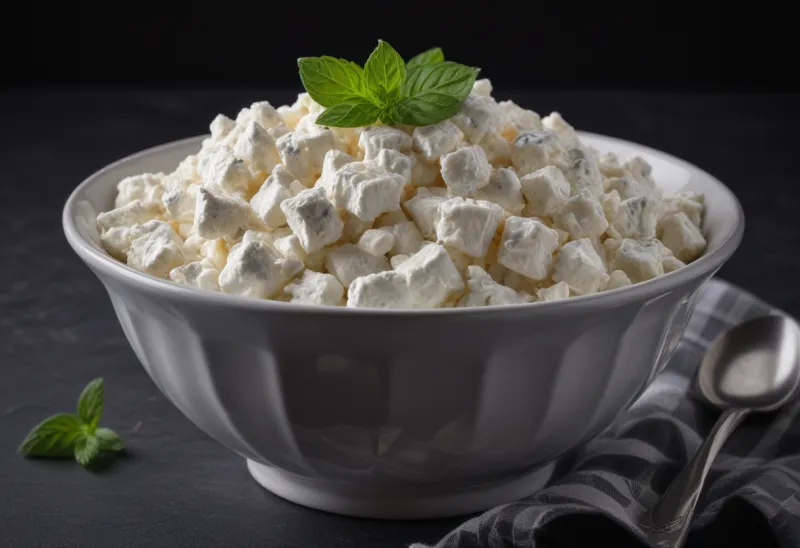
USDA lists lowfat 1% cottage cheese at 72 calories and 12.4 grams of protein per 100 grams1. Divide one by the other and that is 17.2 grams of protein per 100 calories. Nonfat Greek yogurt, the food cottage cheese is usually measured against, comes in at 59 calories and 10.2 grams — 17.3 grams per 100 calories3. Those divisions are mine, and they land a tenth of a gram apart. On the metric people actually buy these foods for, the two are indistinguishable.
What separates them is on a different line of the panel. The same 100 grams of cottage cheese carries 406 mg of sodium against Greek yogurt's 36 — better than eleven times as much, or about 33 mg of sodium per gram of protein against 3.5. A standard 226-gram cup of 1% cottage cheese therefore delivers about 28 grams of protein for 163 calories, which is an excellent trade, and 917 mg of sodium, which is about 40% of the 2,300 mg daily limit in the Dietary Guidelines for Americans5. That is the full shape of cottage cheese, and it is not the shape the current enthusiasm for it describes.
A cup is 104 calories or 163, and the curd is not the reason#
Cottage cheese has a second quirk worth knowing before any of the above is usable: its cup weight moves more than almost any other dairy food's.
| USDA entry | Per 100 g | Protein | Sodium | Calcium | One cup weighs | So one cup is |
|---|---|---|---|---|---|---|
| Cottage cheese, lowfat 1%1 | 72 kcal | 12.4 g | 406 mg | 61 mg | 226 g | ~163 kcal, 28.0 g protein, 917 mg sodium |
| Cottage cheese, nonfat, uncreamed dry curd2 | 72 kcal | 10.3 g | 372 mg | 86 mg | 145 g | ~104 kcal, 14.9 g protein, 539 mg sodium |
| Yogurt, Greek, plain nonfat3 | 59 kcal | 10.2 g | 36 mg | 110 mg | — | — |
The final column is USDA's density applied to USDA's own cup weight — my arithmetic, not a separate measurement.
The two cottage cheese records have identical energy densities and cup weights 56% apart. Dry curd is loose, lumpy and full of air; the dressing in a creamed tub fills the spaces between curds, so more grams fit in the same cup. The result is that "a cup of cottage cheese" is 104 calories and 15 grams of protein, or 163 calories and 28 grams, with no visible difference in the bowl and nothing on the lid to distinguish them. If you log cottage cheese by the cup, that is a 13-gram protein error in either direction.
Worth noting the two records are separate analyses of two products rather than a before-and-after of one batch — which is why the creamed version comes out slightly higher in protein and lower in carbohydrate despite the added dressing. Treat both rows as population values and read your own tub's panel over either.
One line that does not need a paragraph: cottage cheese is a poor calcium source for a dairy food, at 61 to 86 mg per 100 grams. The mechanism is the same one that costs strained yogurt its calcium, and it is worked through there rather than here.
Nine hundred milligrams a cup, and it is a manufacturing decision#
The sodium is the thing this food should be discussed for, because it is large, it is invisible, and it is not intrinsic to the ingredient.
Cottage cheese and Greek yogurt start from the same raw material — cow's milk — and diverge only in processing. One is cultured and strained; the other is curdled, cut, cooked, washed, and then dressed and seasoned. The finished products land at 36 and 406 mg of sodium per 100 grams. Milk itself carries a little sodium naturally, but nothing close to that gap: most of the 370 mg difference arrives in the plant, added deliberately, because salt is what makes a bland washed curd taste like food.
Nonfat Greek yogurt and 1% cottage cheese are a tenth of a gram apart on protein per 100 calories. The whole difference between them is 370 milligrams of sodium.
Whether that matters depends entirely on the rest of your day. Average US sodium intake runs near 3,400 mg against a 2,300 mg recommendation, so most people are already over before the tub is opened. If cottage cheese is an occasional snack, 900 mg in a cup is a normal-sized contribution from a normal-sized food. If it has become a daily habit at two cups — which is exactly what happens when a high-protein food is discovered — that is 1,800 mg from one ingredient, and it deserves to be a deliberate choice rather than an accident of enthusiasm. Reduced-sodium versions exist and cost nothing but shelf attention; so does simply rinsing the curds, which removes some of the dressing along with some of the salt.
The pre-sleep trial that found nothing#
Cottage cheese's other claim to fame is the bedtime one: casein is slow-digesting, so a tub before sleep is supposed to feed muscle overnight and lift next-morning metabolism. The slow-digestion part is real and settled — casein clots in stomach acid and empties over hours, which is the mechanism established in whey vs casein vs plant protein. The overnight-metabolism part is the claim that got tested with actual cottage cheese, and the test came back empty.
Ten active women, in a beverage-blinded randomized crossover, ate cottage cheese supplying 30 g of protein, 10 g of carbohydrate and no fat 30 to 60 minutes before sleep, against an isoenergetic and isonitrogenous casein supplement and against a placebo. Next-morning resting energy expenditure came out at 5,840 kJ/day after cottage cheese, 5,694 after casein and 5,991 after placebo — P = 0.79. The acute measurements were equally flat at P = 0.95, and appetite measures did not separate either. The authors' conclusion is exactly as bare as the numbers: "In active women, pre-sleep consumption of CC does not alter REE or RER more than a CP or PL beverage"4.
Ten participants is a very small crossover, and a null in ten people is not proof of no effect — it is a study with little power to detect one. But note what the null is about. This trial was not asking whether protein before bed helps you build muscle; it was asking whether whole-food protein does something a liquid supplement does not, and whether either raises overnight energy expenditure. On both questions it found nothing, and its most useful result is the boring one: cottage cheese behaved like the casein powder it was compared against. If you want the slow protein, the food and the tub are interchangeable. Whether the timing itself does anything is a separate argument with a shakier control group than most people realize.
What it is actually for#
Strip the bedtime story out and cottage cheese is left with a genuinely strong case, made of two facts and one caution.
The first fact is protein density. At about 17 grams of protein per 100 calories, 1% cottage cheese sits at the top of the whole-food range — level with nonfat Greek yogurt and above almost everything else in the dairy case. A cup clears 28 grams, which is a full protein dose rather than a token one, in a portion small enough to eat standing up. That is precisely the size that has been shown to push the next meal later and lighter, an effect covered in high-protein snacks.
The second is that it needs no preparation and keeps its numbers under any handling, which is why it keeps turning up on lists of inexpensive ways to hit a protein target. Unlike most protein foods, nothing you do to cottage cheese in the kitchen changes what it is.
The caution is the salt, and it is the only reason not to treat this as a free protein source. Read the panel on your tub — sodium in cottage cheese varies more between brands than calories or protein do, because it is the ingredient the manufacturer is choosing rather than the one the cow supplied. Log the grams, not the cups, since the cup is the loosest unit in the whole food. And if cottage cheese has become the thing you eat every day, the number to watch is not the one on the front of the container.
FAQ#
How much protein is in a cup of cottage cheese?#
About 28 grams for a 226-gram cup of lowfat 1%, at roughly 163 calories — USDA lists it at 12.4 grams of protein and 72 calories per 100 grams1. Uncreamed dry curd is a very different cup: USDA puts it at 145 grams, which works out to about 15 grams of protein and 104 calories2. Weigh it rather than scooping it; the cup is the loose part.
Is cottage cheese too high in sodium?#
It is high, and worth tracking if you eat it daily. USDA lists lowfat 1% cottage cheese at 406 mg of sodium per 100 grams against nonfat Greek yogurt's 36 (FDC 173417; FDC 170894). A 226-gram cup therefore carries about 917 mg — roughly 40% of the 2,300 mg daily limit in the Dietary Guidelines for Americans5. Reduced-sodium versions exist, and sodium varies more between brands than calories do.
Does eating cottage cheese before bed boost your metabolism?#
The trial that tested exactly that found no effect. Ten active women ate 30 g of protein as cottage cheese, an isonitrogenous casein supplement, or a placebo 30 to 60 minutes before sleep; next-morning resting energy expenditure was 5,840, 5,694 and 5,991 kJ/day respectively, P = 0.79, with no appetite differences4. Ten people is too few to rule out a small effect, but nothing in the data supports the claim as usually stated.
Sources#
- USDA FoodData Central. Cheese, cottage, lowfat, 1% milkfat (FDC 173417, SR Legacy).
- USDA FoodData Central. Cheese, cottage, nonfat, uncreamed, dry, large or small curd (FDC 172181, SR Legacy).
- USDA FoodData Central. Yogurt, Greek, plain, nonfat (FDC 170894, SR Legacy).
- Leyh SM, Willingham BD, Baur DA, Panton LB, Ormsbee MJ. Pre-sleep protein in casein supplement or whole-food form has no impact on resting energy expenditure or hunger in women. Br J Nutr. 2018;120(9):988-994.
- Snetselaar LG, de Jesus JM, DeSilva DM, Stoody EE. Dietary Guidelines for Americans, 2020-2025: Understanding the Scientific Process, Guidelines, and Key Recommendations. Nutr Today. 2021;56(6):287-295.
Source: BurnWeek — "Cottage cheese: the high-protein comeback food", https://burnweek.fit/blog/calories-and-protein-in-cottage-cheese/. Licensed CC BY 4.0: free to quote or reuse with a link to this page.