The word covers four quite different fish#
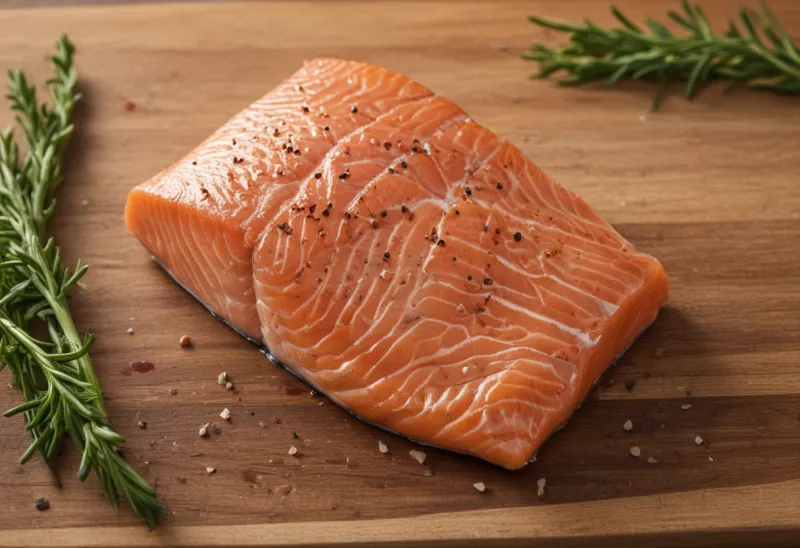
Raw salmon runs from 120 to 208 calories per 100 grams depending on which species is in the packet, with protein sitting in a narrow band around 20 to 22 grams and fat doing all the moving: 3.77 grams in chum, 13.4 in farmed Atlantic1. A 178-gram cooked farmed-Atlantic fillet is about 367 calories; a 155-gram cooked sockeye fillet is about 242. Both are "a fillet of salmon."
The long-chain omega-3s vary further still, and not in the direction most people expect. EPA plus DHA ranges from 0.63 grams per 100 grams in chum to 1.96 in farmed Atlantic — a threefold spread in the nutrient salmon is mainly eaten for. The common-foods reference puts salmon's calorie band down to farmed versus wild, which is true but incomplete: species is the larger lever, and it is the one printed on the label.
Chum to farmed Atlantic, per 100 grams raw#
| Salmon (raw) | Energy | Protein | Fat | EPA + DHA |
|---|---|---|---|---|
| Chum5 | 120 kcal | 20.1 g | 3.77 g | 0.63 g |
| Coho, wild4 | 146 kcal | 21.6 g | 5.93 g | 1.09 g |
| Chinook (king)3 | 179 kcal | 19.9 g | 10.4 g | 1.95 g |
| Atlantic, farmed1 | 208 kcal | 20.4 g | 13.4 g | 1.96 g |
Energy and fat are USDA values; the EPA + DHA column is the sum of USDA's separate EPA and DHA entries, which is addition rather than a fifth measurement.
Read the columns rather than the rows and the structure is clear. Protein barely moves — every salmon is a roughly 20-gram-per-100-grams protein food, and on amino acid quality they are interchangeable, which is why fish sits where it does on a ranking of protein sources. Fat quadruples across the table, and calories follow it almost exactly, because at 9 calories a gram fat is the only term with enough leverage to move the total. And EPA + DHA tracks fat closely, for the simple reason that omega-3s are stored in the fat. Lean salmon is low-calorie salmon is low-omega-3 salmon. Those three properties are not independent choices you get to make separately.
Cooked, the same logic holds with the water driven off: farmed Atlantic comes to 206 calories, 22.1 g protein and 2.15 g EPA + DHA per 100 grams, while sockeye lands at 156 calories, 26.5 g protein and 0.86 g EPA + DHA (FDC 175168; FDC 173692). Sockeye is the most protein-dense salmon USDA lists. Farmed Atlantic is the most omega-3-dense. They are different purchases.
Wild versus farmed gets the omega-3 question backwards#
The folk ranking says wild salmon is the better fish, and for contaminants, colour additives and ecology that debate is real and outside what a nutrition table can settle. For omega-3 content specifically, the ranking is close to inverted.
Farmed Atlantic salmon carries 1.96 grams of EPA + DHA per 100 grams raw — matching wild chinook at 1.95, and nearly double wild coho's 1.09 and roughly triple chum's 0.63. Cooked, farmed Atlantic's 2.15 grams is about two and a half times sockeye's 0.86. The reason is not that farming is nutritionally clever; it is that farmed salmon are fattier, and omega-3s ride along with fat. A wild fish that swam a thousand miles is lean, and lean means less of the oil.
So "I buy wild for the omega-3s" is, for the leaner wild species, a decision that reduces the nutrient it was made for while also reducing calories. If omega-3 intake is the actual goal, the axis that matters is fat content, not provenance — and that is visible on the packet as the species name and in the flesh as visible marbling. There are perfectly good reasons to prefer wild salmon; a higher EPA + DHA dose per serving is usually not one of them.
Farmed salmon's omega-3 content is a moving number#
The farmed figure comes with a caveat that a static database entry cannot express, and it is the most interesting thing in this article. Farmed salmon get their EPA and DHA from their feed, and over the last two decades that feed changed: fish oil, which is finite, was progressively replaced with plant oils such as rapeseed, which contain none.
Analysing more than 3,000 fatty acid profiles from Scottish farmed Atlantic salmon, Sprague, Dick and Tocher found EPA + DHA fell from 2.74 grams per 100 grams of flesh in 2006 to 1.36 grams in 2015 — roughly halved in under a decade7. Their consequence is stated in servings:
"A single 130 g portion of Scottish salmon farmed in 2006 would have been adequate to meet the 3.5 g EPA + DHA weekly intake level set by ISSFAL, whereas in 2015 this would have required two portions."
Two things about how to read that. The study measured Scottish production, and USDA's entry describes a different and largely North American supply, so the 1.96 g in the table above is not the same population as Sprague's 1.36 — you cannot subtract one from the other. What transfers is the mechanism and the direction: farmed salmon's omega-3 content is set by a feed formulation that has been moving, so any published figure for farmed salmon is a snapshot of a particular year's feed. The work comes from an aquaculture research institute, which is worth naming, though the finding runs against the industry's commercial interest rather than for it.
The practical version is modest. Salmon remains among the densest dietary sources of EPA and DHA available, and none of this makes a fillet a poor choice. It does mean that if you are eating farmed salmon specifically to hit an omega-3 target, one portion a week is a thinner assumption than it was fifteen years ago. The evidence on what those omega-3s actually do sits in essential fatty acids and omega-3 and in the broader argument about which fats to favour; this article is about how much of them arrives on the plate.
Buying by the thing you actually want#
Put the fillet weights back in and the choice becomes concrete. USDA puts a cooked farmed-Atlantic fillet at 178 grams and a cooked sockeye fillet at 155. Scaled to those weights — my arithmetic on the per-100-gram values — the farmed Atlantic fillet gives roughly 367 calories, 39 g protein and 3.8 g EPA + DHA; the sockeye fillet gives roughly 242 calories, 41 g protein and 1.3 g EPA + DHA.
Nearly identical protein. A 125-calorie gap. Nearly three times the omega-3. That is the whole trade in one line, and it means the sensible question at the counter is not "which salmon is healthiest" but which of the two things you are short of this week. If it is protein inside a calorie budget, the leaner species win outright. If it is EPA and DHA, the fatty ones win and the calories are the price of admission.
One last practical note, because salmon is a food people routinely log by eye. Fillets are thick at the shoulder and thin at the tail, so two pieces of the same visible length can differ by 50 grams and around 100 calories in the farmed case — the kind of error photo portion estimation is built to bound rather than eliminate. Weighing the fillet once or twice calibrates the eye better than any chart, including this one.
FAQ#
Does wild salmon have more omega-3 than farmed salmon?#
Usually less, per serving. USDA lists farmed Atlantic salmon at 1.96 g of EPA + DHA per 100 g raw against 1.09 g for wild coho and 0.63 g for chum; only wild chinook keeps pace, at 1.95 (FDC 175167; FDC 175136). Omega-3s are stored in fat, and farmed salmon are fattier. Wild salmon has other arguments in its favour; a bigger omega-3 dose is generally not one.
Which salmon is lowest in calories?#
Chum, at 120 calories per 100 g raw, followed by wild coho at 146 (FDC 173689; FDC 175136). Both carry about the same protein as the fatty species — roughly 20 to 22 g per 100 g — so they are the efficient choice on a calorie budget. The trade-off is that they carry proportionally less EPA and DHA, because the calories you avoided were the oil the omega-3s live in.
Has farmed salmon become less nutritious over time?#
On omega-3 content specifically, measurably so in one large dataset. EPA + DHA in Scottish farmed Atlantic salmon fell from 2.74 g per 100 g in 2006 to 1.36 g in 2015 as fish oil in feed was replaced with plant oils7. The authors calculate that one 130 g portion met the ISSFAL weekly target in 2006 where two were needed by 2015. That study covers Scottish production and does not automatically describe salmon farmed elsewhere.
Sources#
- USDA FoodData Central. Fish, salmon, Atlantic, farmed, raw (FDC 175167, SR Legacy).
- USDA FoodData Central. Fish, salmon, Atlantic, farmed, cooked, dry heat (FDC 175168, SR Legacy).
- USDA FoodData Central. Fish, salmon, chinook, raw (FDC 173688, SR Legacy).
- USDA FoodData Central. Fish, salmon, coho, wild, raw (FDC 175136, SR Legacy).
- USDA FoodData Central. Fish, salmon, chum, raw (FDC 173689, SR Legacy).
- USDA FoodData Central. Fish, salmon, sockeye, cooked, dry heat (FDC 173692, SR Legacy).
- Sprague M, Dick JR, Tocher DR. Impact of sustainable feeds on omega-3 long-chain fatty acid levels in farmed Atlantic salmon, 2006-2015. Sci Rep. 2016;6:21892.