Two fats are essential, and the ones you actually want are not among them#
Your body can build almost every fat it needs from scratch. Two it cannot: linoleic acid, an omega-6, and alpha-linolenic acid, an omega-3. Those two are the essential fatty acids in the strict nutritional sense — go without them long enough and you develop a deficiency — and the recommended intakes for both are small enough that a handful of nuts and a spoonful of seed oil largely cover them (how much fat per day sets those figures).
Here is the twist that makes omega-3 confusing. The omega-3s associated with the health outcomes people care about are not alpha-linolenic acid. They are EPA and DHA, the long-chain forms concentrated in oily fish — and those are not classified as essential, because in principle your body makes them from ALA. In practice that conversion is one of the least efficient reactions in human nutrition, and in men it is close to nonexistent. "Not essential" turns out to be a statement about biochemical possibility rather than about biological supply, which is the single most useful thing to understand about this nutrient.
The conversion, measured with labelled carbon#
You can measure this directly: feed someone alpha-linolenic acid tagged with carbon-13, then track where the label ends up. One laboratory did exactly that in young men and young women, publishing both results in the same volume of the same journal in the same year.
In women of reproductive age given 700 mg of [U-¹³C]ALA and followed for 21 days, estimated net fractional conversion came out at 21% to EPA, 6% to DPA and 9% to DHA, with about 22% of the dose recovered as ¹³CO₂ on the breath within 24 hours1. Not efficient, but real: roughly a tenth of the ALA became DHA.
In young men, the same tracer approach produced a different kind of result. There was no apparent ¹³C enrichment of DHA in plasma phospholipids, triacylglycerol or non-esterified fatty acids at any time point measured up to 21 days, and about 33% of the labelled ALA was burned off as CO₂ within the first 24 hours. The authors' conclusion is unusually blunt for a tracer paper: the capacity of adult males to convert ALA to DHA "was either very low or absent"2.
| Fate of labelled ALA | Young women | Young men |
|---|---|---|
| Converted to EPA | 21% | principal product, with DPA |
| Converted to DPA | 6% | principal product, with EPA |
| Converted to DHA | 9% | no detectable enrichment to 21 days |
| Oxidised as CO₂ in 24 h | ~22% | ~33% |
That is a sex difference large enough to change advice. For a woman, flaxseed and walnuts are a partial DHA strategy. For a man, on this evidence, they are an EPA strategy and not a DHA strategy at all — and the surplus is preferentially burned for fuel rather than elongated. Two studies, two populations, one method: this is not a case of the literature conflicting, it is a case of the answer depending on who is asked.
One boundary on how hard to lean on it. These are small tracer studies measuring plasma enrichment over three weeks, not tissue DHA over years, and "below the detection limit" is not the same as zero. The direction is well replicated; the exact figures are estimates from a handful of volunteers.
The ratio is the wrong lever — it is the amounts#
Omega-6 and omega-3 fatty acids are processed by the same desaturase and elongase enzymes, which is where the popular fear of a bad "omega-6 to omega-3 ratio" comes from: eat too much linoleic acid and it supposedly crowds ALA out of the shared machinery. The prediction is testable, and it was tested.
Twenty-nine subjects ate a control diet for four weeks, then spent six weeks on either the control diet, a low-linoleic-acid diet, or a high-ALA diet, with [U-¹³C]ALA given orally and oxidation measured on the breath. The low-LA and high-ALA arms were constructed to hold the same ALA-to-LA ratio of 1:7 — and they produced different metabolic responses. Lowering linoleic acid raised ALA incorporation into phospholipids by 3.6% and 34.3 mg in absolute terms (P = 0.020); raising ALA lowered fractional incorporation by 8.0% while raising the absolute yield of downstream products from 0.7 to 1.9 mg (P = 0.001). The authors' conclusion: "The amounts of ALA and LA in the diet, but not their ratio, determine ALA conversion"3.
So two diets with an identical ratio behaved differently, which is about as direct a refutation of ratio-thinking as a small trial can deliver. Note also the second half of that result: eating more ALA lowered the percentage converted while still increasing the absolute amount produced. Fractional efficiency falls as you push the pathway, but the output still rises — which is why "conversion is only 5–10%" is a reason to eat more of the preformed form, not a reason to give up on plant sources. The broader argument about which fats to favour lives in saturated vs unsaturated fat.
What the supplement trials found, and where they split#
If EPA and DHA matter, capsules should work. This is where the field gets genuinely contested, and the disagreement is specific rather than vague.
The large primary-prevention trial is VITAL: 25,871 US adults randomized to 1 g/day of marine omega-3 or placebo. Major cardiovascular events occurred in 386 participants on omega-3 versus 419 on placebo — a hazard ratio of 0.92 (95% CI, 0.80 to 1.06; P = 0.24). The primary endpoint was null, and the authors say so plainly: supplementation "did not result in a lower incidence of major cardiovascular events or cancer than placebo"4. One secondary result complicates the clean story — total myocardial infarction came out at 0.72 (95% CI, 0.59 to 0.90) — which is a hint rather than a conclusion, being one endpoint among many in a trial that missed its primary.
Then come the two high-dose secondary-prevention trials that reached opposite verdicts.
| REDUCE-IT | STRENGTH | |
|---|---|---|
| Active agent | 3,840 mg EPA, ethyl ester | 2,200 mg EPA + 800 mg DHA, carboxylic acid |
| Placebo | mineral oil | corn oil |
| Primary result | 17.2% vs 22.0%; HR 0.75 (0.68–0.83), p<0.001 | 12.0% vs 12.2%; HR 0.99 (0.90–1.09), p=0.84 |
Both rows in that table are candidate explanations, and that is exactly the problem: the trials differ in two ways at once, so the split cannot be attributed cleanly. REDUCE-IT used pure high-dose EPA; STRENGTH used a mixed EPA/DHA preparation at a lower EPA dose, achieving 89.6 μg/mL plasma EPA against REDUCE-IT's 144.05. If EPA dose is what matters, the results are compatible and STRENGTH simply did not give enough.
The rival explanation is the control arm. REDUCE-IT's mineral-oil placebo did not behave inertly: hsCRP in that group rose from a median 2.1 mg/L at baseline to 2.8 mg/L at year two, a 33% increase, with apolipoprotein B and LDL-C rising too — changes not seen in STRENGTH's corn-oil arm. If the placebo made its group worse, some of REDUCE-IT's benefit is a widened gap rather than a raised bar. The FDA weighed this and approved icosapent ethyl anyway, concluding the mineral-oil effects were unlikely to fully account for the benefit5.
Worth naming the interests on that review: two of its authors work for Sirio Life Technology, one formerly worked at Sirio Pharma, and the corresponding author provides nutrition consultancy to Sirio Pharma — a supplement manufacturer. The trial numbers are the trials' numbers, but a supplement-adjacent group adjudicating whether omega-3 trials worked deserves the same flag this blog puts on dairy-funded protein research.
What to do with all this#
The practical reading is narrower than either the fish-oil aisle or the debunkers suggest.
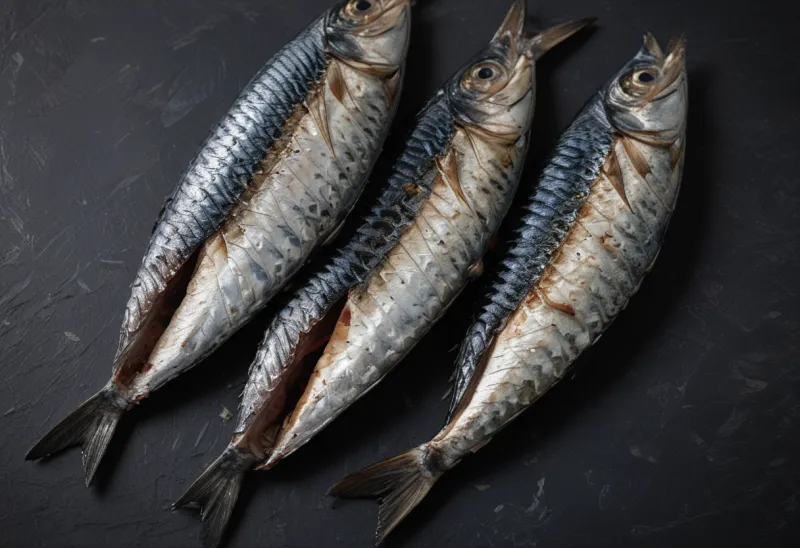
Eat the preformed form if you can. Oily fish delivers EPA and DHA directly and bypasses the conversion bottleneck entirely, which is the whole reason the bottleneck matters. How much arrives per fillet varies enormously by species and farming — a threefold spread — and is worked through in salmon: calories, protein and omega-3s.
Do not treat flaxseed as interchangeable with fish, particularly if you are a man. ALA is genuinely essential and worth eating; it is simply a poor delivery vehicle for DHA specifically. If fish is off the table, an algal oil supplies DHA without the conversion step.
Stop optimising the ratio. Two diets at an identical 1:7 ratio produced different conversion3. The lever is how much ALA and EPA/DHA you actually eat, and that is a number you can read off a label — reading nutrition labels covers where fats are declared, and where fat sits among the three macros is in macronutrients explained.
Hold the supplement case loosely. At 1 g/day in a general population, capsules did not reduce major cardiovascular events. High-dose prescription EPA in high-risk patients may; that question is unsettled and belongs to a cardiologist rather than to a shelf.
FAQ#
Can you get enough EPA and DHA from flaxseed or walnuts?#
Partly, and it depends on who you are. Given labelled ALA, young women converted 21% to EPA and 9% to DHA1, while young men showed no detectable conversion to DHA at any point over 21 days, with the authors describing that capacity as "very low or absent"2. Plant sources reliably supply ALA and EPA precursors; for DHA specifically, oily fish or an algal oil is the direct route.
Which omega-3s are actually essential?#
Only alpha-linolenic acid, the short-chain plant form — alongside linoleic acid, an omega-6. EPA and DHA are not formally essential because the body can synthesise them from ALA, but that classification describes a biochemical pathway rather than a practical supply: the conversion is inefficient in women and largely undetectable for DHA in men, which is why dietary EPA and DHA behave like requirements even though the textbooks do not list them as such.
Do omega-3 supplements prevent heart attacks?#
At ordinary doses in a general population, the controlled evidence says no. In 25,871 adults taking 1 g/day, major cardiovascular events showed a hazard ratio of 0.92 (95% CI, 0.80 to 1.06; P = 0.24)4 — though total myocardial infarction, a secondary endpoint, came out at 0.72 (0.59 to 0.90). High-dose prescription EPA cut events in one high-risk trial (HR 0.75) while a mixed EPA/DHA preparation did not (HR 0.99), and the field has not settled whether the difference is the dose, the formulation, or the mineral-oil placebo5.
Sources#
- Burdge GC, Wootton SA. Conversion of alpha-linolenic acid to eicosapentaenoic, docosapentaenoic and docosahexaenoic acids in young women. Br J Nutr. 2002;88(4):411-420.
- Burdge GC, Jones AE, Wootton SA. Eicosapentaenoic and docosapentaenoic acids are the principal products of alpha-linolenic acid metabolism in young men. Br J Nutr. 2002;88(4):355-363.
- Goyens PLL, Spilker ME, Zock PL, Katan MB, Mensink RP. Conversion of alpha-linolenic acid in humans is influenced by the absolute amounts of alpha-linolenic acid and linoleic acid in the diet and not by their ratio. Am J Clin Nutr. 2006;84(1):44-53.
- Manson JE, Cook NR, Lee IM, et al. Marine n-3 Fatty Acids and Prevention of Cardiovascular Disease and Cancer. N Engl J Med. 2019;380(1):23-32.
- Zhang W, Gan D, Huo S, Chen P. Unraveling the discrepancies between REDUCE-IT and STRENGTH trials with omega-3 fatty acids: new analytical approaches. Front Nutr. 2024;11:1490953. (Authors are employed by or consult for Sirio Pharma / Sirio Life Technology.)