"A cup of rice" means 205 calories or 675, and nothing in the phrase tells you which#
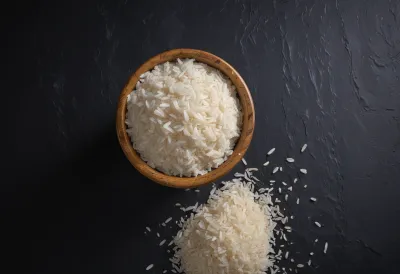
USDA lists dry white long-grain rice at 365 calories per 100 grams and cooked white long-grain rice at 130, and puts one measuring cup of the dry grain at 185 grams and one cup of the cooked at 158 (USDA FoodData Central, FDC 169756; FDC 168878). Multiply each density by its own cup weight and a cup of dry rice is about 675 calories while a cup of cooked rice is about 205 — a 3.3-fold gap between two things people describe with the same three words. That multiplication is mine; the densities and the gram weights are USDA's.
That is the whole trap, and it is worth being precise about where it lives. It is not that cooking adds or destroys calories — it does not, and the bookkeeping behind that is settled in raw vs cooked: which weight should you log. It is that rice is the food people are most likely to measure by volume, at the exact moment in its life when its volume changes by a factor of three. Weigh rice and the ambiguity disappears. Scoop it and you have recorded a number that could be right, or could be wrong by 470 calories, with no way to tell from the log which one you meant.
The gram is stable; the cup is not#
Every figure below is a USDA record, except the final column, which is that record's density applied to that record's own cup weight — arithmetic, not a separate measurement.
| USDA entry | Per 100 g | One cup weighs | So one cup is |
|---|---|---|---|
| White, long-grain, dry1 | 365 kcal | 185 g | ~675 kcal |
| Brown, long-grain, dry4 | 367 kcal | 185 g | ~679 kcal |
| White, long-grain, cooked2 | 130 kcal | 158 g | ~205 kcal |
| White, medium-grain, cooked3 | 130 kcal | 186 g | ~242 kcal |
| Brown, long-grain, cooked5 | 123 kcal | 202 g | ~248 kcal |
Look at the bottom three rows, all of which are fairly described as "a cup of cooked rice." They run from 205 to 248 calories — a 21% spread — and not one gram of it comes from cooking, portion carelessness, or a database error. It comes from how tightly each kind of grain packs into a cup. Medium-grain rice is shorter and stickier, so 186 grams fit where 158 grams of long-grain fit. Volume measures space; calories live in mass; and rice is a food where the relationship between the two is set by the shape of the grain.
The cooked figure quietly assumes someone else's water ratio#
There is a second assumption buried in "cooked rice, 130 calories per 100 grams," and it belongs to whoever cooked the sample rather than to you.
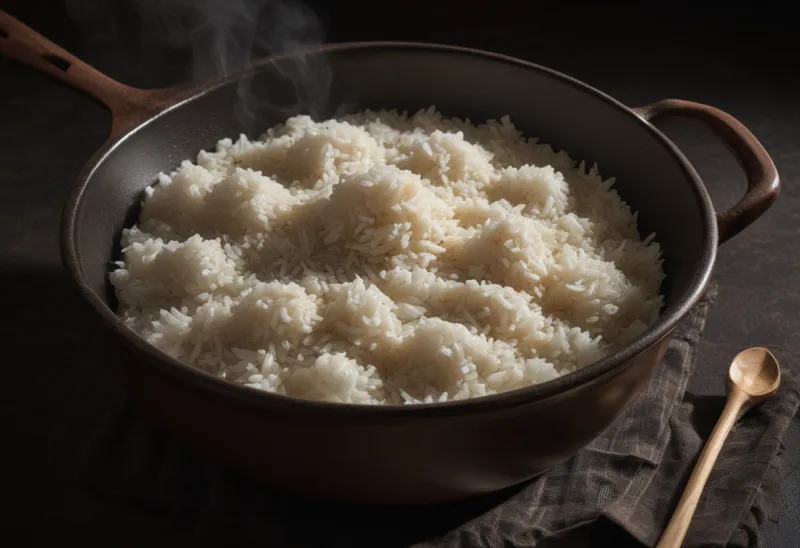
Water carries no calories, so the energy in a pot of rice is fixed the moment the dry grain goes in. Take USDA's two white long-grain entries at face value: 100 grams of dry rice holds 365 calories, and if that same energy ends up at a density of 130 calories per 100 grams, the cooked mass must be 365 ÷ 1.30 ≈ 281 grams. The cooked entry therefore encodes a yield of about 2.8 times the dry weight. Check it the other way and it holds: one 185-gram cup of dry rice is 675 calories, which at 130 calories per 100 grams is about 519 grams of cooked rice, or roughly three and a quarter cups. Both derivations are mine, resting on nothing but the two USDA densities and the arithmetic of conserved energy.
Now suppose your pot does not hit 2.8×. Cook the rice firmer and finish at 2.4× — 240 grams from 100 dry — and those same 365 calories are sitting at about 152 per 100 grams, 17% denser than the entry says. Cook it softer to 3.2× and you are at about 114, 12% lighter. Nobody did anything wrong in either pot. But weigh the result against a fixed cooked-rice entry and the error is baked in before you touch the scale, which is a good illustration of the general point in calorie density estimation: every per-gram figure is a claim about a specific water content.
This is the practical case for weighing rice dry. The dry weight is the only quantity in the whole sequence that nobody's pot, cup, or grain shape can move.
Brown rice is lighter per gram and heavier per cup#
The brown-rice rows deserve their own reading, because they run against the intuition almost everyone brings to them. Cooked brown rice is genuinely less calorie-dense than cooked white — 123 calories per 100 grams against 130 — which is where the "brown rice is lighter" belief comes from, and it is true as far as it goes. But a cup of cooked brown rice weighs 202 grams against white's 158, so a cup of brown rice works out to about 248 calories against white's 205 — roughly 21% more, not less.
Both facts are USDA's; the reversal is arithmetic. Whether brown rice is the lower-calorie choice depends entirely on whether you serve it by weight or by scoop, and most people serve it by scoop. What brown rice does deliver unambiguously is fiber: 1.6 grams per 100 grams cooked against 0.4 for white, and 3.6 against 1.3 in the dry grain (FDC 169704; FDC 169756). A cup of cooked brown rice therefore brings about 3.2 grams of fiber where a cup of white brings about 0.6 — a real contribution against a daily target of 25 to 38 grams, and a better reason to choose it than a calorie advantage that does not survive contact with a measuring cup.
Draining the water pours off more than water#
One more variable, and it separates kitchens rather than cooks. Absorption cooking — the 1:3 rice-to-water method where nothing is discarded — is what USDA's cooked entries describe. Boil-and-drain cooking, standard across much of South and Southeast Asia at ratios of 1:6 or higher, throws away the cooking liquid, and that liquid is not clean water by the time it leaves the pot.
Comparing those methods directly, Mwale and colleagues measured what the discarded water takes with it: cooking at 1:6 removed about 50% of the rice's potassium, 22.4% of its magnesium, 14.5% of its calcium, 16.5% of its manganese and 8.2% of its iron, alongside a 30% reduction in total arsenic (rising to 44% with parboiling at 1:10)6. Those are mineral measurements, not energy measurements, and it would overreach to convert them into a calorie discount. What they establish is the direction: soluble material leaves with the drained water, so boil-and-drain rice is not compositionally the same food as the absorption-cooked rice USDA analyzed. If you drain, treat the cooked entry as approximate in a way the label cannot flag.
Letting cooked rice go cold shifts a slice of its starch into a resistant form that yields less energy — a real effect and a small one, worked through properly in does cooking change a food's calories rather than re-argued here.
Logging rice so the number stays put#
The fix is one habit, and it is smaller than the problem it solves: weigh rice dry, before it goes in the pot, and log it against a dry entry. One hundred grams of dry white rice is 365 calories and will still be 365 calories no matter how much water your pot took up, how sticky the grain is, or how heaped the serving spoon was. Everything that makes rice hard to count happens after that moment.
When you cannot — a shared pot, a restaurant plate, yesterday's batch from the fridge — then weigh the cooked rice and use a cooked entry, accepting a band of maybe ±15% around it for the water ratio you did not choose. What is not worth doing is measuring cooked rice by volume and calling the result a number: at 205, 242 or 248 calories for the same honest phrase, a cup of rice carries a wider band than almost any other staple in the common-foods reference, and unlike most of them, this one is free to eliminate with a scale you already own.
FAQ#
How many calories are in a cup of cooked rice?#
About 205 for white long-grain, 242 for white medium-grain, and 248 for brown long-grain. Those come from USDA's per-100-gram energy values applied to USDA's own cup weights — 158 g, 186 g and 202 g respectively (FDC 168878; FDC 168880; FDC 169704). The cup is the same; the grain packs differently. If you want one planning figure for cooked rice, use about 220 calories a cup and treat it as a midpoint.
Does brown rice have fewer calories than white rice?#
Per gram, slightly — 123 calories per 100 g cooked against white's 130. Per cup, no: a cup of cooked brown rice weighs 202 grams against white's 158, which works out to about 248 calories against 205 (FDC 169704; FDC 168878). Serve by weight and brown is marginally lighter; serve by scoop and it is not. Its clearer advantage is fiber, at 1.6 g per 100 g cooked against 0.4.
Why does my rice come out to more calories than the package suggests?#
Usually because the package figure is for the dry grain and you measured the cooked result, or because your pot finished drier than the database assumed. USDA's cooked entry implies a yield of about 2.8 times the dry weight; a firmer pot at 2.4× puts the same calories at roughly 152 per 100 grams instead of 130 — my arithmetic on the USDA densities. Weighing dry removes both problems at once.
Sources#
- USDA FoodData Central. Rice, white, long-grain, regular, raw, unenriched (FDC 169756, SR Legacy).
- USDA FoodData Central. Rice, white, long-grain, regular, enriched, cooked (FDC 168878, SR Legacy).
- USDA FoodData Central. Rice, white, medium-grain, enriched, cooked (FDC 168880, SR Legacy).
- USDA FoodData Central. Rice, brown, long-grain, raw (FDC 169703, SR Legacy).
- USDA FoodData Central. Rice, brown, long-grain, cooked (FDC 169704, SR Legacy).
- Mwale T, Rahman MM, Mondal D. Risk and Benefit of Different Cooking Methods on Essential Elements and Arsenic in Rice. Int J Environ Res Public Health. 2018;15(6):1056.
Source: BurnWeek — "Rice calories: why cooked vs dry trips people up", https://burnweek.fit/blog/calories-in-rice-cooked-vs-dry/. Licensed CC BY 4.0: free to quote or reuse with a link to this page.