The water moved; the calories stayed put#
Here is the whole decision in one line: log raw when you can, and if you log cooked, use a cooked database entry — because cooking changes a food's weight without changing the calories inside it, so the only mistake that costs you is mixing the two bases. A cup of dry rice becomes a much larger cooked pile with the same calories in it; a chicken breast shrinks. Pair a raw weight with a raw entry, or a cooked weight with a cooked entry. Cross the two and you import the entire cooking-weight gap into your day.
That gap is not a rounding error. When researchers estimated the nutrients of cooked meat dishes using raw ingredient codes — the exact mismatch above — energy was overestimated by 10 to 50 percent and fat by 20 to 60 percent, and a beef brisket point came out at more than double its true cooked value4. So "raw or cooked?" is worth getting right, and the good news is that once you see the mechanism, the rule is trivial to follow. This is the deep version of one line in why homemade meals are hardest to count; here we work out exactly how large the swing is and which way it runs.
Cooking is water bookkeeping, not calorie removal#
A food's calories come from its protein, carbohydrate, and fat. Water contributes exactly zero. So when heat drives water out of a food or the pot drives water into it, the weight moves but the energy the food carries barely does — which means the calories per gram change even though the calories in the portion do not.
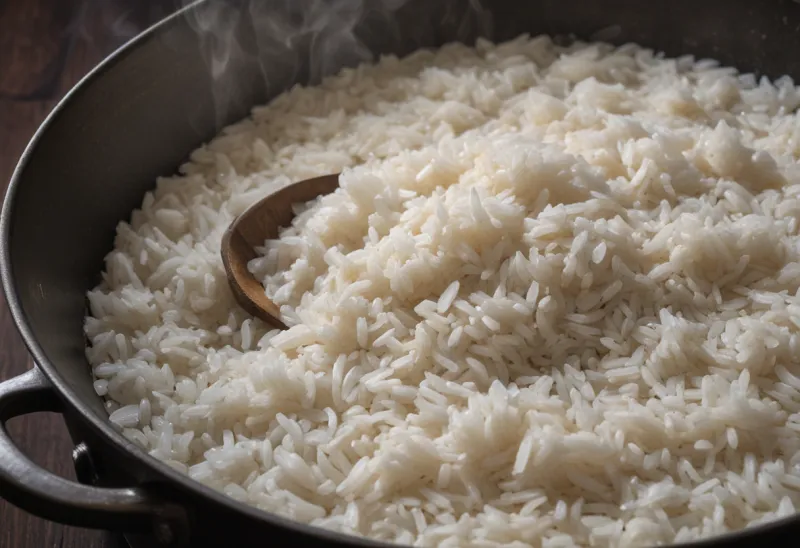
Rice is the cleanest illustration, because it moves in the gaining direction. Dry white long-grain rice carries about 365 calories per 100 grams; cooked, the same rice is about 130 calories per 100 grams1. The calories did not fall by two-thirds — the grains drank up water, so 100 grams of dry rice becomes roughly 2.8 times its weight once cooked (my arithmetic from those two energy densities), and the fixed pile of calories is now spread across nearly three times the grams. Pasta does the same thing from a dry density of about 371 calories per 100 grams1.
Meat moves the other way. Cooked broiler breast sheds roughly 17 to 21 percent of its weight as water, depending on method and endpoint temperature3, and USDA Prime beef cuts lost 23.6 to 25.4 percent — with the authors noting the total energy of the cooked cuts was greater than the raw "because of a decrease in moisture, resulting in an increase in the concentration of protein and lipids"2. Same mechanism, opposite sign: water leaves, and every remaining gram gets denser.
| Food | What cooking does to the weight | Calories per gram |
|---|---|---|
| White rice | absorbs water, ~2.8× heavier (365 → 130 kcal/100 g) | falls sharply |
| Pasta | absorbs water | falls |
| Chicken breast | sheds ~17–21% as water3 | rises |
| Beef cuts | sheds ~24%, concentrating protein and fat2 | rises |
For most foods, cooking is water bookkeeping, not calorie removal: the weight changes and the calories per gram follow, but the total pile of calories was set before the heat came on.
The only real error is mixing the two bases#
Because the calories are conserved but the weight is not, everything hinges on making your weighing and your entry agree about which state the food is in. Get that alignment and the transformation is invisible to your log. Break it and the whole cooking-weight gap lands in your total.
Work it through with rice. Weigh 100 grams of dry rice and you are holding 365 calories. If you then log it against a cooked rice entry at 130 calories per 100 grams, you record 130 calories for food that is really 365 — an undercount of nearly three to one (again, my arithmetic on the USDA densities). Do the reverse with meat — weigh the shrunken cooked portion, then log it against a raw entry — and you undercount the density the water loss created. The measured version of this is the Yun analysis: swapping raw codes for cooked codes and measured cooking yields moved estimated energy by −10 to −50 percent, which is exactly the size of the error a basis mismatch injects4. A mismatch is not a few calories; on staples it can be the biggest avoidable error in your log — which is why it earns a line in the list of common tracking mistakes.
There is a subtler trap hiding underneath, and it argues for logging raw. The "cooked" entry in a database may never have been cooked at all — most databases derive cooked values by applying yield factors to raw laboratory data — modelled on a generic preparation rather than the pan in your kitchen (why homemade meals are hardest to count takes that apart). A raw weight logged against a raw entry sidesteps that second layer of estimation entirely.
The exception: grilled fatty meat really does lose calories#
Everything above assumes the calories are conserved and only the water moves. For grains, vegetables, and lean cuts, that holds. But there is one case where cooking genuinely removes energy, not just water, and it is worth flagging because it breaks the tidy rule.
When a fatty cut is grilled or roasted, real fat renders and drips away — it leaves the food and ends up in the pan. The Yun team names this directly: "grilled meats tend to lose a considerable portion of fat and water, which can lead to overestimation of energy and fat intake when using raw food codes"4. Here the cooked portion truly holds fewer calories than the raw weight implies, because at 9 calories a gram the dripped fat was carrying a lot of them. So for a marbled steak or fatty sausage on a grill, logging the raw weight against a raw entry does not merely misplace water — it counts fat you did not eat. This is the one situation where "raw vs cooked" stops being pure bookkeeping and becomes a real difference in the calories on your plate, and it points the same way each time: the cooked figure is the honest one.
So — raw or cooked?#
For most foods, raw is the better default, for three practical reasons. Recipes and packages specify raw weights, so raw matches the number you already have. Raw happens before the pan, so you are not waiting for food to cool while it steams. And logging raw against a raw entry avoids the derived-cooked-entry problem above. Weigh the dry pasta, the raw chicken, the uncooked rice, and you have pinned the calories before cooking rearranges the grams.
Cooked is perfectly fine when it is simply easier — a restaurant portion, a batch of grains you scooped from the fridge, a shared dish you served yourself from — as long as the entry you pick says "cooked." The rule is not "always raw." It is: choose one basis per food, and never let your scale and your database disagree about it. That single habit collapses a swing that can otherwise reach 50 percent down to nothing, and it turns a food's calories back into the range they actually are rather than a number corrupted by which side of the pan you weighed on. The remaining question — whether cooking also changes how many of those calories your body can absorb — is a separate lever, worked through in does cooking change a food's calories, and it sits inside the broader accuracy stack.
FAQ#
Does 100 grams of dry rice have the same calories as 100 grams of cooked rice?#
No — not remotely. Dry white rice runs about 365 calories per 100 grams and cooked about 1301, because cooked rice is mostly absorbed water. The same dry portion keeps all its calories when cooked; it just spreads them across nearly three times the weight. Compare like with like: dry-to-dry or cooked-to-cooked.
If I weigh my chicken after cooking, which database entry do I use?#
A "cooked" one. Cooked chicken breast has lost roughly a fifth of its weight as water3, so it is denser per gram than raw — pairing a cooked weight with a raw entry misreads that concentration. Match the entry to the state you weighed, every time.
Why do calorie apps overestimate grilled meat?#
Because raw ingredient codes still contain the fat that drips off on the grill. Switching from raw codes to cooked codes cut estimated energy by 10 to 50 percent and fat by 20 to 60 percent in one analysis4. For grilled or roasted fatty cuts, the cooked figure is the truer one, because some of the raw food's calories literally left in the pan.
Sources#
- USDA National Nutrient Database for Standard Reference — energy (kcal) values for rice and pasta, raw and cooked.
- Mortensen EG, Fuerniss HF, Legako JF, Thompson LD, Woerner DR. Nutrient analysis of raw and cooked USDA Prime beef cuts. Nutrients. 2024.
- Pang B, Bowker B, Zhuang H, Yang Y, Zhang J. Comparison of 3 methods used for estimating cook loss in broiler breast meat. Poult Sci. 2020.
- Yun S-Y, Lee HJ, Lee T, et al. Application of cooked meat codes to improve the validity of nutrient content estimation in a recipe-based food ingredient database. Nutr Res Pract. 2025.
Source: BurnWeek — "Raw vs cooked: which weight should you log?", https://burnweek.fit/blog/raw-vs-cooked-calorie-difference/. Licensed CC BY 4.0: free to quote or reuse with a link to this page.