Two different calories, and cooking moves the one that counts#
Does cooking change a food's calories? It depends which calories you mean, and the distinction is the whole answer. Cooking barely touches the gross energy a laboratory could burn out of a food — that figure is mostly a story about weight, and it is the subject of raw vs cooked: which weight to log. But cooking substantially changes the net energy your body actually extracts, and it usually moves it up, because heat makes protein and starch far more digestible. Raw egg protein is only about half-digested in the human small intestine; cooked, it is nearly fully digested2. The flame did not add calories to the egg. It unlocked the ones that were already there but passing through you.
That gap between what a food contains and what you absorb is invisible to a calorie label, which is computed on the assumption that you digest nearly everything. For most cooked, processed food that assumption roughly holds — which is exactly why raw and minimally processed foods are where it breaks, and where cooking quietly changes the number your body keeps. This article walks the mechanisms: how heat pre-digests protein, unlocks starch, lowers the cost of digestion, and how cooling a cooked starch claws a little of that energy back.
The calorie on the label is not the calorie you keep#
Food energy comes in two flavours that a single printed number blurs together. Gross energy is what a bomb calorimeter releases by incinerating the food completely — the raw fuel value. Metabolizable energy is what your body actually captures after some of that fuel escapes undigested in stool or is lost in urine. The Atwater factors behind every label — 4 calories per gram of protein and carbohydrate, 9 for fat — are gross values already discounted by average digestibility, and the operative word is average. They assume you extract nearly all of it.
Cooking is the single biggest lever on whether that assumption holds, because raw food frequently violates it. And the effect has been measured at the level of the whole organism, not just the test tube. When mice were raised on cooked versus raw diets, they gained more net energy from cooked meat despite eating less of it, and maintained body weight on cooked tubers while losing weight on the identical tubers served raw — an effect the authors showed was greater than the effect of merely pounding the food1. Same food, same gross calories, different amount kept. The label would have printed one number for both.
A calorimeter and your gut disagree about a raw egg. The flame burns all of it; your small intestine digests about half. Cooking closes that gap — which is why the calories you keep can rise while the calories on the label never move.
Heat pre-digests protein#
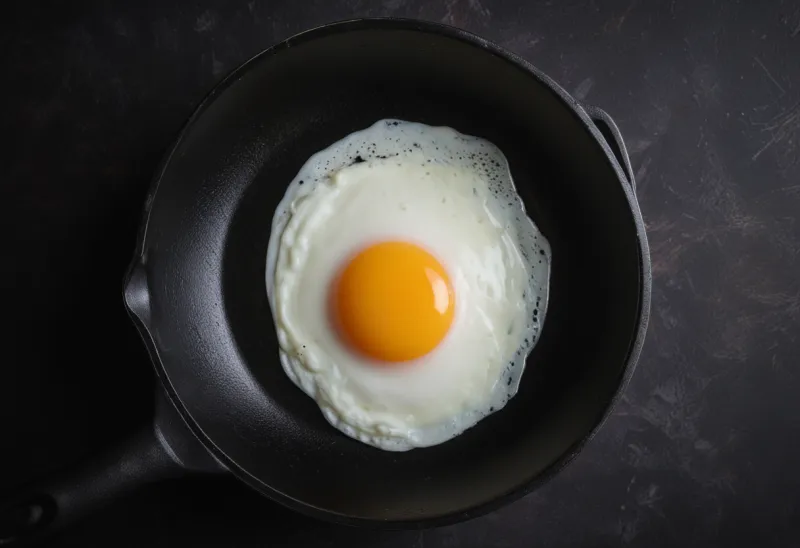
The egg is the cleanest human demonstration, because it was measured directly. Researchers fed five ileostomy patients 25 grams of egg protein labelled with stable isotopes, once cooked and once raw, and collected what reached the end of the small intestine. True ileal digestibility of the cooked protein was 90.9 percent; raw, it was 51.3 percent2. Nearly half of the raw egg's protein sailed past the small intestine undigested.
The mechanism is denaturation. In its raw state a protein is folded into a tight, compact shape that shields its backbone from digestive enzymes. Heat unwinds that structure, and the unfolded chains become, as the cooking-energetics work puts it, "more susceptible to proteolytic enzymes in the small intestine"1. The protein content on the label did not change when you cooked the egg. The fraction of it you can actually reach did — it roughly doubled. (The sample was five people, so read the exact figure loosely; the direction and rough size are the robust part.)
Heat unlocks starch — and food structure sets the ceiling#
Starch tells the same story through a different mechanism. Raw starch is packed into semi-crystalline granules that human enzymes struggle to break into; cooking with water gelatinizes them, transforming, in the same paper's words, "resistant semicrystalline structures into amorphous compounds that are readily hydrolyzed to sugars and dextrins"1. This is why the mice starved on raw tuber and held their weight on cooked: raw starch largely passes through, and cooked starch is fuel you can actually get at.
But cooked does not mean fully available, and this is the part that keeps the whole thing a range rather than a switch. When researchers measured how much starch from six cooked foods was digested by the time it reached the end of the small intestine in ileostomy subjects, the figure ranged from 64 percent for canned beans to 96 percent for a low-amylose custard3. A third of the beans' starch was never absorbed in the small intestine at all. So "digestible carbohydrate" is a spectrum set by amylose content and the food's physical structure, not a constant the label can capture.
| Food component | Raw / native state | After cooking | Net effect on absorbed energy |
|---|---|---|---|
| Egg protein | ~51% ileal digestibility | ~91%2 | rises sharply |
| Starch granule | resists enzymes, largely passes through | gelatinized, readily hydrolyzed | rises |
| Cooked starch (varies by food) | — | 64–96% digested3 | rises, but not to 100% |
Cooling claws a little back#
Cooking pushes digestibility up; letting the food go cold pushes a slice of it back down. When gelatinized starch cools, some of it re-crystallizes into a form enzymes can no longer open — resistant starch. In one trial, chilling cooked white rice for 24 hours and reheating it raised resistant starch from 7.52 to 11.96 grams per 100 grams, and the cooled rice produced a markedly lower blood-glucose response than the same rice eaten fresh4. That extra resistant starch behaves less like sugar and more like fibre: it slips past small-intestine digestion and is fermented in the colon, which yields less energy than digestion would. So the same rice, cooked hot versus cooked-then-cooled, hands you a slightly different net calorie count — modestly, not magically. It is a real effect, and a small one against the size of a normal portion error.
What this means for your log#
Stack the mechanisms and the verdict is clear: cooking changes the calories you absorb even when it barely changes the calories the food contains, and your label reports the second, not the first. Cooking raises the number your body keeps; intact structure lowers it, which is why whole nuts deliver far less energy than their Atwater value — the cell walls shield the fat, the same logic running the opposite way (the full accuracy audit works that case). None of this is on a nutrition label, which assumes near-complete digestion and cannot know how you prepared the food.
The practical takeaway is not to start correcting your log for gelatinization. These shifts are real but small next to portion error, and chasing them buys a tidier digit rather than a truer trend. The point is the opposite: they are a concrete reason the true number was always a band, not a figure. Log the food, read it as a range, and let the width quietly hold the difference between what your dinner contained and what you actually kept — a difference that is also why how much you cook and cool your food nudges the same starchy meal a few points either way.
FAQ#
Do cooked foods have more calories than raw?#
On the label, barely — that difference is mostly water weight. In your body, often yes, because cooked food is more digestible, so you absorb a larger share of what it contains: raw egg protein was 51 percent digestible in the small intestine against 91 percent cooked2. The calories the food holds barely move; the calories you keep can rise.
Does cooling rice actually lower its calories?#
Slightly, and by a real mechanism. Chilling cooked rice re-crystallizes some starch into resistant starch — one study saw it rise from 7.52 to 11.96 grams per 100 grams after 24 hours4. That fraction is fermented in the colon rather than digested in the small intestine, yielding less energy. The effect is modest, not a way to make rice calorie-free.
Does a calorie label account for cooking's effect on digestion?#
No. Labels use Atwater factors that assume you digest nearly all of the protein, carbohydrate, and fat — so they report gross energy, not what you absorb. They cannot see that raw food passes more through undigested, that cooking unlocks it, or that a plate of beans gives up only about two-thirds of its starch to the small intestine3.
Sources#
- Carmody RN, Weintraub GS, Wrangham RW. Energetic consequences of thermal and nonthermal food processing. Proc Natl Acad Sci USA. 2011.
- Evenepoel P, Geypens B, Luypaerts A, Hiele M, Ghoos Y, Rutgeerts P. Digestibility of cooked and raw egg protein in humans as assessed by stable isotope techniques. J Nutr. 1998.
- Zhou Z, Topping DL, Morell MK, Bird AR. Changes in starch physical characteristics following digestion of foods in the human small intestine. Br J Nutr. 2010.
- Strozyk S, et al. Influence of resistant starch resulting from the cooling of rice on postprandial glycemia in type 1 diabetes. Nutr Diabetes. 2022.
Source: BurnWeek — "Does cooking change a food's calories?", https://burnweek.fit/blog/how-cooking-changes-calories/. Licensed CC BY 4.0: free to quote or reuse with a link to this page.