A medium potato is about 160 calories in every form that doesn't involve oil#
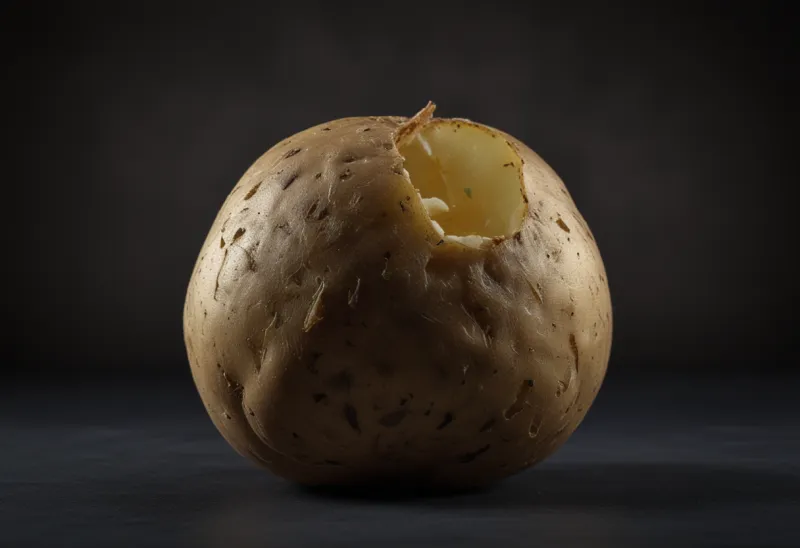
USDA puts a medium raw potato at 213 grams and 77 calories per 100 grams; a medium baked potato at 173 grams and 93 calories per 100 grams; a medium boiled potato at 167 grams and 86 (FDC 170026; FDC 170093; FDC 170440). Multiply each pair and the answers are 164, 161 and 144 calories. Three cooking methods, three different weights, three different densities — and a spread of 20 calories.
Then USDA lists plain salted potato chips at 532 calories per 100 grams, which means 22 chips weighing 28 grams come to about 149 calories6. A handful of crisps and a whole baked potato are the same calorie transaction, and the potato weighs six times as much. That is the entire story of potato calories, and the rest of this article is about proving that the variable in it is not the potato.
The potato is mostly water, and its density is a readout of how much is left#
Every figure in the first four columns below is a USDA record. The fifth column — calories per gram of dry matter, meaning everything that isn't water — is my division of their energy value by 100 minus their water figure. It is the column that makes the rest of the table make sense.
| USDA entry | Energy | Fat | Water | Solids | kcal per g of solids | Potassium |
|---|---|---|---|---|---|---|
| Raw, flesh and skin1 | 77 kcal | 0.09 g | 79.2 g | 20.8 g | 3.70 | 425 mg |
| Boiled, no skin2 | 86 kcal | 0.10 g | 77.5 g | 22.5 g | 3.82 | 328 mg |
| Baked, flesh and skin3 | 93 kcal | 0.13 g | 74.9 g | 25.1 g | 3.71 | 535 mg |
| Mashed flakes, dehydrated4 | 354 kcal | 0.41 g | 6.58 g | 93.4 g | 3.79 | 1,100 mg |
| French fries, frozen, oven-heated5 | 161 kcal | 5.13 g | 63.1 g | 36.9 g | 4.36 | 471 mg |
| Chips, plain, salted6 | 532 kcal | 34.0 g | 1.86 g | 98.1 g | 5.42 | 1,200 mg |
Look at the top four rows of that last column: 3.70, 3.82, 3.71, 3.79. Those four foods differ in energy density by a factor of 4.6 — from 77 calories per 100 grams to 354 — and once you price them per gram of actual food rather than per gram of food-plus-water, they agree to within 3.2%. Raw potato, boiled potato, baked potato and dehydrated potato flakes are, on this measure, the same substance in four states of dryness.
The dehydrated row is the control that makes the point unarguable. Potato flakes carry 0.41 grams of fat per 100 grams — essentially none, and less than a fifth of a gram more than a raw potato. Nothing was added. Water was removed, and the calorie density went up 4.6-fold. If you want to know why a potato preparation is calorie-dense, ask what happened to the water before you ask what happened to the oil.
The potassium column moves for the same reason, plus one extra. Boiling drops it from 425 to 328 mg per 100 grams because potassium is water-soluble and some of it leaves in the cooking water. Baking raises it to 535 because water leaves and the potassium stays. Drying takes it to 1,100. None of that is the potato changing; it is the denominator changing.
Frying is two operations, and only one of them is about the potato#
Now the bottom two rows, where the constant breaks. Oven-heated frozen fries come in at 4.36 calories per gram of solids and chips at 5.42 — 16% and 44% above the fat-free band. Something has been added, and it is not hard to find.
Run the arithmetic backwards. A potato chip carries 34.0 grams of fat per 100 grams. At the standard 9 calories per gram, that fat accounts for about 306 of its 532 calories — 57% of a potato chip is oil, by energy. Take those 306 calories out and the remaining 226 sit on 64 grams of fat-free solids, which is 3.53 calories per gram: back inside the band, near enough. Do the same for fries and the 5.13 grams of fat account for about 46 of the 161 calories, leaving 115 calories on 31.8 grams of fat-free solids, or 3.62 per gram. Both derivations are mine, resting on USDA's water and fat figures and one conversion factor.
Which means frying does two separable things, and confusing them is why people argue about potatoes at cross purposes. It drives out water, which concentrates the potato exactly the way baking or drying does and adds no calories at all. And it replaces some of that departed water with oil, which is where every extra calorie comes from. A chip is 98% solids because it was dried, and 57% oil by energy because it was fried in fat. The first operation is thermodynamics. The second is a decision someone made about a pan, and it is the one the fried-food estimation piece exists to pin down, because surface area — not potato — decides how much oil a cut can hold.
That also explains the one genuinely useful rule of thumb here. Cut a potato thinner and you have not changed the potato; you have multiplied the surface available for oil to sit on. A chip and a wedge come from the same tuber and differ by a factor of three in energy density, entirely on that account.
Filling, and cheap to be wrong about#
Boiled potato has the highest score on the classic satiety index of any food tested — and the reason it wins turns out to be serving weight and water content rather than the fiber or protein people expect — a result taken apart in the hunger article. Note how neatly that result sits on top of this one. The same property that makes a boiled potato only 86 calories per 100 grams — that three quarters of it is water — is the property that makes 300 grams of it a large, heavy, filling amount of food. Satiety per calorie and low calorie density are not two facts about potatoes. They are one fact, read from two directions.
Which makes the potato unusually forgiving to estimate. If you are eyeballing a boiled or baked potato, a 20% error in your weight guess costs you about 30 calories, because the food is light. If you are eyeballing a plate of fries, the same 20% error costs three or four times that, and it sits on top of a much larger unknown — how much oil the kitchen used. This is the asymmetry that the calorie-density check is built to surface: spend your precision on the dense end of a plate and let the light end float.
Two footnotes worth having. Chilling a cooked potato puts part of its starch beyond the reach of your digestive enzymes, so the same gram yields less energy; the size of that discount is quantified in the resistant-starch piece. And the skin is where a good share of the fiber and potassium sit, which is one reason USDA's baked-with-skin entry outperforms its boiled-without-skin one on both.
What to do with a potato and a calorie log#
The practical version is short, because the science above collapses into two numbers.
Unfried potato, in any form, is roughly 0.8 to 0.95 calories per gram. Weigh it or guess it; either way you will be close, and being wrong is cheap. A medium potato is about 150 to 165 calories whether you boiled it, baked it or roasted it dry, and the mash you made from flakes is the same food re-wetted.
Fried potato is 1.6 to 5.3 calories per gram, and the number depends on the cut, not the potato. This is where estimation actually costs you, and it is worth logging as a range rather than a point, because the pan is the unknown and nobody in the kitchen wrote down what it did. The general principle — that cooking changes what you absorb without changing what the label says — applies here in its most legible form.
So the answer to whether potatoes are fattening is that the question has been asked about the wrong object for about forty years. On its own, a potato is one of the lowest-energy-density staples in the shop and one of the most filling foods measured. Put it in oil and you have made a different food, whose calories are mostly the oil's. The potato was never the variable.
FAQ#
How many calories are in a medium potato?#
About 144 to 164, depending on how it was cooked and therefore how much water it still holds. USDA lists a medium raw potato at 213 g and 77 kcal per 100 g, a medium baked one at 173 g and 93 kcal per 100 g, and a medium boiled one at 167 g and 86 (FDC 170026; FDC 170093; FDC 170440). Use about 155 calories as a planning figure for any unfried medium potato.
Are potatoes fattening?#
Not on their own — they are among the least calorie-dense staples available. USDA prices boiled potato at 86 calories per 100 grams against cooked pasta's 158 and cooked white rice's 130. What changes the picture is oil: potato chips come in at 532 calories per 100 grams, and about 306 of those are fat6. The preparation, not the vegetable, is what carries the calories.
Do french fries have more calories because of the potato or the oil?#
Almost entirely the oil, plus the water frying drives off. Priced per gram of solids rather than per gram of food, raw, boiled, baked and dehydrated potato all land between 3.70 and 3.82 calories, while oven-heated fries land at 4.36 and chips at 5.42 — my arithmetic on USDA's energy, fat and water figures (FDC 170437; FDC 169677). Subtract the fat at 9 calories a gram and both fried forms fall back inside the unfried band.
Sources#
- USDA FoodData Central. Potatoes, flesh and skin, raw (FDC 170026, SR Legacy).
- USDA FoodData Central. Potatoes, boiled, cooked without skin, flesh, without salt (FDC 170440, SR Legacy).
- USDA FoodData Central. Potatoes, baked, flesh and skin, without salt (FDC 170093, SR Legacy).
- USDA FoodData Central. Potatoes, mashed, dehydrated, flakes without milk, dry form (FDC 170445, SR Legacy).
- USDA FoodData Central. Potatoes, french fried, crinkle or regular cut, salt added in processing, frozen, oven-heated (FDC 170437, SR Legacy).
- USDA FoodData Central. Snacks, potato chips, plain, salted (FDC 169677, SR Legacy).
Source: BurnWeek — "Potatoes: surprisingly filling for the calories", https://burnweek.fit/blog/calories-in-potatoes/. Licensed CC BY 4.0: free to quote or reuse with a link to this page.