The oil goes in after the fryer, not in it#
To estimate a fried food, estimate the oil — and the first thing to know is that most of that oil entered after the food came out of the pan. This is not a figure of speech. Reviewing the mechanism, food scientists put the split at "about 20% oil uptake takes place during deep frying and about 80% during cooling"1. Two separate teams frying battered fish nuggets found the same thing directly: "the oil content absorbed during frying was significantly lower than the one absorbed during cooling"3, and in the other, "the penetrated surface oil is mainly produced during the cooling stage"2.
The working method that follows is simple, if unsatisfying: log the item's weight as served, assign it a fat fraction based on its shape rather than its ingredient, and record the widest band in your diary. Measured 5-millimetre french fries came out at 23 and 20 percent fat after two minutes at 140 and 185 °C1; batter-breaded fish nuggets fried at 180 °C for a minute ran 11.3 to 14.2 percent fat on a dry-weight basis2. A fifth of a portion of fries being fat is the anchor worth carrying, and at 9 calories a gram that is 180 calories per 100 grams of fries before any of the potato is counted — my arithmetic on their measurement.
What is actually happening in the food#
Frying is often described as cooking in oil. Mechanically it is closer to two separate events, and only the second one is about oil at all.
The first is drying. Water in the food turns to steam and blasts outward, carving channels through the structure as it goes. That is why oil uptake is bounded by moisture loss: "Oil can only enter areas where water evaporates, since oil pickup is mostly a surface process. Consequently, there is a connection between oil absorption and moisture loss"4. While the food is in the fryer, the outward rush of steam is actively holding oil out.
Then you lift it out, and the pressure reverses. The crust cools, the steam inside it condenses, the internal pressure drops, and the film of oil clinging to the surface is drawn into the channels the steam just cut. Food scientists formalise this by splitting the fat into three fractions: "(i) structural oil (STO), oil absorbed in the microstructure during frying time; (ii) penetrated surface oil (PSO), oil migrated into the product during cooling after food is taken out from the deep fryer; and (iii) surface oil (SO), oil adhered to the surface"1. In the fish-nugget measurements, the cooling-stage fraction was the larger one for every oil tested — 6.3 to 9.0 percent of the product against 3.5 to 5.0 percent still sitting on the surface2.
The fryer is where the water leaves. The draining rack is where the oil arrives.
That single fact reorganises the whole estimation problem. The frying time you saw is not the variable. The variable is how much oil was on the surface when the food came out, and what happened to it in the minutes afterwards — none of which you observed, and none of which appears on a menu.
Surface area sets the number, not size#
The second reason fried food resists estimation is that the quantity governing uptake is not the one your eye measures. The review is explicit: "The dimension and structural properties influencing the oil uptake during deep frying are not linked to the volume, but to the permeability and the surface area"1.
Surface area per gram scales roughly as one over the thickness, so halving the cut of a potato roughly doubles the exposed area on every gram of it — my arithmetic, but it is the geometry behind an ordering everyone already knows and misattributes. A thin crisp is not oilier than a thick wedge because crisps are a worse food. It is oilier because there is more outside per unit of inside, and outside is where oil lives.
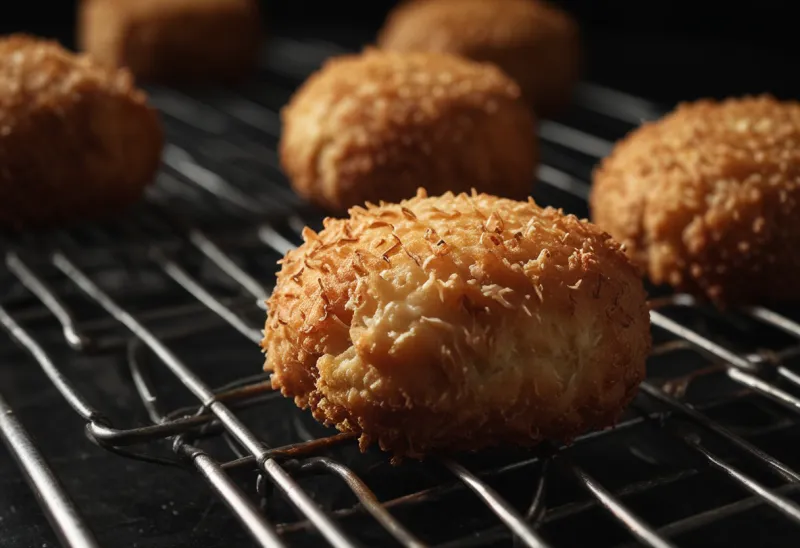
Batter and breading are the same lever operating twice. They add starch, which people do account for, and they add a porous, high-surface-area shell, which people do not — and that shell is exactly the structure the cooling-stage suction fills. It is why a battered item and a naked one of the same weight are not comparable estimates, and why coatings are the target of most of the food-industry research on cutting fat in fried products3.
Every remaining variable is invisible to you#
Here is the uncomfortable summary of what decides a fried food's calories.
| Variable | Direction | Evidence |
|---|---|---|
| Surface area per gram | more area, more oil | uptake tracks permeability and surface area, not volume1 |
| Oil temperature | hotter, less oil | 5 mm fries at 23% (140 °C) vs 20% (185 °C)1; nugget equilibrium oil content fell as temperature rose 160→180 °C4 |
| Which oil is in the fryer | palm highest, soybean lowest | 14.2% vs 11.3% total fat, same food2 |
| Coating | batter and breading add porous surface | (Cui 2022; Sun 2022) |
| Draining and cooling | ~80% of uptake happens here | (Lumanlan 2020; Sun 2022) |
Two rows deserve a second look. The temperature row runs backwards from intuition — a hotter fryer produces less oily food, and two independent measurements on different foods point the same way. The mechanism is the one above: violent steam release holds oil out and dries the crust faster, so there is less time and less wet channel for oil to occupy. A restaurant fryer held properly hot can hand you a lighter portion than a home pan whose temperature collapsed the moment the food went in. That is a real effect and one you can neither see nor ask about.
The oil row is the quietest. Swapping palm for soybean moved the same nugget's fat content by about a quarter, my arithmetic on their figures, with nothing else changed. No menu carries that information.
And since roughly four-fifths of the uptake happens after cooking, how the food was drained and packed is a live variable too — the surface film is the reservoir the cooling food draws from, so a portion racked and drained has less to draw in than one that sat in a closed box. That inference is mine rather than a measured result, but it follows directly from the fractions above, and it is the mechanism behind the folk wisdom that soggy takeaway chips are worse than fresh ones.
How to log it#
Weigh or estimate the item as served, then apply a fat fraction by shape. Thick-cut fries at around a fifth of their weight as fat is the best-anchored figure available. Thin crisps sit well above that; a thick, uncoated piece of fish or chicken sits below it. Shape first, ingredient second.
Price the fat, not the food. Fat carries more than twice the energy per gram of the protein and starch around it, which is why the general rule for eyeballing a plate is to measure the fats and eyeball the rest — and fried food is the case where you cannot measure them, because they were added by someone else's fryer to a depth nobody recorded. If you fry at home, tracking the oil you pour is the one lever you actually hold.
Give it the widest band in your log. Every variable in the table above is unobservable to the person eating, and they compound. A fried item genuinely deserves a wider range than anything else you will record that day — wider than a homemade dish, wider than a barcoded snack, and wider than the restaurant plate it arrived on.
Then run the density check. Divide your estimate by the item's weight in grams and see whether the resulting calories-per-gram is plausible for something that is part starch and part absorbed oil. The method is in using calorie density to sanity-check an estimate, and fried food is where it earns its keep, because the absorbed oil is the one ingredient with no visual signature at all.
None of this makes a fried portion knowable. It makes the uncertainty legible, which is the realistic goal for the food category that sits at the far end of the whole accuracy stack — and a reminder that cooking changes a food's calories in more ways than heat and water alone.
FAQ#
How much oil does deep-fried food actually absorb?#
Enough to dominate the estimate. Measured 5-millimetre french fries came out at 20 to 23 percent fat depending on frying temperature1, and batter-breaded fish nuggets at 11.3 to 14.2 percent on a dry-weight basis2. At a fifth of the served weight as fat, a 100-gram portion of fries carries about 180 calories from oil alone before the potato is counted.
Does draining or blotting fried food reduce the calories?#
Plausibly, and by more than you would think, because most of the absorption has not happened yet when the food leaves the oil. Roughly 80 percent of uptake occurs during cooling1, drawn from the film sitting on the surface — so removing that film early removes the reservoir. No trial has measured the effect of blotting on final calories, so treat this as mechanism rather than a measured result.
Do thicker chips absorb less oil than thin ones?#
Per gram, yes, and it is geometry rather than anything about the potato. Oil uptake tracks "the permeability and the surface area" rather than the volume1, and surface area per gram rises as the cut gets thinner — halving the thickness roughly doubles the exposed area on each gram. That single relationship explains most of the ordering from crisps down to thick wedges.
Sources#
- Lumanlan JC, Fernando WMADB, Jayasena V. Mechanisms of oil uptake during deep frying and applications of predrying and hydrocolloids in reducing fat content of chips. Int J Food Sci Technol. 2020;55(4):1661-1670.
- Cui L, Chen J, Zhai J, Peng L, Hayes DG. Oil penetration of batter-breaded fish nuggets during deep-fat frying: effect of frying oils. Foods. 2022;11(21):3369.
- Sun Y, et al. Effects of konjac glucomannan on oil absorption and safety hazard factor formation of fried battered fish nuggets. Foods. 2022;11(10):1437.
- Demiray ID, Ergezer H, Demiray E, et al. Deep-fat frying of chicken nuggets: impacts on mass transfer and some quality indices. Food Sci Nutr. 2025;13(6):e70451.
Source: BurnWeek — "How to estimate calories in fried foods", https://burnweek.fit/blog/estimating-calories-in-fried-foods/. Licensed CC BY 4.0: free to quote or reuse with a link to this page.