Starch that reaches your colon still assembled — about 5 grams a day of it#
Most starch is taken apart into glucose in the small intestine and absorbed within a couple of hours. A minority is not. Resistant starch is the share that survives that passage intact and arrives in the colon, where bacteria ferment it — the same fate as dietary fiber, and in food analysis it is usually counted as fiber. Fermentation is a poorer energy deal than digestion, which is why EU labeling law prices fibre at 2 kcal per gram against carbohydrate's 48. A gram of starch that resists you is worth roughly half a gram that doesn't.
The quantities are small, and almost nobody eats them deliberately. Linking a resistant-starch food database to 24-hour dietary recalls from 18,305 participants in NHANES 1999–2002, Murphy and colleagues put US intake at about 4.9 g of resistant starch per day, with a plausible range of 3 to 8 g, arriving mostly from breads (21%), cooked cereals and pasta (19%), non-legume vegetables (19%) and bananas and plantains (14%)2. Trials that produce measurable metabolic effects generally supplement at 8 g a day or more, and the best-known mechanistic study used 30. The distance between 4.9 and 30 is most of what follows.
Five types, and only one of them is made in a kitchen#
The textbook scheme has four categories; the current one has five. Birt and colleagues, reviewing the field for Advances in Nutrition, list RS1 through RS51, and the useful thing about the list is how little of it is under your control.
| Type | What makes it resist | Where it shows up |
|---|---|---|
| RS1 | Physically inaccessible — locked inside intact plant structure | Coarsely ground or whole-kernel grains, legumes |
| RS2 | Granular starch in the B- or C-polymorph, which enzymes open slowly | High-amylose maize starch, raw potato, raw banana starch |
| RS3 | Retrograded — recrystallized after cooking and cooling | Cooked and cooled starchy foods |
| RS4 | Chemically modified in a factory | Cross-linked starch, octenyl succinate starch |
| RS5 | Amylose–lipid complex | Stearic-acid-complexed high-amylose starch |
RS1 is a property of how coarsely the grain was milled, and grinding destroys it. RS2 is a property of the raw granule, and cooking destroys it — the gelatinization that makes a potato edible is the same event that makes its starch digestible. RS4 and RS5 are manufacturing outputs; they arrive in your food already made, or not at all.
That leaves RS3, and RS3 is the only one a home cook can create on purpose. Birt's group describes the mechanism plainly: amylose molecules are linear, so they "have a great tendency to form double helices, particularly near refrigeration temperatures (4–5°C) and with adequate moisture content." Cook the starch, then chill it, and some of it recrystallizes into a structure digestive enzymes no longer fit.
Chilling pasta moved blood glucose a great deal and calories very little#
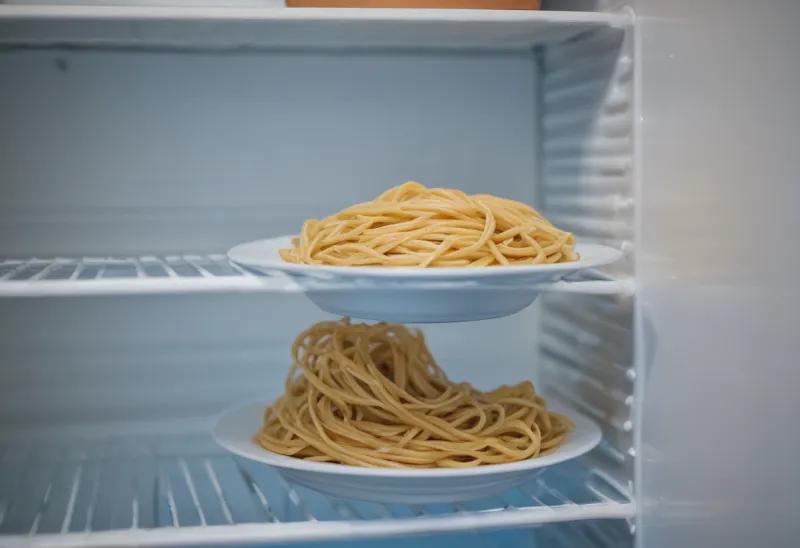
The cleanest recent measurement comes from a population where postprandial glucose is watched closely. Thirty-two adults with type 1 diabetes ate two standardized 50 g-carbohydrate pasta meals in a randomized single-blind crossover — one freshly cooked, one cooked, held 24 hours at 4 °C and reheated — dosing insulin through their pump calculators ten minutes before eating. The cooled-and-reheated pasta measured 12.88 g of resistant starch per 100 g against the fresh pasta's 8.03. Peak glucose came in at 10.7 versus 12.6 mmol/L, the maximum rise at 2.8 versus 4.7 mmol/L, and the 180-minute incremental area under the curve at 211.9 versus 524.8 mmol/L × 180 min (p < 0.0001), with no excess hypoglycemia5. The glucose curve was not merely flattened; it also peaked earlier, at 65 minutes rather than 125.
Now price the same plate in calories, which the study did not do. A 200 g serving of that cooked pasta carries about 9.7 g more resistant starch than the fresh version. Repricing those grams from starch's 4 kcal to fibre's 2 gives a saving of roughly 19 calories — my arithmetic on the study's resistant-starch figures and the EU conversion factors, not a measurement anyone made.
A 60% cut in the glucose curve and a 20-calorie cut in the meal are the same intervention read on two scales. Only one of them is worth rearranging dinner over.
The direction replicates in other foods and other kitchens. Raatz and colleagues cooked three commercial potato varieties by baking and by boiling and served them hot, chilled and reheated: resistant starch varied by cooking method and by service temperature but not by variety, with baked above boiled and chilled above either hot or reheated6. Reviewing 94 papers on resistant starch in commonly eaten US foods, Patterson and colleagues reach the same generalization — foods cooked then chilled carry more resistant starch than foods merely cooked, and high-amylose varieties carry more than native ones7. Rice behaves the same way, and the calorie bookkeeping for it is worked through in does cooking change a food's calories rather than repeated here.
The colon runs on butyrate, which is what the calorie arithmetic misses#
Fermenting starch is not simply a less efficient way of extracting energy from it. The products are short-chain fatty acids, and one of them has a job. Butyrate, in Birt's description, is "an end-product of microbial fermentation of resistant starch and the primary energy source for colonocytes," actively transported into the cells lining the colon rather than left to diffuse1. The same review notes butyrate's antitumorigenic behavior in colorectal tumor cell lines and reports that high-fiber and resistant-starch feeding in animals raised fecal bulk and butyrate concentration while lowering proliferation markers and colon carcinogenesis.
Those are cell-line and animal findings, and they should be held at that weight — nobody has shown that adding resistant starch to a human diet prevents a human cancer. What they do establish is that the energy you fail to absorb has not simply vanished from the transaction. Some of it is feeding the tissue that handles it, and some of it is building bacterial biomass you then excrete, which is the mechanism behind the extra calories a fiber-rich diet sends into stool. How fast a fiber ferments decides how much of it reaches the far colon at all — the axis that soluble versus insoluble gets wrong.
One clamp study, twenty-two trials, and what separates them#
The mechanistic case is genuinely strong. Ten healthy volunteers took 30 g of resistant starch daily for four weeks against a placebo, and insulin sensitivity measured by euglycemic-hyperinsulinemic clamp — the reference method — came out higher on the starch (9.7 versus 8.5 × 10⁻² mg glucose · kg⁻¹ · min⁻¹ per mU insulin/L, P = 0.03). Forearm muscle cleared glucose faster during a meal test despite lower circulating insulin, 44% faster once adjusted for insulin; fatty acid and glycerol release from abdominal fat fell; blood acetate and propionate rose3.
Pool the clinical endpoints and the picture thins out. Snelson and colleagues collected 22 randomized controlled trials of RS2 supplementation at 8 g a day or more, covering 670 participants over 1 to 12 weeks. Serum triacylglycerol fell in healthy participants by 0.10 mmol/L (95% CI −0.19 to −0.01, n = 269) and body weight fell in people with type 2 diabetes by 1.29 kg (95% CI −2.40 to −0.17, n = 90). Fasting glucose, HbA1c and HOMA-IR did not move. The authors are unusually direct about the fragility: both positive results were "heavily influenced by positive results from a small number of individual studies which contradicted the conclusions of the majority of trials," most trials enrolled 10 to 60 people, most carried unclear risk of bias, and the conclusion is that "short-term RS2 supplementation in humans is of limited cardiometabolic benefit"4. The review declares no external funding and no conflicts.
These two results are not in conflict, and it matters that they aren't. Robertson measured a physiological quantity — how much glucose a fixed insulin signal moves — in a design built to detect exactly that. Snelson pooled clinical outcomes, several of which are structurally hard to shift inside twelve weeks; HbA1c is a rolling three-month average, and a 1.29 kg weight difference resting on 90 people is a thin plank. Resistant starch does something measurable to insulin action. Whether that something accumulates into an outcome you would notice, at doses reachable by eating food rather than opening a tub, is unresolved — and the trials are too short and too small to have resolved it.
Where the extra grams actually live#
Nothing in the evidence supports treating resistant starch as a calorie loophole; the arithmetic above caps that at about twenty calories a plate. What it does support is a mild preference ordering inside carbohydrates you were going to eat anyway.
Legumes and coarsely milled or intact grains bring RS1 that survives because the plant structure survived — the same reason whole versus refined is the line that matters. Green-tipped bananas and plantains bring RS2, and lose it as they ripen. Cooked-and-cooled potato, pasta and rice bring RS3, and reheating gives some of it back to digestion without erasing the gain. Doubling a typical intake from roughly 5 g to 10 g is realistic on that menu and is not a diet change; it is a subset of the 25 to 38 grams of fiber a day most people already miss. If you count carbohydrates by subtraction, note that resistant starch is one of the reasons the fiber term in a net-carb calculation is a moving target rather than a constant.
FAQ#
Does resistant starch have fewer calories than ordinary starch?#
Roughly half. Starch digested in the small intestine is priced at 4 kcal per gram; starch that reaches the colon is fermented instead, and EU labeling rules price fibre at 2 kcal per gram8. The catch is scale. Converting the 4.85 g per 100 g that cooling added to pasta in one crossover trial5 saves about 19 calories on a 200 g serving — my arithmetic, and not a large number.
Does reheating cooled pasta or potatoes destroy the resistant starch?#
Not all of it. Raatz and colleagues found chilled potatoes carried more resistant starch than either hot or reheated ones, so reheating does cost you some of the gain6. But the pasta in the type 1 diabetes crossover was reheated before eating and still measured 12.88 g per 100 g against 8.03 g fresh, with the glucose benefit intact5. Chilled-and-eaten-cold is the maximum; chilled-and-reheated keeps most of the difference.
How much resistant starch do people actually eat?#
About 4.9 g a day in the US, with a defensible range of 3 to 8 g, according to a resistant-starch database matched to NHANES recalls from 18,305 people2. Nearly every trial showing a metabolic effect used 8 g a day or more of supplemental resistant starch, and the clamp study that found improved insulin sensitivity used 30 g3. Food alone rarely reaches those doses.
Sources#
- Birt DF, Boylston T, Hendrich S, et al. Resistant starch: promise for improving human health. Adv Nutr. 2013;4(6):587-601.
- Murphy MM, Douglass JS, Birkett A. Resistant starch intakes in the United States. J Am Diet Assoc. 2008;108(1):67-78.
- Robertson MD, Bickerton AS, Dennis AL, Vidal H, Frayn KN. Insulin-sensitizing effects of dietary resistant starch and effects on skeletal muscle and adipose tissue metabolism. Am J Clin Nutr. 2005;82(3):559-67.
- Snelson M, Jong J, Manolas D, et al. Metabolic Effects of Resistant Starch Type 2: A Systematic Literature Review and Meta-Analysis of Randomized Controlled Trials. Nutrients. 2019;11(8):1833.
- Rogowicz-Frontczak A, Strozyk S, Pilacinski S, et al. Does Resistant Starch Formed by Cooling Pasta Decrease the Postprandial Glycemic Response in Type 1 Diabetes? A Randomized Single-Blind Crossover Study. Nutrients. 2026;18(7):1152.
- Raatz SK, Idso L, Johnson LK, Jackson MI, Combs GF Jr. Resistant starch analysis of commonly consumed potatoes: Content varies by cooking method and service temperature but not by variety. Food Chem. 2016;208:297-300.
- Patterson MA, Maiya M, Stewart ML. Resistant Starch Content in Foods Commonly Consumed in the United States: A Narrative Review. J Acad Nutr Diet. 2020;120(2):230-244.
- Regulation (EU) No 1169/2011 on the provision of food information to consumers, Annex XIV — conversion factors for the calculation of energy.