A serving of almonds is labelled 165 calories and delivers about 129#
Nuts are the densest whole food most kitchens contain — 579 calories per 100 grams for almonds, and 598 for smooth peanut butter8. The label, though, overstates what your body extracts. Feed people fixed amounts of almonds under controlled conditions, collect and bomb-calorimeter everything that leaves, and a 28-gram serving comes out at 129 calories against the 168 to 170 the label's arithmetic predicts — a 32% overestimate1. The mechanics of that measurement, and what it does and doesn't generalize to, are in do you absorb all the calories you eat.
What that page can't tell you is the part specific to this food: the discount is not a property of "nuts." It runs from 32% in almonds to 5% in pistachios, it shrinks as you break the nut apart, and even at its largest it is only the second reason a daily handful fails to show up on the scale. The first reason is that you quietly eat less of everything else — about three-quarters of the calories back, without deciding to.
Four nuts, four different discounts#
The same USDA lab ran essentially the same experiment on four nuts: a controlled base diet, a nut-supplemented arm, complete collection of urine and feces, and bomb calorimetry on all of it. The answers were not close to each other.
| Nut (28 g serving) | Measured energy | Atwater prediction | Shortfall |
|---|---|---|---|
| Almonds, raw whole | 129 kcal (4.6 kcal/g) | 168-170 kcal | 32%1 |
| Walnuts | 146 kcal (5.22 kcal/g) | 185 kcal (6.61 kcal/g) | 21%2 |
| Cashews | 137 kcal (4.89 kcal/g) | — | 16%3 |
| Pistachios | 5.4 kcal/g (22.6 kJ/g) | 5.7 kcal/g (23.7 kJ/g) | 5%4 |
(The pistachio row is the paper's kilojoule figures converted at 4.184 kJ per kcal — our arithmetic, not theirs.)
A sixfold spread between the top and bottom row is not a rounding difference, and it has an awkward property: nobody can currently predict it. The intuitive story — harder nut, tougher cell walls, more fat that never meets a lipase — orders almonds above pistachios correctly and then fails on the middle. Walnuts are soft and oily and lose 21%; cashews are soft and starchy and lose 16%. A systematic review of 21 human and in vitro studies confirms the direction for every nut tested and attributes it to reduced fat release and higher fecal fat excretion, while stopping short of a predictor, and flags that the studies vary enough in method to weaken the base5.
So the usable version of this finding is narrow. Almonds have a large, replicated discount. Pistachios have one you could lose in a weighing error. Anything you have not seen measured — macadamias, pecans, Brazil nuts — has an unknown one, and assuming 30% because you read it about almonds is how a real result turns into a bad habit.
Who paid for the good news#
This literature has a pattern worth stating out loud, because it points the same way every time.
The pistachio study was funded jointly by USDA Agricultural Research Service and Paramount Farms, a pistachio grower4. The cashew study lists USDA ARS and the Global Cashew Council of the International Nut and Dried Fruit Council3. The best-known trial of almonds and body weight was funded outright by the Almond Board of California6. A finding that a food contains fewer calories than its label is a marketing asset, and the people who own that asset largely paid for its discovery.
A metabolic balance study is very hard to bend. It is not at all hard to choose. Every nut with a published calorie discount is a nut with a trade association.
That second sentence is the real limitation, and it is a selection problem rather than a fraud problem. Three things keep the results credible anyway: the endpoint is physical mass in and physical energy out rather than a questionnaire; a federal research lab co-ran every one of them; and an independent Australian review team, funded by no nut body, read the whole literature and reached the same conclusion5. Disclose the interest, keep the measurement — the same standard this blog applies when the funding points the other way.
The bigger lever is what you stop eating#
Suppose the almond discount were zero. A daily handful would still be close to free, and this is the part that gets skipped.
Twenty women added 1,440 kJ of almonds — about 344 calories, roughly 60 grams — to their normal diet every day for ten weeks, with no instruction on how to fit them in. Body weight did not change. The dominant reason was compensation: 74% of the almonds' energy was offset by eating less of other foods, with absorption inefficiency accounting for more of the rest. Resting metabolic rate, thermic effect of food and total energy expenditure did not move at all6.
Run the leftover through the usual arithmetic, and it is ours rather than the authors': 26% of 344 calories is about 90 a day unaccounted for by appetite alone, or roughly 6,300 across the ten weeks — which at the conventional 3,500 calories per pound would have predicted somewhere near 0.8 kg of gain. The scale showed none. Absorption explains part of that, measurement noise on a 20-person trial explains part, and the honest reading is that the two mechanisms together close the gap without either one having to do it alone.
It is also not one study's quirk. Pooling 55 randomized trials of daily nut consumption, body weight did not shift when participants were given no substitution advice (standardized mean difference 0.01; 95% CI −0.07 to 0.08; I² = 0%), and did not shift when they were. In the trials that told people to swap nuts for something, body fat percentage fell slightly (SMD −0.32%; 95% CI −0.61 to −0.03)7. An I² of zero across 55 trials is unusual in nutrition; the trials agree with each other more than most literatures manage.
Note what none of this licenses. "No detectable weight gain from adding 344 calories of almonds" is not "nuts are free." It is a statement about a food eaten in handfuls by people who were not tracking anything.
The jar is where the accounting breaks#
Two separate things go wrong when the nut becomes a butter, and only one of them is famous.
The first is structural. Metabolizable energy rises as the nut is broken down — the review's ordering is flour above chopped above whole, and butter above roasted above raw5. Grinding does what your molars couldn't, and the label's number stops being an overstatement. Do you absorb all the calories you eat has the measured form-by-form ladder for almonds specifically.
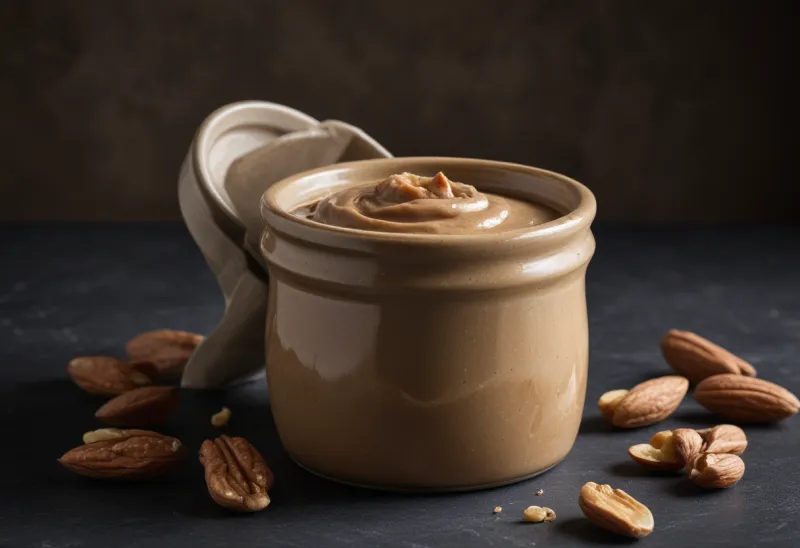
The second is portion, and it is larger. USDA's reference serving of smooth peanut butter is 2 tablespoons at 32 grams — 191 calories8. A knife loaded from the jar and scraped across toast is not a level tablespoon, and unlike a nut, a butter has no unit. Whole almonds are one of the few genuinely countable foods in the kitchen: USDA puts a single kernel at 1.2 grams, so 23 of them is an ounce and about 164 calories (USDA FoodData Central). You can count 23. You cannot count a spoonful.
There is also a gap in the evidence that gets papered over. Every compensation figure above was measured on whole nuts. Nobody has shown that a spoon of butter buys the same 74% appetite offset that a handful of almonds does, and given that the offset is the larger of the two mechanisms, that is not a small unknown. Treating nut butter as "nuts, but spreadable" assumes a result nobody has produced.
What to actually do with this#
Log nuts at the label figure. The discount is real, it is unevenly distributed, and it belongs in your margin of error rather than in your budget — the same way you shouldn't spend the compensation you haven't consciously made. If you want the size of that margin for a specific food, the calorie density framing is the useful one: an error on a 580-calorie-per-100-grams food costs you three times what the same gram error costs on rice.
The practical asymmetry is between the bag and the jar. Nuts in the shell or the bag are countable, self-limiting and discounted; nuts in a jar are free-poured, ground, and priced at full label value. Weigh the butter once to see what your normal spoon actually weighs, then estimate from there. For the rest of the day's spread, the hand portion guide covers the foods where eyeballing is good enough — nut butter is emphatically not one of them, and neither are the other dense extras in high-protein snacks.
FAQ#
How many calories are in a tablespoon of peanut butter?#
About 96, using USDA's smooth peanut butter at 598 calories per 100 grams and its own reference portion of 2 tablespoons = 32 grams8. The catch is that a spoon out of a jar is rarely a level tablespoon; a generously loaded knife can easily double it. Peanut butter is the food where weighing pays for itself fastest.
Will a daily handful of nuts make you gain weight?#
The trials say no. Across 55 randomized trials of daily nut intake, body weight did not change whether or not participants were told to substitute nuts for other foods (SMD 0.01; 95% CI −0.07 to 0.08)7. The mechanism is mostly appetite, not metabolism: adding 344 calories of almonds a day for ten weeks produced no weight change, with 74% of the energy offset by eating less of other things6.
Are roasted nuts and nut butter higher in calories than raw whole nuts?#
In available energy, yes. Processing releases fat that intact cell walls would otherwise shield, and measured metabolizable energy rises accordingly — flour above chopped above whole, butter above roasted above raw5. The gross calories on the label barely move; what changes is how much of them you keep.
Sources#
- Novotny JA, Gebauer SK, Baer DJ. Discrepancy between the Atwater factor predicted and empirically measured energy values of almonds in human diets. Am J Clin Nutr. 2012;96(2):296-301.
- Baer DJ, Gebauer SK, Novotny JA. Walnuts consumed by healthy adults provide less available energy than predicted by the Atwater factors. J Nutr. 2016;146(1):9-13.
- Baer DJ, Novotny JA. Metabolizable energy from cashew nuts is less than that predicted by Atwater factors. Nutrients. 2018;11(1):33. (Funded jointly by USDA ARS and the Global Cashew Council, International Nut and Dried Fruit Council.)
- Baer DJ, Gebauer SK, Novotny JA. Measured energy value of pistachios in the human diet. Br J Nutr. 2012;107(1):120-125. (Funded by USDA ARS and Paramount Farms, Inc.)
- Nikodijevic CJ, Probst YC, Tan SY, Neale EP. The metabolizable energy and lipid bioaccessibility of tree nuts and peanuts: a systematic review with narrative synthesis of human and in vitro studies. Adv Nutr. 2023;14(4):796-818.
- Hollis J, Mattes R. Effect of chronic consumption of almonds on body weight in healthy humans. Br J Nutr. 2007;98(3):651-656. (Funded by the Almond Board of California.)
- Guarneiri LL, Cooper JA. Intake of nuts or nut products does not lead to weight gain, independent of dietary substitution instructions: a systematic review and meta-analysis of randomized trials. Adv Nutr. 2021;12(2):384-401.
- USDA FoodData Central. Peanut butter, smooth style, without salt (FDC 172470) and Nuts, almonds (FDC 170567), SR Legacy.
Source: BurnWeek — "Nuts and nut butter: calorie-dense but filling", https://burnweek.fit/blog/calories-in-nuts-and-nut-butters/. Licensed CC BY 4.0: free to quote or reuse with a link to this page.