Your hand is a good ruler and a bad cup#
The hand-portion system works, but not in the way it is usually taught. When researchers tested it properly, the hand used as a measuring stick — finger widths laid against a food's length, width, and height — was strikingly good. The hand used as a container — fist for a pile of rice, cupped palm for cereal — was the worst method in the study, and lost outright to an ordinary measuring cup.
That matters because the popular palm-fist-thumb system is built almost entirely on the container idea. This guide keeps the parts the evidence supports, names the part it doesn't, and draws the line where the data draws it: a hand is an excellent instrument for steering your own intake over weeks and a poor one for telling you what is on the plate tonight. If you want the broader toolkit for working without a scale, estimating calories without a scale covers the rest of it; this is the deep dive on the estimator you can't leave at home.
What happened when someone actually measured#
Sixty-seven adults at the University of Sydney estimated 42 food items — each presented in two sizes — using their hands, then using household measures like cups and spoons. Every item had a true weight1.
| Method | Food type | Within ±25% of true weight | Within ±10% |
|---|---|---|---|
| Finger width (hand as ruler) | Geometric foods & liquids | 80% | 13% |
| Household measures | Geometric foods & liquids | 29% | 8% |
| Fist (hand as container) | Amorphous foods | zero foods within 10% | — |
| Household measures | Amorphous foods | three foods within 10% | — |
Data: Gibson et al., 2016.
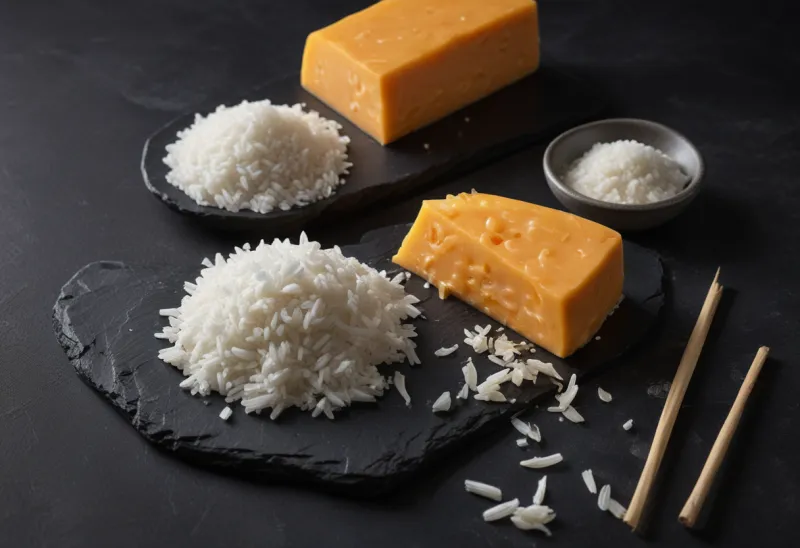
The top two rows are a rout. Measuring a piece of cheese or a slab of cake by laying finger widths against it put 80 percent of estimates within a quarter of the true weight, against 29 percent for a measuring cup — the authors' own framing is that "80 % were within ±25 % of the true weight of the food, and 13 % were within ±10 %, in contrast to only 29 % of those estimated with the household method"1. Your fingers are a ruler you always have, and a ruler is a genuinely good tool for anything with edges.
Then look at the bottom two rows.
The fist is the most famous tool in the hand-portion system and the worst performer in the data — for shapeless foods it landed zero items within 10 percent, while a plain measuring cup managed three.
This is not a small caveat. Rice, cereal, and mashed potato are exactly the foods people reach for the fist to estimate, and it is the one job the hand does worse than the cheap plastic alternative. The reason is structural rather than anatomical: a fist has a fixed volume but a pile of rice has no fixed shape, so you are matching a rigid object against something with no edges to match. A cup at least imposes a boundary. For shapeless food, use the container — that is what containers are for.
So does the whole system work, or not?#
Here the evidence genuinely splits, and the thing that separates the two studies is the finding.
A much larger evaluation followed 1,081 free-living Japanese adults aged 20 to 69 through 4-day weighed dietary records — 12,148 meals in total — recording both what they actually ate in grams and the number of hands they would have used to describe it (fists for grains and fruits, palms for protein foods, handfuls for vegetables). Correlations between real consumption and self-reported hand counts were 0.59 for grain foods, 0.85 for fruits, 0.72 for protein, and 0.76 for vegetables, and models built on hand counts explained 34 to 65 percent of the variance in consumption per meal. The authors concluded that "the hand scale can serve as an appropriate portion size estimation tool"2.
Opposite verdicts — and the two studies are not measuring the same thing. Gibson asked whether a hand can tell you the weight of this item, and answered mostly no. Shinozaki asked whether hand counts track what a person eats across many meals, and answered yes. The tell sits inside Shinozaki's own abstract: estimated and actual consumption were comparable, with mean differences of just −2.5 to −0.3 g per meal, "despite wide limits of agreement"2. A mean difference near zero across 12,148 meals with wide limits of agreement is a description of errors cancelling in aggregate, not of any single meal being right. Both results are true at once, and together they say something more useful than either alone: the hand is a tracking instrument, not a measuring one.
One more caveat belongs to the second study, and it is not a small one: those models needed participant characteristics fitted alongside the hand counts to reach that performance. The raw number of fists was not the instrument. A researcher's calibrated model of your body plus your hand count is a different thing from you holding up a fist in a kitchen.
For scale, a purpose-built augmented-reality tool that projects a correct serving onto your actual plate got 65.2 percent of estimates within ±25 percent of the reference, against 33.7 percent for unaided guessing and 47.4 percent for people simply told what a standard serve was3. Those numbers are not directly comparable with Gibson's — different foods, and a reference serving rather than a true weight — so resist the arithmetic. What survives the caveat is the shape: no aid, including a tablet running computer vision, gets ordinary people close to exact.
Hand size varies, and that is the feature#
The standard objection to hand portions is that hands differ. They do, and by more than people assume. In the Sydney study, male fist volume averaged 321.1 ml against 217.9 ml for females (P < 0.001), and male finger width averaged 1.8 cm against 1.5 cm (P < 0.001)1. That is roughly a 47 percent difference in fist volume between the sexes — my arithmetic on their figures, not a result they report.
Read that as a design property rather than a flaw. Hands scale with bodies, and bigger bodies need more food, so a fist-based rule quietly hands a 95 kg man a larger portion than a 55 kg woman without either of them doing a calculation. That is precisely what you want from a rule of thumb, and precisely why it cannot also be a unit of measurement. An instrument whose calibration depends on whose arm it is attached to is not measuring grams. It is allocating shares.
So the honest specification: a hand is a self-scaling allocator with roughly ±25 percent resolution on foods that have edges, and worse on foods that don't.
Using it well#
Use fingers as a ruler on anything with a shape. A fillet, a steak, a wedge of cheese, a slice of cake — lay finger widths against the dimensions rather than comparing the whole thing to your palm. This is the move with the actual evidence behind it, and it is not how the system is usually taught.
Don't fight the shapeless foods with your fist — give them a container. Rice, oats, pasta, cereal: serve with a consistent scoop or cook in a measured amount. You are not being lazy; you are using the tool that measurably won for that food class.
Treat the thumb rule for fats as the loosest part of the system, and the most expensive. Fat carries 9 calories per gram against 4 for protein and carbohydrate4, and spreads were the category where Gibson's participants struggled with both hands and household measures alike — only the larger oil portion landed within 25 percent by either method1. A thumb of oil is the single highest-consequence guess on the plate. Weigh the oil.
Use it to hold a line, not to compute a number. Hand counts track intake across many meals2 while missing badly on any given one, so "a palm of protein at each meal" is a sound rule and "that palm was 34 grams of protein" is not a measurement — for that arithmetic, see how much protein per day. The wider case for logging roughly and often rather than precisely and rarely is in how to count calories, and what a rough estimate can legitimately tell you is the subject of why calorie counts are ranges. Hands are one layer of a stack that is imprecise all the way down — how accurate calorie counting is audits the rest.
FAQ#
Is the palm-fist-thumb system scientifically validated?#
Partly, and less than its marketing implies. Two peer-reviewed evaluations exist and they split by design: hands beat household measures for shaped foods and lost for shapeless ones1, while hand counts tracked real intake across 12,148 meals2. Worth knowing: the best-known version of the system is a commercial product, and the impressive-sounding accuracy figures circulating for it — including a frequently cited trial of 412 people — appear only on marketing pages, with no locatable primary study behind them. Judge the method on the two real evaluations.
Do hand portions still work if I have small hands?#
Yes, and that is the design. Male fist volume averaged 321.1 ml versus 217.9 ml for females1 — the rule scales the serving to the person holding it, which is the whole point of using a body part. It does mean your "one fist" and someone else's are different quantities, so hand portions cannot be shared, compared, or converted to grams between two people.
Are hand portions better than measuring cups?#
It depends entirely on the food, which is the most useful thing in this article. For foods with edges, finger-width estimates hit within ±25 percent of true weight 80 percent of the time against 29 percent for household measures. For shapeless foods the ranking flips — the fist landed zero items within 10 percent while household measures managed three1. Use the ruler on solids and the cup on piles.
Sources#
- Gibson AA, et al. Accuracy of hands v. household measures as portion size estimation aids. J Nutr Sci. 2016.
- Shinozaki N, et al. Is the hand scale an appropriate tool for guiding and estimating food portions? An evaluation among free-living adults. Appetite. 2025.
- Rollo ME, et al. ServAR: an augmented reality tool to guide the serving of food. Int J Behav Nutr Phys Act. 2017.
- Regulation (EU) No 1169/2011 on the provision of food information to consumers, Annex XIV — Conversion factors.
Source: BurnWeek — "Hand portions: estimating servings without measuring", https://burnweek.fit/blog/hand-portion-size-guide/. Licensed CC BY 4.0: free to quote or reuse with a link to this page.