About 91 to 94 percent of it — and the label already knew#
No, you do not absorb every calorie you eat, and the size of the shortfall is smaller and more interesting than the internet suggests. When 42 adult men ate two fully controlled diets for ten weeks each with complete collection of food and feces, apparent energy digestibility came to 94.3% on the low-fiber diet and 91.4% on the high-fiber one1. Most of your dinner arrives; a slice of it does not.
The important half of the answer is that the number on your food already accounts for this on average. The Atwater factors behind every calorie figure — 4 for protein and carbohydrate, 9 for fat — already have an average allowance for what you fail to digest and what leaves in urine subtracted out of them6. They are estimates of metabolizable energy, not of the energy in the food. So "you don't absorb it all" is not a discount to apply on top of the label. It is a description of what the label is already trying to be, and the question worth asking is where that average fails. It fails in a specific, structural way — which is one strand of the wider error stack in how accurate calorie counting is, and the reason the arithmetic behind 4/4/9 has its own accounting.
Where the missing energy goes, macronutrient by macronutrient#
The loss is not spread evenly, and the pattern says something about which foods can move it.
| Nutrient | Digestibility, low-fiber diet | Digestibility, high-fiber diet |
|---|---|---|
| Carbohydrate | 97.0% | 95.4% |
| Fat | 95.5% | 92.5% |
| Protein | 89.4% | 83.7% |
| Energy overall | 94.3% | 91.4% |
Data: Miles, 1992 — 42 adult men, crossover, 10 weeks per diet; high-fiber arm supplied 64 g fiber per day.
Protein is the least completely absorbed of the three, and it loses the most ground when fiber rises — 5.7 percentage points. Carbohydrate, the one people assume is leaking energy, barely moves. Whatever intuition says about "clean" and "unclean" calories, the measured hierarchy has nothing to do with food virtue and everything to do with how physically accessible a nutrient is to your digestive enzymes.
Fiber moves the whole diet, not just the fibrous part#
The three-point swing in that table is the first genuinely useful finding, and it is easy to misread. Fiber does not simply contribute fewer calories itself. It reduces the digestibility of the food travelling with it.
That was tested directly. Seventeen subjects each ate nine different diets for two weeks apiece — fat at 18%, 34% or 47% of energy, crossed with total dietary fiber at 3%, 4% or 7% of dry matter — with complete collection of food, urine and feces. Increasing fiber decreased both fat digestibility and protein digestibility, and as a consequence the metabolizable energy content of the entire diet fell as fiber rose2.
Fiber does not only carry fewer calories of its own. It reduces the fraction you extract from everything eaten alongside it.
Two cautions keep this in proportion. The effect is a few percent of a day, not a loophole — a three-percentage-point difference on 2,200 calories is around 66 calories, which is my arithmetic on Miles's figures rather than a published finding, and it is well inside the error of the estimate that produced the 2,200 in the first place. And the fiber intakes producing it were substantial: 64 g/day in the high-fiber arm, roughly double what most people manage. The reasons to hit a fiber target are almost entirely elsewhere (fiber benefits and targets), and the mechanism gets its own treatment in how fiber affects calorie absorption.
Almonds are the best-measured case in the literature#
If fiber is the diet-level version of this effect, whole nuts are the food-level version, and almonds are the food where somebody actually did the work.
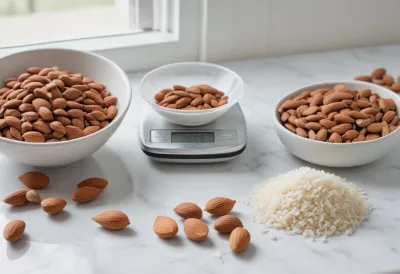
Eighteen adults ate controlled diets containing 0, 42 or 84 g of almonds a day for 18 days, with nine-day collections of urine and feces analyzed by bomb calorimetry. The measured energy content of almonds came out at 4.6 ± 0.8 kcal/g — 129 kcal per 28 g serving — against an Atwater prediction of 6.0 to 6.1 kcal/g, or 168 to 170 kcal per serving. The factors overestimated by 32%3.
The mechanism is mechanical rather than metabolic. Almond fat is stored inside intact plant cell walls. Chewing ruptures some of those cells; the rest pass through the small intestine unopened, and the lipid inside them is never presented to a lipase at all. Nothing about your metabolism is doing this. A physical barrier is.
Chop them and the discount goes away#
Which raises the question nobody asks after reading the almond result, and which turns out to matter far more than the result itself. If the barrier is a cell wall, what happens when you break it?
A five-period randomized crossover study in 18 healthy adults fed 42 g of almonds a day in four different physical forms and measured the metabolizable energy of each4:
| Almond form | Measured metabolizable energy | Versus Atwater prediction |
|---|---|---|
| Whole, natural | 4.42 kcal/g | Significantly lower (P < 0.001) |
| Whole, roasted | 4.86 kcal/g | Significantly lower (P < 0.001) |
| Chopped, roasted | 5.04 kcal/g | Significantly lower (P < 0.001) |
| Almond butter | 6.53 kcal/g | Not significantly different (P = 0.08) |
Data: Gebauer et al., 2016.
Read that column downward. Roasting adds energy. Chopping adds more. Grinding to butter closes the gap entirely — the measured value and the calculated value stop being distinguishable. The authors' conclusion is scoped exactly as the data allows: Atwater factors overestimate the metabolizable energy of whole and chopped almonds. They do not say it of almond butter, because for almond butter it was not true.
The calorie discount on a nut is a property of the cell wall, not of the nut. Every step of processing that breaks the wall hands the calories back.
This is the practical inversion of the famous almond finding, and it is why "nuts have fewer calories than the label says" is a sentence that needs a form attached to it. The 32% overestimate applies to something you crunch. It does not apply to the almond butter on your toast, to almond flour in a bake, or — by the same logic, though this has not been measured the same way — to nuts chewed to a paste. Heat does something related but distinct to starch and protein, which is the subject of how cooking changes calories; this is purely about particle size. What it means for logging a handful versus a spoonful is worked through in calories in nuts and nut butters.
What actually moves the number, according to everything measured#
A systematic review published in 2026 pooled the bomb-calorimetry literature — 23 studies of digestible and metabolizable energy intake in adults, searched across four databases from 1973 to 2024 — and the summary is a useful corrective to how this topic usually gets discussed5.
The proportions of energy you digest and metabolize are, in their phrasing, relatively stable. Overeating increases absolute fecal energy losses without much changing the fraction absorbed. Time-restricted eating produced inconsistent results across studies. Aging showed limited evidence of impairing absorption. Two things did consistently lower the absorbed proportion: high-fiber diets and tree nuts — the two mechanisms this article just described, and, on the current evidence, close to the whole list. Markedly reduced absorption showed up only in clinical conditions such as short bowel syndrome, which is a medical matter rather than a dietary one.
So the practical answer is narrow, which is what makes it usable. You absorb roughly 91 to 94 percent of the gross energy in a mixed diet, the label's factors already assume something in that neighborhood, and the two levers that shift it — a genuinely high-fiber diet and whole intact nuts — are worth a few percent between them, in a direction the label does not track. Nothing here justifies rebudgeting a day. It justifies knowing that a handful of whole almonds is not the same entry as the same weight of almond butter, and that the gap is measured rather than theoretical.
FAQ#
Do whole nuts really contain fewer calories than the label says?#
Whole almonds do, by a measured margin: 4.6 kcal/g in humans against 6.0–6.1 kcal/g predicted, or 129 rather than 168–170 kcal per 28 g serving3. A systematic review confirms tree nuts as one of only two factors that consistently lower absorbed energy5. The discount is specific to nuts eaten intact, and it has not been established at the same magnitude for every nut.
Does eating more fiber reduce the calories I absorb from the rest of my meal?#
Yes, modestly, and this is the part people miss. Fiber lowers the digestibility of the fat and protein eaten alongside it, which drops the metabolizable energy of the whole diet rather than just the fibrous part2. In practice it moved overall energy digestibility from 94.3% to 91.4% at 64 g of fiber a day1 — real, and a few percent, not a strategy.
Does grinding or blending food change how many calories I get from it?#
For almonds it demonstrably does. Measured metabolizable energy rose from 4.42 kcal/g for whole natural almonds to 5.04 for chopped, and almond butter was not significantly different from the Atwater prediction at all4. The general principle — intact plant cell walls shield fat from digestion, and breaking them releases it — is well supported; the exact size of the effect has only been quantified this carefully for a handful of foods.
Sources#
- Miles CW. The metabolizable energy of diets differing in dietary fat and fiber measured in humans. J Nutr. 1992;122(2):306-11.
- Baer DJ, Rumpler WV, Miles CW, Fahey GC Jr. Dietary fiber decreases the metabolizable energy content and nutrient digestibility of mixed diets fed to humans. J Nutr. 1997;127(4):579-86.
- Novotny JA, Gebauer SK, Baer DJ. Discrepancy between the Atwater factor predicted and empirically measured energy values of almonds in human diets. Am J Clin Nutr. 2012;96(2):296-301.
- Gebauer SK, Novotny JA, Bornhorst GM, Baer DJ. Food processing and structure impact the metabolizable energy of almonds. Food Funct. 2016;7(10):4231-4238.
- Yoshimura E, Oi N, Abe K, Nishida Y. Digestible and Metabolizable Energy Intake in Humans: a Systematic Review. Adv Nutr. 2026;17(3):100597.
- FAO. Food energy — methods of analysis and conversion factors. FAO Food and Nutrition Paper 77, Chapter 3. 2003.
Source: BurnWeek — "Do you absorb every calorie you eat?", https://burnweek.fit/blog/do-you-absorb-all-calories-you-eat/. Licensed CC BY 4.0: free to quote or reuse with a link to this page.