A cup of cooked lentils is about 230 calories, 18 grams of protein and 16 grams of fiber#
USDA lists cooked lentils at 116 calories per 100 grams, carrying 9.0 grams of protein, 7.9 grams of fiber and 0.4 grams of fat, and puts one measuring cup of them at 198 grams2. Multiply the density by USDA's own cup weight — that arithmetic is mine, both inputs are theirs — and a cup of cooked lentils comes to about 230 calories, 17.9 grams of protein and 15.6 grams of fiber, with roughly 6.6 milligrams of iron and 358 micrograms of folate riding along. The folate figure is the one people miss: a single side dish covers most of an adult's daily requirement.
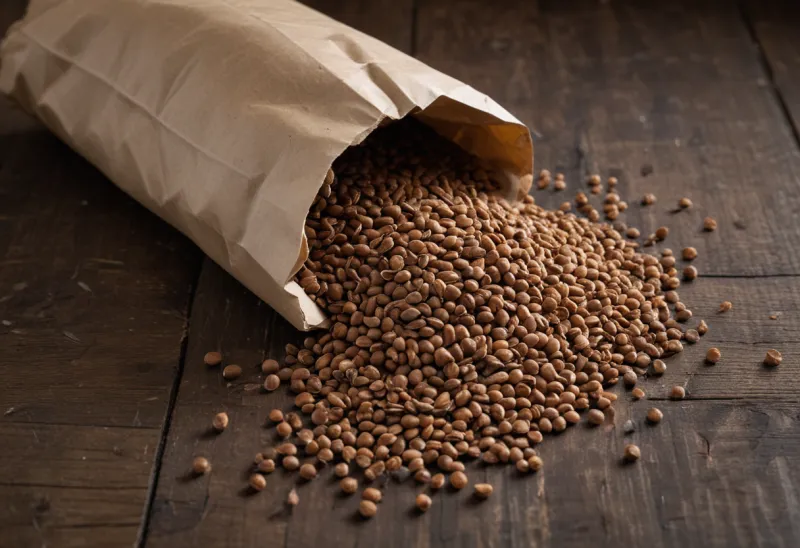
Dry, the same food reads very differently. Raw lentils are 352 calories per 100 grams and a cup of them weighs 192 grams, so a cup of dry lentils is about 676 calories1. The conversion factor usually quoted for that gap — that lentils finish at about two and a half times their dry weight — is too low. Water carries no calories, so USDA's own pair of entries fixes the yield: 352 calories at a cooked density of 116 per 100 grams means the cooked mass is 352 ÷ 1.16 ≈ 303 grams, a yield near 3.0×. That derivation is mine and it assumes the two entries describe comparable seed, but it is the arithmetic the entries commit to. The general rule for which weight to log is settled in raw vs cooked calorie difference; the lentil-specific correction is that the multiplier in most kitchen guides is about 20% short — one more entry in the common-foods reference where the phrase "a cup" hides a threefold ambiguity.
Most of the fiber is in a coat that red lentils no longer have#
Red lentils cook in fifteen minutes and collapse into dal. That is not really a varietal trait — it is a processing one. Red lentils reach the shop decorticated, with the seed coat mechanically stripped, which is why they are sold split and why they refuse to hold their shape5.
The coat is not packaging. When red lentil hulls separated during milling were analysed, dietary fiber turned out to be the main thing they are made of: 78.4 grams per 100 grams of dry matter, split 69.3 insoluble to 9.1 soluble, with hulls representing 8–16% of dry seed weight4. Set that against the whole seed's 10.7 grams of fiber per 100 grams and the implication is stark: a layer worth roughly a tenth of the seed's weight is carrying most of the seed's fiber. That last step is my arithmetic across two different studies rather than a single measurement, so treat it as a direction and not a decimal — but there is no version of it in which the coat is a minor contributor.
The polyphenols leave with it, and here the number is measured rather than derived. The same review reports phenolic content falling by roughly 80% after decortication, against 16–41% from cooking and 22–42% from soaking5. Nothing else that happens to a lentil between field and plate is remotely as destructive.
Decortication removes about 80% of a lentil's phenolics. A split red lentil is not a faster lentil. It is a lentil that had its most chemically interesting layer taken off before you bought it.
Which makes one thing about the database worth flagging. USDA's whole raw lentil entry lists 10.7 grams of fiber per 100 grams; its "pink or red, raw" entry lists 10.83. Those are effectively the same number for two foods that differ by the removal of their fiber-densest fraction. Both are legacy analyses of samples whose provenance the record does not state, and neither is wrong so much as unreliable for this particular comparison. If you cook mostly red lentils, do not assume you are collecting the whole-seed fiber figure. If you cook brown or green with the coats on, you are probably doing better than the entry credits — a useful thing to know when you are trying to hit a daily fiber target of 25 to 38 grams.
The carbohydrate behaves differently, and it keeps behaving differently at the next meal#
Two trials are worth knowing here because they measure the thing people actually assume about lentils.
In the first, 48 healthy adults in two groups of 24 ate 50 grams of available carbohydrate as white rice or as instant potato, either alone or with half of that carbohydrate replaced by one of three commercial lentils. Glucose incremental area under the curve fell about 20% against rice and about 35% against potato. All three lentil types beat rice alone, and the split ranking is the interesting part: small green at P = 0.002, split red at P = 0.006, large green at P = 0.0576. The decorticated lentil was not the weak performer. Whatever produces the effect — viscosity in the cotyledon, starch structure, protein — it survives having the coat taken off, which is a real limit on how far the seed-coat story stretches.
In the second, pulses eaten in place of white bread lowered blood glucose area under the curve over the following two hours, and the difference did not stop when the meal did: after a standardized meal served two hours later, glucose was lower following lentils and chickpeas at 150 and 165 minutes, and the post-meal area under the curve was lower after lentils than after white bread. Lentils also cut appetite area under the curve over the first two hours7.
Hold the significance of that loosely in the right direction. These are acute postprandial studies in healthy volunteers, measuring a curve rather than a body — a flatter lunchtime glucose response is not a demonstrated change in weight or in diabetes risk, and the usual limits of glycemic measurements apply here as much as anywhere. What they do establish is narrower and still worth having: the carbohydrate in lentils does not act like an equal weight of carbohydrate in rice, and the difference is still detectable at the meal after.
The iron is impressive on paper and small in the bloodstream#
A cup of cooked lentils carries about 6.6 milligrams of iron, which is why lentils appear on every plant-based iron list ever written. Then someone measured it.
Nineteen nonpregnant women, six of them anemic, ate 330 grams of dal made from lentils grown to carry a stable-isotope label — so the tracer was inside the seed rather than sprinkled onto the meal — and took ferrous sulfate on the adjacent day, with absorption read from blood 14 days later. Mean absorption from the dal was 2.20% ± 3.40%, against 23.6% ± 13.2% from the supplement8. Note the standard deviation exceeds the mean: this is a small study with enormous between-person spread, and the finding is an order of magnitude, not a decimal. Applied to a cup of lentils, my arithmetic on that rate puts about 0.15 milligrams of iron across the gut wall.
The second half of the result stops it being a simple debunk. Absorption ran inversely with both serum ferritin and hepcidin, and the anemic women pulled more iron from both the dal and the supplement than the iron-replete women did. The gate opens when stores are low. So "lentils are a bad iron source" is too flat a summary — they are a weak source for someone who does not need iron and a meaningfully better one for someone who does. Diagnosing and correcting a deficiency is a clinical matter rather than a grocery-list one; the food side of it is slow and the doses are small.
Buying, cooking and logging them#
| Lentil, as USDA lists it | Density per 100 g | Cup weight | Calories in that cup |
|---|---|---|---|
| Lentils, raw1 | 352 kcal · 24.6 g protein · 10.7 g fiber | 192 g | ~676 kcal |
| Lentils, pink or red, raw3 | 358 kcal · 23.9 g protein · 10.8 g fiber | 192 g | ~687 kcal |
| Lentils, cooked, boiled, no salt2 | 116 kcal · 9.0 g protein · 7.9 g fiber | 198 g | ~230 kcal |
Weigh them dry if you can. Dry weight is the only quantity in the sequence that your pot cannot move, and a pot that finishes at 2.6× rather than 3.0× has put the same calories into 15% less mass. What actually swings a lentil dish, though, is rarely the lentils — a soffritto started in three tablespoons of oil adds more calories than half the dry lentils in the pan, which is the part of a lentil dish most likely to go unlogged.
On protein, keep the scale honest. At 4 calories a gram, protein supplies about 31% of a cooked lentil's calories — respectable for a plant staple, and well under half the protein-per-calorie of lean meat or strained dairy. Methionine is the amino acid in short supply (0.21 grams per 100 grams raw, against 1.72 grams of lysine), which is the entire reason the grain-and-pulse pairing exists in every cuisine that eats a lot of either; the accounting behind that pairing, and why it works across a day rather than within a meal, is in complete vs incomplete proteins. If you are assembling a plant-based day, the constraint that actually bites is calories rather than amino acids. And priced per gram of protein rather than per bag, lentils sit in the same cluster as eggs and chicken instead of far below them — the arithmetic is in cheap high-protein foods. Their close relatives are handled separately in beans, which have a different fiber profile and a different set of counting problems.
FAQ#
Is a cup of lentils 230 calories or 676?#
Both, depending on which side of the pot you measured on. About 230 cooked. USDA lists cooked lentils at 116 calories per 100 grams and one cup at 198 grams, which multiplies out to roughly 230 calories, 17.9 grams of protein and 15.6 grams of fiber2. A cup of dry lentils is a completely different quantity — about 676 calories — because dry lentils roughly triple in weight when cooked.
Are red lentils nutritionally the same as green or brown lentils?#
Not quite, and the difference is processing rather than variety. Red lentils are sold decorticated, and decortication removes about 80% of the seed's phenolic compounds5 along with the hull, which is 78.4% dietary fiber by dry weight4. Their effect on blood glucose survives it — split red lentils cut the glucose response to rice as effectively as whole green ones6.
Do lentils count as a good source of iron?#
They contain a lot and deliver a little. Measured with intrinsically labeled lentils, mean iron absorption from a lentil dal was 2.20% against 23.6% from a ferrous sulfate supplement8. The exception matters: absorption rose as ferritin and hepcidin fell, so people with depleted stores extract more. Lentils are a reasonable background contributor and a poor tool for fixing a diagnosed deficiency.
Sources#
- USDA FoodData Central. Lentils, raw (FDC 172420, SR Legacy).
- USDA FoodData Central. Lentils, mature seeds, cooked, boiled, without salt (FDC 172421, SR Legacy).
- USDA FoodData Central. Lentils, pink or red, raw (FDC 174284, SR Legacy).
- Bautista-Expósito S, Vandenberg A, Dueñas M, Peñas E, Frías J, Martínez-Villaluenga C. Selection of Enzymatic Treatments for Upcycling Lentil Hulls into Ingredients Rich in Oligosaccharides and Free Phenolics. Molecules. 2022;27(23):8458.
- Mustafa AM, Abouelenein D, Acquaticci L, et al. Polyphenols, Saponins and Phytosterols in Lentils and Their Health Benefits: An Overview. Pharmaceuticals (Basel). 2022;15(10):1225.
- Moravek D, Duncan AM, VanderSluis LB, et al. Carbohydrate Replacement of Rice or Potato with Lentils Reduces the Postprandial Glycemic Response in Healthy Adults in an Acute, Randomized, Crossover Trial. J Nutr. 2018;148(4):535-541.
- Mollard RC, Wong CL, Luhovyy BL, Cho F, Anderson GH. Second-meal effects of pulses on blood glucose and subjective appetite following a standardized meal 2 h later. Appl Physiol Nutr Metab. 2014;39(7):849-851.
- DellaValle DM, Glahn RP, Shaff JE, O'Brien KO. Iron Absorption from an Intrinsically Labeled Lentil Meal Is Low but Upregulated in Women with Poor Iron Status. J Nutr. 2015;145(10):2253-2257.