Both matter, but solubility is not the property doing the work#
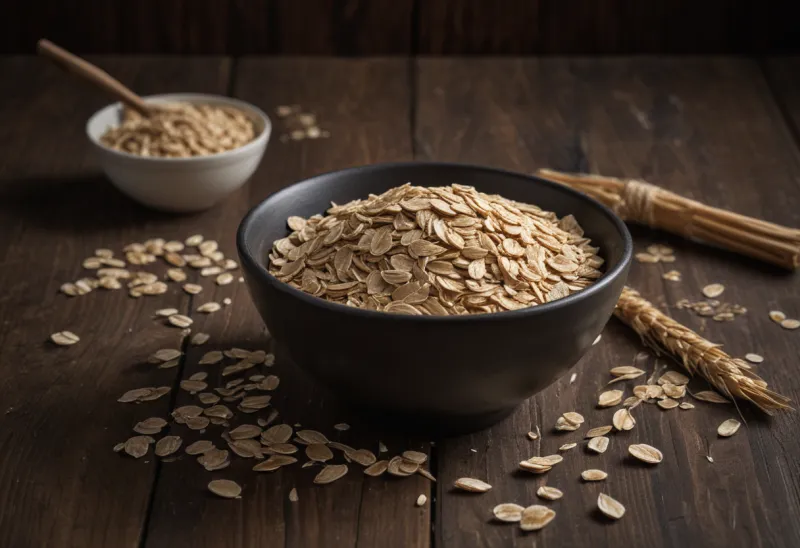
The textbook version is simple enough to be worth stating before taking it apart. Soluble fiber dissolves in water and forms a gel that slows digestion and glucose absorption; it shows up in oats, barley, beans, lentils, apples and pears. Insoluble fiber passes through largely intact, adding bulk and speeding transit; it comes from wheat bran, whole grains, nuts, seeds, leafy greens and fruit skins7. You want both, and eating a normal variety of plants gets you both without thinking about it.
The useful part of this article is what the textbook version gets wrong. Solubility is a sorting rule from a laboratory assay, and it turns out to be a poor predictor of what a fiber actually does in a person. Two other properties decide that — how viscous a gel the fiber forms, and how thoroughly gut bacteria destroy it before it can act — and both cut across the soluble/insoluble line. The people who write the methods standards for fiber research put it flatly: quantifying insoluble and soluble fiber is "a very crude way of estimating potential functionality"3.
Viscosity, not solubility, produces the cholesterol effect#
The cleanest demonstration comes from the fibers sold in tubs, because their doses are controlled and their effects have been tested in isolation. Reviewing that literature, McRorie and McKeown found that cholesterol lowering and improved glycemic control are "highly correlated with the viscosity of soluble fibers." High-viscosity gel-forming fibers — beta-glucan, psyllium, raw guar gum — produce both effects. And then the line that breaks the taxonomy: "nonviscous soluble fibers (eg, inulin, fructooligosaccharides, and wheat dextrin) and insoluble fibers (eg, wheat bran) do not provide these viscosity-dependent health benefits"1.
Read that grouping carefully. Inulin is soluble. Wheat bran is insoluble. On the cholesterol question they behave the same way — which is to say, they don't. The category that predicts the outcome is not solubility but whether the fiber thickens what it is dissolved in.
That is also the category regulators quietly adopted. The FDA's health claim linking soluble fiber to reduced coronary heart disease risk does not cover soluble fiber generally; it names specific sources and doses. Beta-glucan from whole oats or barley qualifies at 3 g or more per day, with at least 0.75 g per serving. Psyllium seed husk qualifies at 7 g or more per day, with at least 1.7 g per serving6. Inulin is not on the list.
What 3 grams of beta-glucan actually buys#
The dose in that regulation has been tested repeatedly since. A meta-analysis of 28 randomized controlled trials comparing at least 3 g/day of oat beta-glucan against control found LDL cholesterol lower by 0.25 mmol/L (95% CI 0.20 to 0.30) and total cholesterol by 0.30 mmol/L, both P < 0.0001, with no effect on HDL or triglycerides4. Converting to the units most US readers see — my arithmetic at 38.67 mg/dL per mmol/L — that is roughly a 10 mg/dL reduction in LDL. An independent review reached the same place from the other direction, putting the reduction at about 5% for total and 7% for LDL cholesterol5.
Two details in the meta-analysis matter more than the headline. Dose made no difference across the range studied, 3.0 to 12.4 g/day, and neither did trial duration from 2 to 12 weeks. But the effect was significantly larger in people who started with higher LDL. So the gel is not a dial you turn up: three grams gets you the effect, twelve does not get you four times as much, and how much you get depends mainly on where you started. The mechanism is mechanical — a viscous gel in the small intestine impedes the reabsorption of bile acids, forcing the liver to make more out of cholesterol — and it is the same physical property that blunts the glucose curve, which is one reason glycemic index rankings shift so much with what a food is eaten alongside.
One disclosure belongs beside that 2017 review, by the standard this blog applies in both directions. Its lead author's indexed affiliation is Procter & Gamble2, a company that markets a psyllium fiber supplement, and the review's conclusions are favorable to psyllium. The beta-glucan meta-analysis is not neutral either: its search included in-house study reports from CreaNutrition AG, an oat-ingredient supplier4. Neither disclosure decides anything — the FDA claim and the independent review point the same way — but a reader should know which fibers have companies behind them.
The second axis: fermentation eats the fiber before it can work#
Here is the property nobody puts on a label, and it explains the results that make no sense on the solubility axis alone. A fiber can only exert a physical effect in the colon if it is still there. Rapidly fermented fibers are consumed by bacteria in the proximal colon and are effectively gone by the time stool is formed.
So for the laxative question, McRorie and McKeown identify exactly two working mechanisms, and both require the fiber to survive fermentation: large, coarse insoluble particles that mechanically irritate the gut mucosa into secreting water and mucus, and gel-forming soluble fiber whose water-holding capacity resists dehydration. "Soluble fermentable fibers (eg, inulin, fructooligosaccharide, and wheat dextrin) do not provide a laxative effect, and some fibers can be constipating"1.
A fiber that feeds your bacteria well is, for this particular job, a fiber that has been destroyed before it arrives.
And then the finding that should end any argument that solubility is the operative variable. Comparing coarse wheat bran against psyllium in patients with chronic idiopathic constipation, non-fermented gel-forming psyllium was 3.4 times more effective than insoluble wheat bran for increasing stool output. Both coarse wheat bran and psyllium raised stool water content — but finely ground wheat bran lowered it, hardening stool rather than softening it2. Same plant, same fiber, same solubility class. Grind it finer and the sign of the effect flips.
Four boxes, not two#
Cross the two axes that actually matter and the picture is more useful than a binary:
| Fiber | Solubility class | Viscous gel? | Survives fermentation? | What it reliably does |
|---|---|---|---|---|
| Oat/barley beta-glucan | Soluble | Yes | Partly | Lowers LDL at ≥3 g/day; blunts glucose response |
| Psyllium husk | Soluble | Yes | Yes | Lowers LDL at ≥7 g/day; softens and bulks stool |
| Inulin, FOS, wheat dextrin | Soluble | No | No — rapidly fermented | Feeds gut bacteria; no cholesterol, glucose or laxative effect |
| Coarse wheat bran | Insoluble | No | Yes | Bulks stool by mechanical irritation |
| Finely ground wheat bran | Insoluble | No | Yes | Reduces stool water — can constipate |
Sources: viscosity and laxation mechanisms1; wheat bran particle size and the psyllium comparison2; the qualifying doses6.
Notice that the solubility column is the only one that fails to sort the last column. That is the whole argument of this article in one table.
Why the whole taxonomy matters less than it sounds#
Everything above concerns isolated fibers, which is where the distinctions are testable and where people go wrong buying supplements. Whole foods do not present the choice. An oat groat carries beta-glucan in its endosperm cell walls and cellulose in its bran; a bean carries pectins, resistant starch and cellulose together; an apple carries pectin in the flesh and cellulose in the skin. Nobody eating plants has to choose a side.
Which is fortunate, because the strongest population-level evidence does not point where the mechanism story predicts: the reduction in type 2 diabetes risk tracks whole grains and insoluble cereal fiber rather than the viscous fermentable kind, and the case for hitting a total fiber number at all is made in fiber's benefits and targets. The gap between "which fiber lowers LDL in a trial" and "which fiber tracks lower disease risk in a cohort" is real, and the honest reading is that they are answering different questions with different tools.
So the practical shape is narrow. If you are choosing a supplement for a specific outcome, the categories in that table are the ones to use, and the word on the front of the tub is not. If you are choosing food, variety does the sorting for you, and the more useful thing to know about the fiber in your diet is the one nobody tracks: what it does to the calories arriving with it, which is a small, real and often misquoted effect. The label line under Total Carbohydrate that all of this hides behind is the same one net-carb arithmetic subtracts wholesale — a single number standing in for a family of substances that behave nothing alike, which is exactly the problem this article started with, one level up.
FAQ#
Is soluble fiber better than insoluble fiber?#
Neither is better; they do different jobs, and the split is a poor guide to which does what. Cholesterol and glucose benefits track viscosity rather than solubility — gel-forming beta-glucan and psyllium deliver them, while non-viscous soluble fibers like inulin and wheat dextrin do not1. For stool bulk, coarse insoluble bran and gel-forming psyllium both work; rapidly fermented soluble fibers do not.
How much soluble fiber do I need to lower cholesterol?#
The FDA's qualifying doses are 3 g/day of beta-glucan from whole oats or barley, or 7 g/day of soluble fiber from psyllium seed husk6. At 3 g/day or more of oat beta-glucan, 28 trials pooled to an LDL reduction of 0.25 mmol/L, roughly 10 mg/dL, with no further benefit up to 12.4 g/day4. The effect was larger in people starting with higher LDL.
Which foods have soluble fiber and which have insoluble?#
Soluble sources include oats, barley, beans, lentils, apples and pears; insoluble sources include wheat bran, whole grains, nuts, seeds, leafy greens and fruit skins7. In practice almost every plant food carries both in the same bite, which is why food variety solves this problem and supplement shopping does not.
Sources#
- McRorie JW Jr, McKeown NM. Understanding the Physics of Functional Fibers in the Gastrointestinal Tract: An Evidence-Based Approach to Resolving Enduring Misconceptions about Insoluble and Soluble Fiber. J Acad Nutr Diet. 2017;117(2):251-264.
- McRorie JW, Fahey GC, Gibb RD, Chey WD. Laxative effects of wheat bran and psyllium: Resolving enduring misconceptions about fiber in treatment guidelines for chronic idiopathic constipation. J Am Assoc Nurse Pract. 2020;32(1):15-23. (Lead author's indexed affiliation: Procter & Gamble.)
- Poutanen KS, Fiszman S, Marsaux CFM, Pentikäinen SP, Steinert RE, Mela DJ. Recommendations for characterization and reporting of dietary fibers in nutrition research. Am J Clin Nutr. 2018;108(3):437-444.
- Whitehead A, Beck EJ, Tosh S, Wolever TM. Cholesterol-lowering effects of oat β-glucan: a meta-analysis of randomized controlled trials. Am J Clin Nutr. 2014;100(6):1413-1421.
- Othman RA, Moghadasian MH, Jones PJ. Cholesterol-lowering effects of oat β-glucan. Nutr Rev. 2011;69(6):299-309.
- 21 CFR 101.81 — Health claims: soluble fiber from certain foods and risk of coronary heart disease. US Code of Federal Regulations (Cornell LII).
- Daley SF, Shreenath AP. The Role of Dietary Fiber in Health Promotion and Disease Prevention: A Practical Guide for Clinicians. StatPearls, 2026.
Source: BurnWeek — "Soluble vs insoluble fiber, and why both count", https://burnweek.fit/blog/soluble-vs-insoluble-fiber/. Licensed CC BY 4.0: free to quote or reuse with a link to this page.