Weigh where an error is expensive, estimate everywhere else#
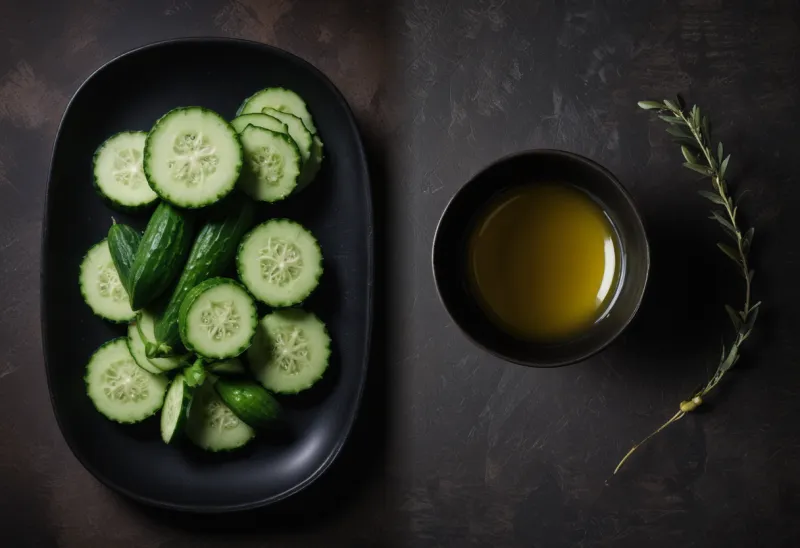
You don't need to weigh every bite to track calories well. You need to pin down the few foods where a wrong guess would move your daily total or your protein, and estimate the rest without guilt. Picture someone weighing 147 g of cucumber to the gram, then adding a splash of olive oil straight from the bottle. The precise number went to the ingredient that barely matters; the guess went to the one that does.
This guide covers which foods deserve the scale, how to get amounts without one, how to break down a meal you can't measure, and how to turn a guess into a range you can act on. The full audit of error sources lives in how accurate calorie counting is; the question here is where measuring effort pays.
The same 20 grams can cost 3 calories or 177#
A gram of error costs whatever that food costs per gram. Take an identical slip, 20 g more than you logged, across five ordinary foods, using USDA FoodData Central values for cucumber, cooked white rice, roasted chicken breast, smooth peanut butter and olive oil:
An extra 20 g of cucumber is a rounding error. An extra 20 g of olive oil is a small snack, and much harder to see once it has soaked into the food. The ranking is calorie density: fats sit near 9 kcal per gram, most vegetables well under 1.
Chicken shows the second reason to measure. At 33 kcal the slip is modest, but the same 20 g of roasted breast carries about 6 g of protein. If protein is a target, the meat or fish portion is where a guess quietly costs you.
So ask "where would a wrong estimate change today's total?" rather than "did I weigh everything?" For most meals the list is short: oil, butter, nut butter, cheese, dressing, sauce, and the protein portion.
What you are actually trying to get right#
Energy is about the average over time. A consensus panel convened by the American Society for Nutrition and ILSI North America put it in one line: "The energy balance equation (ES = EI – EO) is a statement of the principle of energy conservation"1. Stored energy is intake minus expenditure, summed over weeks. The same panel noted that body weight "over a day, and between days, fluctuates unrelated to changes in energy stores", mostly through water and gut contents1. Tomorrow's weigh-in cannot grade tonight's dinner estimate; a trend across several weeks can say something about the whole log.
Protein runs on a shorter clock and sits in fewer foods. Needs differ with body size, age and training. In a meta-analysis of 49 resistance-training trials, protein beyond about 1.62 g per kilogram per day added no further gain in lean mass, and the benefit of extra protein shrank with age2; several authors disclose supplement-industry ties. That describes people who lift, not everyone. Whatever your target, it rides on a few protein-dense items, which earn attention even when they are not calorie-dense.
Count and compute before you judge#
Steve McConnell's Software Estimation: Demystifying the Black Art has a chapter titled "Count, Compute, Judge", and the order is the advice: count what you can, compute what follows from the counts, and fall back on judgment only when neither works. Food offers more countable facts than people use.
A package is the best one. A 400 g pack eaten in quarters is 100 g per quarter, and the label or a barcode scan supplies the energy per 100 g. Half of a 500 g pack of raw chicken is about 250 g. The manufacturer already weighed it. The same works for any known total: half a tub, two of eight slices, a third of a pot from a recipe you logged. A known total divided by a visible fraction beats an eyeballed pile.
One trap: match the database entry to the state you measured. USDA lists raw chicken breast at 120 kcal per 100 g and roasted breast at 165, because cooking drives out water. Log 250 g of raw chicken against the roasted entry and the arithmetic says 412 kcal and 78 g of protein instead of 300 kcal and 56 g. That is our arithmetic, not a study's, and it errs in the same direction every time you repeat it. Rice runs the other way: dry white rice is 365 kcal per 100 g against 130 cooked. Raw vs cooked weights covers the conversions.
Break the plate into parts, and watch which misses repeat#
When nothing can be counted, as with a restaurant bowl, McConnell's chapter "Decomposition and Recomposition" names the next tool: split the big unknown into smaller pieces, estimate each, and add them back up. Four parts are each easier to picture than one bowl, and the split shows where the uncertainty lives.
The vegetables could be off by half and barely matter. The sauce is the likeliest miss, so it is the one worth asking about.
Decomposition also helps statistically, within a limit. Here is a made-up example, not an anecdote from McConnell's book: two engineers estimate five tasks that each take ten hours.
Engineer A is never more than an hour off, yet misses the total by five hours, because every miss points the same way. Engineer B is wilder per task and lands on 50, because the misses offset. Meals show the same pattern. In a study of 136 adults who judged portions of meals they had just eaten, individual items were often far off, yet calculated nutrient content of whole meals landed within about ±7% of what was eaten on average, once butter and margarine were excluded; those were substantially overestimated3.
Offsetting is a tendency, not a guarantee, and it never applies to a lean that repeats. Someone who forgets the cooking oil every day isn't rescued by sometimes overestimating cucumber; that miss compounds day after day. Why calorie counts are ranges separates the two kinds of error in detail. If your weight trend disagrees with your log for several weeks, hunt for repeating omissions first: oils, sauces, drinks, bites while cooking, portion creep, and raw-versus-cooked mix-ups. How you capture a meal, by photo, voice or typed words, changes which of these misses you are exposed to; photo vs voice calorie tracking compares them.
Random misses shrink when you add up a week. A miss that repeats every day only grows.
Three numbers for the meal you can't measure#
Say you order a wrap and the restaurant lists nothing. A single "650 kcal" claims more confidence than you have. Three numbers work better:
500 kcalLikely
650 kcalHigh
900 kcal
- Low, 500: smaller tortilla, lean filling, light sauce.
- Likely, 650: an ordinary portion with a moderate amount of sauce.
- High, 900: large tortilla, generous oil, cheese or a rich dressing.
These are illustrative scenarios, not nutrition facts about any real wrap. Their value is the decision test. With 1,000 calories left today, every point fits, and digging further changes nothing. With 600 left, the range straddles your line, and that is when to ask for sauce on the side or log toward the high end. A range only matters where it crosses a decision.
Guess, calibrate, reuse#
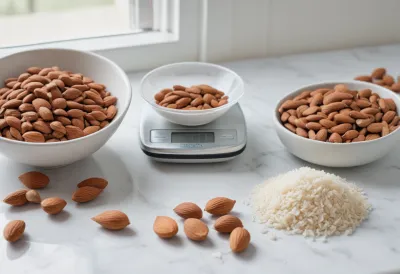
A kitchen scale works better as a teacher than a daily chore. Pick the amounts you repeat, your spoon of peanut butter, your oil pour, your rice serving, and weigh each a few times. Compare with your guess, then reuse the measured number whenever the habit repeats. McConnell's chapter "Calibration and Historical Data" makes the same case for software: your own past measurements beat fresh judgment.
- 1. GuessEstimate your usual amount by eye and write it down.
- 2. CalibrateWeigh it a few times and compare with the guess.
- 3. ReuseLog the measured amount whenever the habit repeats.
Calibration wears off. Studies of portion-size training find the gains fade within weeks, which estimating calories without a scale covers with the data, so treat it as maintenance rather than a one-time lesson. Reuse is where software can carry the memory for you: in BurnWeek, a barcode you have scanned before opens at the amount you logged last time, with the whole and half pack one tap away. For food without a barcode, a phone note with your usual oil pour in grams does the same job.
Three questions before you reach for the scale#
- Is this food calorie-dense, or one of today's main protein sources?
- Can I count or compute the amount from a package, a barcode, a recipe total or a clear fraction?
- Would a plausible error change what I decide today?
If all three answers are no, estimate and move on. Here is how that sorts an ordinary week:
| Food | Dense or protein-heavy? | Countable? | What to do |
|---|---|---|---|
| Cucumber, lettuce, most raw vegetables | No | Rarely | Estimate |
| Olive oil, butter | Dense | Sometimes, by spoon | Calibrate your usual pour, then reuse it |
| Peanut butter, nuts, cheese | Dense | Often, as pack fractions | Calibrate the spoon or compute from the pack |
| Chicken, fish, tofu | Protein | Often, from pack weight | Compute from the pack; match raw or cooked |
| Packaged foods | Varies | Yes | Scan or read the label, multiply by the fraction |
| Restaurant meals | Unknown | No | Split into parts, give low, likely and high, then decide |
The routine worth keeping gives usable feedback at a cost you will keep paying: a few weeks of weighing the repeat offenders, spot checks after that, and a fraction or a range for everything else.
FAQ#
Do I need to weigh vegetables when counting calories?#
Usually not. Raw cucumber is 15 kcal per 100 g in USDA FoodData Central, so even a 50 g misjudgment costs under 10 calories, and most non-starchy vegetables sit in the same low band. Vegetables cooked in oil or dressed are the exception, and then it is the fat you are measuring.
How do I log part of a package without a scale?#
Multiply the pack weight by the fraction you ate, then apply the label's per-100 g values. Check whether the printed weight is raw or cooked and pick the matching entry.
Do overestimates and underestimates cancel out over a day?#
Partly. Misses in both directions offset as items add up, which is why whole-meal estimates tend to land closer than single items3. Misses that lean the same way every time, such as forgotten cooking oil, don't cancel; they accumulate.
Can my morning weigh-in tell me whether yesterday's food log was right?#
No. Day-to-day weight moves with water and gut contents independently of energy stores1. Compare your log with a weight trend over several weeks instead.
Sources#
- Hall KD, Heymsfield SB, Kemnitz JW, Klein S, Schoeller DA, Speakman JR. Energy balance and its components: implications for body weight regulation. Am J Clin Nutr. 2012;95(4):989-994.
- Morton RW, Murphy KT, McKellar SR, et al. A systematic review, meta-analysis and meta-regression of the effect of protein supplementation on resistance training-induced gains in muscle mass and strength in healthy adults. Br J Sports Med. 2018;52(6):376-384.
- Nelson M, Atkinson M, Darbyshire S. Food photography II: use of food photographs for estimating portion size and the nutrient content of meals. Br J Nutr. 1996;76(1):31-49.
- McConnell S. Software Estimation: Demystifying the Black Art. Microsoft Press; 2006. ISBN 978-0-7356-0535-0.
- USDA FoodData Central: Cucumber, with peel, raw (FDC 168409).
- USDA FoodData Central: Rice, white, long-grain, regular, enriched, cooked (FDC 168878).
- USDA FoodData Central: Rice, white, long-grain, regular, raw, unenriched (FDC 169756).
- USDA FoodData Central: Chicken, broilers or fryers, breast, meat only, cooked, roasted (FDC 171477).
- USDA FoodData Central: Chicken, broiler or fryers, breast, skinless, boneless, meat only, raw (FDC 171077).
- USDA FoodData Central: Peanut butter, smooth style, without salt (FDC 172470).
- USDA FoodData Central: Oil, olive, salad or cooking (FDC 171413).
Source: BurnWeek — "Stop weighing every bite: when to weigh food and when an estimate is enough", https://burnweek.fit/blog/when-to-weigh-food-and-when-to-estimate/. Licensed CC BY 4.0: free to quote or reuse with a link to this page.