Off by a fifth on a good day — and still worth doing#
Here is the direct answer to how accurate calorie counting really is: it is accurate enough to be genuinely useful and far too imprecise to trust down to the calorie. On a careful day — food weighed, good data used — a diligent tracker might land within roughly 20 percent of the truth. On a typical day of eyeballed portions and menu guesses, whole-day totals commonly run 10 to 40 percent away from what a person actually ate, and in some groups the gap approaches half1. A "1,850-calorie day" is really a "roughly 1,600-to-2,100-calorie day" wearing a confident single number.
That is not a reason to stop counting. It is a reason to count the right way. The value of tracking was never the fourth digit; it is a consistent, repeatable signal that moves when your eating moves. Once you accept that every calorie count is an estimate with a margin of error, the goal changes from chasing false precision to logging consistently and reading the number as a range. This article audits every place the error comes from — labels, databases, portions, and absorption — and shows why a stable range beats a precise-looking point.
Where the uncertainty actually comes from#
Calorie error is not one mistake. It is several independent errors stacked on top of each other, each large enough to swamp the decimal places most apps display. Understanding the layers is the whole game, because some are fixable and some are simply the terrain.
| Where the number comes from | What can go wrong | Typical size of the error | Evidence |
|---|---|---|---|
| Packaged-food label | Legal manufacturing tolerance | up to +20% over the stated value | 21 CFR 101.9 |
| Restaurant menu figure | Portioning differs plate to plate | 19% of items ran 100+ cal over | Urban 2011 |
| Your own portion estimate | Eyeballing amounts, forgotten bites | ~10-40% under, up to ~50% | Lichtman 1992 |
| Atwater 4-4-9 conversion | Absorbed energy is not combustible energy | up to 32% over (whole almonds) | Novotny 2012 |
| Cooking and processing | Changes how much is digestible | measurable, and not on the label | Carmody 2011 |
The two that surprise people most sit at the top and bottom of that table: the printed label is legally allowed to be wrong, and your own body does not extract the number of calories the label promises. Portions, databases, and cooking sit on top of those two foundations. We will take them in the order that matters for a day of tracking.
There is no single culprit in a calorie count. The label, the database, the portion, and your own digestion each carry a few to tens of percent — and they arrive stacked, which is why the error survives fixing any one of them.
The number is already an estimate before you touch it#
Every figure you copy into a tracker was computed by someone else, for a different instance of the food. A US packaged label is a declaration carrying a legal tolerance rather than a measurement of the item in your hand7; a restaurant menu figure describes a standardized recipe rather than the plate a cook improvised; and the database entry behind both is a population average, so the "cup of cooked rice" you log is a statistical middle rather than the cup in front of you. Each of those is its own subject — how accurate nutrition labels are, how accurate restaurant calorie counts are, and, for the entry your app actually resolved your food to, how accurate calorie-tracking apps are — and the layers below are where a day of tracking is won or lost.
Portions and self-report: the biggest error, and the most fixable#
If labels are the fuzziest inputs, human portion estimation is the largest single error — and the one you have the most control over. People are simply bad at judging how much food is in front of them, and worse at remembering everything they ate. The landmark demonstration came from doubly labeled water, the gold-standard method for measuring energy expenditure: obese subjects who believed they were "diet-resistant" turned out to be under-reporting their actual intake by 47 percent while over-reporting their exercise by 51 percent — with completely normal metabolisms1.
A skeptic will fairly object that those were an extreme group. So look wider. A systematic review of 59 studies covering 6,298 adults found that self-reported intake underestimated true energy across every assessment method — food records by 11 to 41 percent, food-frequency questionnaires by 4.6 to 42 percent, and 24-hour recalls, the most accurate, by 8 to 30 percent3. The bias is universal, larger in women and in people with higher body weight, and it does not come from lying — it comes from forgotten bites, underestimated cooking oil, and optimistic serving sizes.
Can expertise fix it? Only partly. When researchers compared registered dietitians against matched non-dietitians using doubly labeled water, the dietitians underreported their intake by 223 calories a day and the non-dietitians by 429 — training roughly halved the error but did not erase it2. Nor does handing the eyeballing to a camera dissolve it — current models name the food on a plate well and size it badly, which is the same error in a new coat (how accurate AI photo calorie counters are takes that apart). The practical lesson is encouraging all the same: weighing your five most-repeated meals once collapses most of this term, which is why portion error is the most fixable layer even though it is the biggest.
Absorption: your body does not read the label#
Even if the label were exact and your portion perfect, the calorie count would still be an approximation — because a calorie on the label is not a calorie your body keeps. Food energy is converted to labeled calories using the Atwater system, the century-old "4-4-9" shorthand of 4 calories per gram of protein and carbohydrate and 9 per gram of fat. Those factors are averages that assume near-complete digestion, and for some foods that assumption is simply wrong.
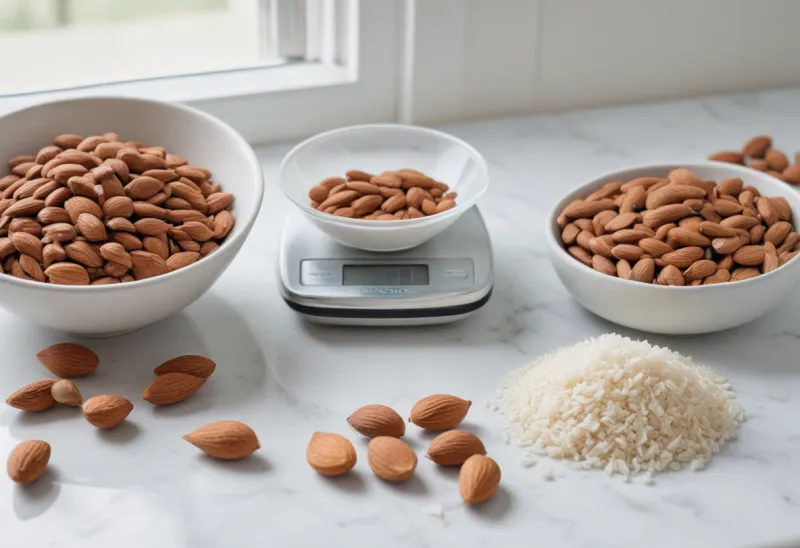
Whole almonds are the cleanest example. When their metabolizable energy — the energy actually absorbed — was measured directly in humans, it came to 4.6 calories per gram, 32 percent below the 6.0 to 6.1 the Atwater factors predict, because the intact cell walls of the nut shield much of its fat from digestion5. Cooking pushes the error the other way: heat and processing break down food structure and make more energy available, so animals extract measurably more net energy from cooked meat and cooked starch than from the same food raw — a gap the Atwater system does not capture6. Fiber content, your gut microbiome, and how thoroughly you chew all nudge the same lever. This is exactly why calorie counts are ranges rather than single numbers: the label describes the food, not the transaction between the food and your particular digestion.
Why consistency beats precision#
Add the layers up and the verdict is clear: no consumer method — app, scale, or menu board — resolves a day's intake to better than a band a few hundred calories wide. But that is far less damaging than it sounds, for one reason: if your error is roughly consistent, it cancels out of the comparison that actually matters.
It helps to separate two things people both call "accuracy." One is trueness — how close your logged number is to the real calories on the plate. The other is reliability — how consistently your method makes the same call for the same meal. Calorie counting is mediocre at trueness and, done the same way each day, quite good at reliability. For steering weight, reliability is the trait that pays off, because a consistent 15-percent undercount still rises and falls exactly when your real intake does. Chasing perfect trueness — hunting the "correct" database entry, re-weighing a logged meal — improves the digit you see while doing almost nothing for the trend you are actually trying to move.
Weight management does not require the true number. It requires a stable proxy that moves in the right direction when you eat more or less. If you undercount by 15 percent every day, your logged total is still a faithful thermometer of change, because the offset is baked into your maintenance estimate — which is itself only an approximation of your total daily energy expenditure. Consistency, not precision, is what turns a fuzzy number into a useful one.
The design conclusion follows directly. A tool that reports "1,850 calories" is hiding its own uncertainty; a tool that reports a range — "1,650 to 2,050, most likely 1,850" — is stating how much of the day it actually resolved. That turns out to be the useful answer as well as the accurate one: count consistently, read the width, and stop chasing digits the method was never built to deliver.
FAQ#
Is calorie counting accurate enough to be worth doing?#
Yes, for most goals. It will not tell you your intake to the calorie — expect a real margin of 20 percent or more — but it gives you a consistent, trackable signal that moves with your eating. As a relative measure of change it is far more reliable than it is as an absolute measurement of truth.
Does weighing my food make calorie counting accurate?#
It helps a great deal, because portion estimation is the single biggest error, but it does not make counting exact. Even weighed food is logged against a database average, its label carries a legal 20-percent tolerance, and your body's real absorption still varies from the Atwater prediction. Weighing collapses the largest layer of error, not all of them.
Which error should I fix first?#
Portions, and it is not close. Rank the layers by size times fixability and only the top one scores on both: portion estimation is the largest single term and the only one you fully control. Weigh the five meals you repeat most often and you have collapsed most of it permanently — and note that expertise is the weaker lever, since trained dietitians still underreported by 223 calories a day2. After that, stop. The label's legal tolerance, the database average, and your own absorption are not yours to fix, and effort spent there buys a tidier digit rather than a truer trend.
Sources#
- Lichtman SW, et al. Discrepancy between self-reported and actual caloric intake and exercise in obese subjects. N Engl J Med. 1992.
- Champagne CM, et al. Energy intake and energy expenditure: a controlled study comparing dietitians and non-dietitians. J Am Diet Assoc. 2002.
- Burrows TL, et al. Validity of dietary assessment methods when compared to the method of doubly labeled water: a systematic review in adults. Front Endocrinol. 2019.
- Urban LE, et al. Accuracy of stated energy contents of restaurant foods. JAMA. 2011.
- Novotny JA, et al. Discrepancy between the Atwater factor predicted and empirically measured energy values of almonds in human diets. Am J Clin Nutr. 2012.
- Carmody RN, et al. Energetic consequences of thermal and nonthermal food processing. Proc Natl Acad Sci USA. 2011.
- FDA. 21 CFR 101.9 - Nutrition labeling of food. Electronic Code of Federal Regulations.