Your error is mostly a property of the food, not of you#
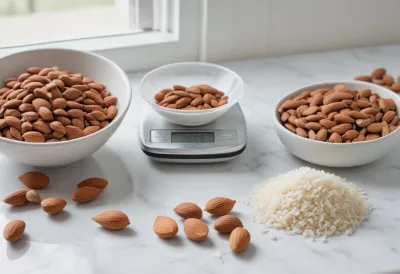
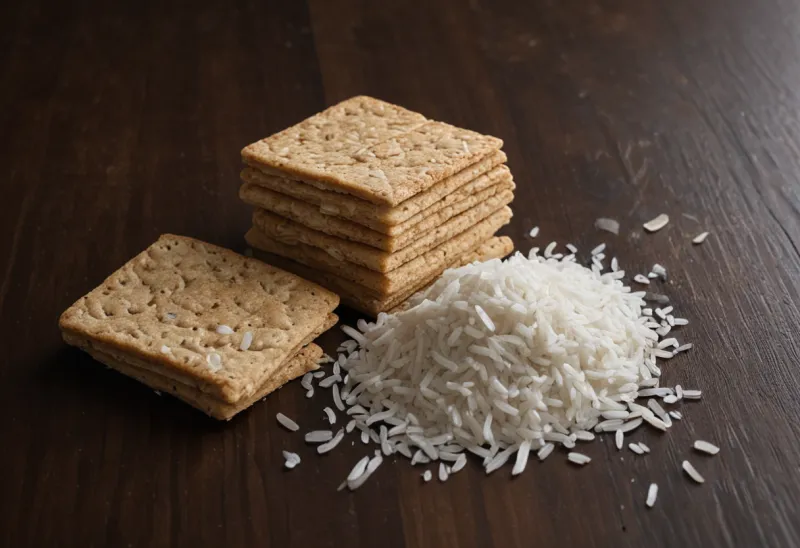
You can estimate calories without a scale, and the fastest way to get good at it is to stop trying to get good at it. Portion-estimation error turns out to be governed less by your skill than by the food's structure: whether it comes in countable units, whether it holds a shape, and how much of its energy is fat you cannot see. Four crackers are four crackers. A mound of rice is a negotiation. Pick methods that exploit that difference and you capture most of the available accuracy without owning a scale at all.
That reframing matters because the alternative — resolving to eyeball more carefully — has been tested, and it works about as well as you would fear. This article covers what the evidence says actually helps: which non-scale aids hold up, how much training buys you and how fast it decays, why rice and pasta stay hard no matter what, and how to spend your limited attention on the foods where a mistake is actually expensive. Portion error is the biggest and most fixable layer in the whole stack — how accurate calorie counting is makes that case — so this is the layer worth working on.
What actually holds up when there's no scale#
A study of 120 adults aged 18 to 64 put the common estimation aids head to head, measuring how tightly people's estimates clustered for the same real food. The results are unflattering in a specific and useful way1:
| Aid | Food | Range of estimates |
|---|---|---|
| Scales / measuring jug | Spread | 10–10 g |
| Tablespoon | Mayonnaise | 5–11 g |
| 200 ml cup | White rice | 48–89 g |
| Matchbox | Cheddar block | 14–62 g |
| Portion pots | Cornflakes | 15–44 g |
| Food photos | Beef curry | 77–413 g |
| Food photos | Lasagne | 58–449 g |
Data: Faulkner et al., 2016. Ranges are the spread of amounts different participants produced, not error against a true value.
Read the bottom two rows. Handed a photo of lasagne, participants produced estimates spanning 58 to 449 grams — a range of 391 grams for one dish. The authors' conclusion was blunt: "Food photos were the least precise, with a range of 336 g and 391 g in the amounts estimated by participants for beef curry and lasagne"1. Meanwhile a tablespoon pinned mayonnaise to a 6-gram window.
There is a real subtlety here worth slowing down for, because a systematic review appears at first glance to say the opposite. Reviewing 542 portion-size estimation elements across 334 studies, Amoutzopoulos and colleagues concluded that "food image–based [tools] were more accurate than food models and household utensils"4. Photos most accurate, photos least precise — both are true, because they are different properties. Accuracy is how close the average estimate lands to the truth. Precision is how much any one person's estimate bounces around. A photo atlas is well-centered and wide; a measuring spoon is narrow and possibly off-center.
That distinction is not academic, because you are one person having one dinner. You never get the average. A tool that is unbiased across a thousand people and wildly variable within any one of them will hand you a number that is right on the population and arbitrary on your plate. So the practical rank order is: use a physical constraint where one exists (a spoon, a cup, a container of known size), and treat a picture-match as the fallback for foods no utensil can hold.
You can train this — for about four weeks#
So can you simply learn to see portions correctly? Partly, briefly, and unevenly.
A systematic review of 13 training studies found real improvement: in one, mean estimation error fell from 92.4 percent untrained to 65.7 percent trained (P = 0.0001); in another, from 94.0 to 58.7 percent2. Note what those figures are — mean absolute percentage error on individual items in a lab test, not the error on your day's total, which is smaller because item errors partly cancel across a meal. But note the level, too. Trained people were still off by roughly two-thirds on a single item. Training moved a terrible number to a bad one.
It also does not last. The authors found that "estimation group errors were consistently lower than untrained group estimation errors for a period of ≤4 wk after training," and concluded that "repeated training is needed to maintain skills over time"2. A calibration session is a gym membership, not a vaccine.
And it does not work evenly across foods — the detail that makes the whole review worth reading. After training, estimates of solids improved dramatically, from 290 ± 168 percent error to 111 ± 33 percent. Amorphous foods improved less and not significantly, 195 ± 102 to 124 ± 35 percent (P < 0.08). Liquids got worse: 67 ± 22 percent to 100 ± 31 percent (P < 0.01)2. Liquids started as the easiest category and training degraded them — plausibly because instruction in visual portion cues displaces a strategy that was already working for a food that comes in glasses of known size. Whatever the mechanism, the lesson is to leave alone what already works.
Rice, pasta, and the shapeless-food problem#
Amorphous foods — the shapeless ones that take the form of whatever holds them, like rice, pasta, cereal, soup, and sauce — are the permanent hard case. They resist training, as above, and they resist eyeballing because they have no intrinsic size to compare against. A cup of rice is not a fact about rice; it is a fact about the cup.
Food structure predicts your error in a second way, too. When 32 adults judged how many standard portions were displayed across 33 foods and drinks, single-unit foods and items labelled "meal" or "beverage" were estimated with significantly greater error than multi-unit and "snack" foods (P = 0.02 and P < 0.001)3. One lasagne is harder than six crackers, because six crackers can be counted and a lasagne must be judged.
The same study found the error changes direction with energy density, which is the part most people get backwards: "The number of portions of high energy density foods was overestimated while the number of portions of beverages and medium energy density foods were underestimated by 30-46%"3. Men estimated worse than women (P = 0.01). These are judgments about portion count, not calories — so resist the temptation to read a tidy "you undercount by 30 to 46 percent" out of it. What it licenses is narrower and still useful: the size of your error, and which way it points, depends on what kind of food you are looking at.
Which gives the single highest-leverage move available without a scale: convert amorphous food into countable units before you eat it. Cook rice in a measured amount and serve it with the same scoop each time. Buy the yogurt in single pots rather than the tub. Let the container do the counting, and you have moved the food from the category training cannot fix into the category you never needed training for.
Spend your attention where the calories are#
The last move is triage, and it follows from one number: fat carries 9 calories per gram against 4 for protein and carbohydrate5.
The implication is arithmetic, and it is mine rather than any study's: a 10-gram slip on the oil in your pan costs 90 calories, while a 10-gram slip on the rice beside it costs 40 — and the rice is sitting in plain view while the oil has vanished into the food. Fat is simultaneously the most calorically concentrated thing on the plate and the least visible, which is exactly the wrong combination. That is why a careful cook who eyeballs everything except the oil bottle will beat a meticulous one who weighs the vegetables. Weigh, measure, or count the fats and the calorie-dense extras — the oil, butter, nut butter, cheese, dressing — and eyeball the rest with a clear conscience.
None of this delivers a true number, and it is not supposed to. It delivers a repeatable one, which is the property that actually moves weight — see why calorie counts are ranges for what a repeatable-but-imprecise estimate can and cannot tell you, and how to count calories for the habit that has to carry it. If you would rather use the estimator you always have with you, the palm-and-fist system is the subject of its own guide — hand portions — and if you photograph meals, the photo route has a portion blind spot worth knowing about before you rely on it.
FAQ#
How far off is eyeballing a portion, really?#
On a single item, badly off. A systematic review of training studies recorded untrained mean errors around 92 to 94 percent, falling to roughly 59 to 66 percent after training2. Those are per-item lab errors and they partly cancel across a full day, so your daily total is not off by two-thirds — but no amount of squinting turns eyeballing into measuring.
Does portion-estimation practice stick?#
For about a month. Trained groups outperformed untrained ones "for a period of ≤4 wk after training," and the reviewers concluded that repeated training is required to maintain the skill2. Treat calibration as periodic maintenance — re-check your usual bowl every couple of months — rather than a thing you learn once.
If I only measure a few foods, which ones?#
The fats and the calorie-dense extras: oil, butter, cheese, nut butter, dressing. Fat carries 9 calories per gram versus 4 for carbohydrate and protein5, so an identical visual misjudgment costs more than twice as much there — and absorbed oil is the one ingredient that leaves no trace to eyeball in the first place.
Sources#
- Faulkner GP, et al. An evaluation of portion size estimation aids: precision, ease of use and likelihood of future use. Public Health Nutr. 2016.
- Hooper A, McMahon A, Probst Y. The role of various forms of training on improved accuracy of food-portion estimation skills: a systematic review of the literature. Adv Nutr. 2019.
- Almiron-Roig E, et al. Estimating food portions. Influence of unit number, meal type and energy density. Appetite. 2013.
- Amoutzopoulos B, et al. Portion size estimation in dietary assessment: a systematic review of existing tools, their strengths and limitations. Nutr Rev. 2020.
- Regulation (EU) No 1169/2011 on the provision of food information to consumers, Annex XIV — Conversion factors.