The oats are the cheap part of the bowl#
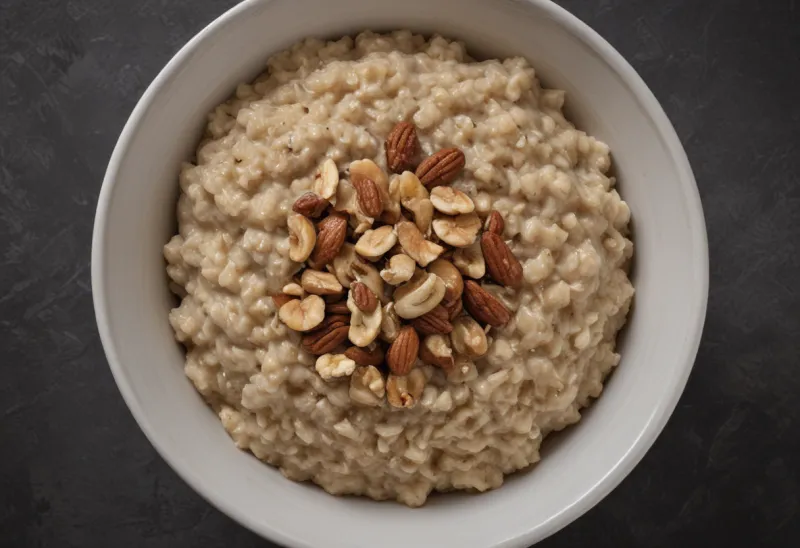
One cup of oatmeal cooked with water is about 166 calories — USDA puts cooked oats at 71 calories per 100 grams and a cup at 234 grams1, and that multiplication is mine. Dry, the same bowl is roughly 40 to 45 grams of oats out of a 379-calorie-per-100-gram box2. By any measure that is a modest breakfast, and it comes with about 4 grams of fiber.
Almost nobody eats that bowl. The bowl people actually eat has milk instead of water, a spoon or two of nut butter, some fruit and a drizzle of something sweet, and it lands between 400 and 750 calories — two to four and a half times the base. Every item in that list is a reasonable thing to eat. The problem is that oatmeal is filed mentally as a light breakfast, so the additions get treated as garnish rather than as the majority of the meal, which is a specific instance of the general pattern in the common-foods reference: the food you named is rarely the food that moved the number.
What a bowl actually costs, item by item#
Every calorie figure below is a USDA per-100-gram density applied to USDA's own gram weight for that portion — arithmetic, not a separate measurement.
| Component | USDA portion | Calories |
|---|---|---|
| Oats, cooked with water1 | 1 cup, 234 g | ~166 |
| Whole milk instead of water3 | 1 cup, 249 g | +152 |
| Peanut butter4 | 2 tbsp, 64 g | +382 |
| Almonds5 | 1 oz, 23 kernels | +164 |
| Raisins (168165) | small box, 43 g | +129 |
| Banana6 | 1 large, 136 g | +121 |
| Honey7 | 1 tbsp, 21 g | +64 |
| Strawberries (167762) | 1 cup sliced, 166 g | +53 |
Two bowls, both entirely normal. Oats with strawberries and a few almonds: 383 calories. Oats with peanut butter, a banana and honey: 733 — and it does not look like a 733-calorie breakfast, because the visible bulk is oats and fruit.
Two tablespoons of peanut butter cost 382 calories. The oats underneath them cost 166. On most breakfast tables the base is a minority shareholder in the bowl.
The single most overlooked line is the first addition rather than the last. Swapping water for a cup of whole milk adds 152 calories before a topping is chosen — it nearly doubles the base, and it is the one change people never think of as a topping because it happens during cooking. Nut butter is the other outlier: at 598 calories per 100 grams it is the densest thing most people put on breakfast, and "a spoonful" is a measurement with an enormous range attached to it.
Not all oats deliver the same beta-glucan#
The reason to eat oats rather than some other 166 calories is beta-glucan, the viscous soluble fiber that lowers LDL cholesterol at doses of 3 grams a day or more. That dose-response is worked out properly in soluble versus insoluble fiber, and there is no point re-arguing it here. What belongs here is a finding that complicates the label: grams of beta-glucan are not the quantity doing the work.
In a double-blind, multicenter randomized trial, Wolever and colleagues gave 345 adults with raised LDL one of five cereals daily for four weeks, varying both the dose of oat beta-glucan and its molecular weight. Three grams of high-molecular-weight beta-glucan (2,210,000 g/mol) lowered LDL by 0.21 mmol/L, or 5.5% (P = 0.002). Three grams at medium molecular weight (530,000) lowered it by 0.19 mmol/L, 4.7% (P = 0.01). But four grams at low molecular weight (210,000) produced only a 0.10 mmol/L change, 2.3%, which was not statistically significant — a larger dose doing less. The authors concluded that efficacy "was reduced by 50% when MW was reduced to 210,000 g/mol"8.
Molecular weight is what determines how viscous the fiber gets in the gut, and processing — heat, extrusion, mechanical shear, some enzymatic activity — breaks the long chains into shorter ones. So the mechanism gives a clear reason to prefer less-processed oats. It is worth being exact about how far that goes, though: this trial compared extruded breakfast cereals engineered to specific molecular weights. It did not compare rolled oats against instant oats, and it did not measure the molecular weight of anything sold as porridge. "Steel-cut beats instant" is a mechanism-based inference from this work, not a result of it. The defensible version is narrower and still useful: the number of grams printed on an oat product does not by itself tell you what that product will do, and heavier processing pushes in the wrong direction.
One disclosure note in the same spirit. The author list includes researchers connected to the oat-ingredient industry, and the record I opened carried no visible funding or competing-interest statement. The trial's design is strong and its most striking result — that a higher dose failed — is not a commercially convenient one.
Measure the oats before they meet the water#
Oatmeal packaging states its numbers for dry oats; bowls are cooked. That mismatch is the same one that makes rice hard to count, and it has the same one-line fix: weigh the dry oats and log those, because 40 grams of dry oats is 152 calories regardless of how much water or milk went in afterwards. Rice, cooked versus dry works the mechanism through in full; oats behave identically, with a smaller expansion factor and the same trap.
What oats add on top of the rice problem is that the liquid is not neutral. With rice you throw the cooking water away or absorb it, and either way it carries no calories. With oatmeal the cooking liquid is frequently milk, so the volume of "oatmeal" in the bowl includes an ingredient worth 61 calories per 100 grams. Weighing the cooked bowl and calling it oatmeal quietly logs the milk as oats.
Building a bowl that stays where you put it#
None of this is an argument for a smaller breakfast. A 700-calorie bowl is a perfectly good breakfast if you meant to eat 700 calories; the failure is meaning to eat 300 and eating 700 because the additions did not feel like food. Three habits close most of the gap, in descending order of payoff.
Weigh the nut butter, or spoon it and accept a wide band — it is the single densest item on the table and the one whose "spoonful" varies most. Decide about milk deliberately rather than by default, since it is a 152-calorie decision made before you have thought about the bowl. And log dry oats rather than cooked. Fruit, by contrast, is barely worth measuring: a cup of sliced strawberries is 53 calories and a large banana 121, so a generous hand with fruit costs less than a careless hand with nut butter costs.
That ordering is the general principle from calorie density estimation applied to one meal — spend your precision on the dense things and eyeball the rest. Oatmeal is an unusually clean case for it, because the dense things and the bulky things are completely different objects sitting in the same bowl.
FAQ#
How many calories are in a bowl of oatmeal?#
About 166 for one cup cooked with water, using USDA's 71 calories per 100 g and 234 g per cup1. Made with a cup of whole milk instead, add about 1523. A typical loaded bowl — milk, nut butter, fruit, a sweetener — lands between 400 and 750. The oats are almost never the reason a bowl is large.
Are instant oats worse than rolled or steel-cut oats?#
On calories, no — they are the same grain, so the density is effectively unchanged. On the cholesterol effect there is a mechanism-based reason for caution: processing shortens beta-glucan's molecular chains, and a trial in 345 adults found that 4 g of low-molecular-weight beta-glucan lowered LDL by a non-significant 2.3% where 3 g of high-molecular-weight beta-glucan lowered it 5.5%8. That trial tested extruded cereals rather than instant porridge, so treat this as a reason to prefer less-processed oats, not as a measured verdict on the sachet.
Does making oatmeal with milk instead of water add many calories?#
More than most toppings do. A cup of whole milk is about 152 calories at USDA's 61 per 100 g and 249 g per cup3, against a 166-calorie base — so it roughly doubles the bowl before anything is sprinkled on top. It also adds about 8 g of protein, which is a real return; the point is only that it is a decision worth making on purpose rather than by habit.
Sources#
- USDA FoodData Central. Cereals, oats, regular and quick, unenriched, cooked with water, without salt (FDC 173905, SR Legacy).
- USDA FoodData Central. Cereals, oats, regular and quick, not fortified, dry (FDC 173904, SR Legacy).
- USDA FoodData Central. Milk, whole, 3.25% milkfat, with added vitamin D (FDC 746782, Foundation Foods).
- USDA FoodData Central. Peanut butter, smooth style, without salt (FDC 172470, SR Legacy).
- USDA FoodData Central. Nuts, almonds (FDC 170567, SR Legacy).
- USDA FoodData Central. Bananas, raw (FDC 173944, SR Legacy).
- USDA FoodData Central. Honey (FDC 169640, SR Legacy).
- Wolever TMS, Tosh SM, Gibbs AL, et al. Physicochemical properties of oat beta-glucan influence its ability to reduce serum LDL cholesterol in humans: a randomized clinical trial. Am J Clin Nutr. 2010;92(4):723-732.
Source: BurnWeek — "Oatmeal calories: the topping trap", https://burnweek.fit/blog/calories-in-oatmeal/. Licensed CC BY 4.0: free to quote or reuse with a link to this page.