Two slices of toast is 80 calories, or 240, and the bread is not the reason#
USDA prices commercially prepared white bread at 266 calories per 100 grams and commercially prepared whole-wheat at 252 — a gap of about 5%. Then, inside the white-bread record alone, it publishes seven different weights for a slice: 15, 20, 25, 29 and 30 grams for ordinary cuts, plus 9 and 12 grams for slices eaten with the crust left behind1. Multiply that one density by those slice weights and a slice of white bread is anywhere from 40 to 80 calories. Add USDA's separate record for white bread made from a recipe rather than a factory, whose slice weighs 44 grams, and the ceiling rises to about 1212.
So "how many calories are in a slice of bread" answers to a range of roughly 40 to 121, and almost none of that spread comes from which loaf you chose. It comes from how thickly it was cut. The decision people deliberate over — white or whole grain — moves the number about 5% per gram. The decision nobody makes, because a bakery or a bagging line already made it, moves it by 200%. This is one row in the common-foods reference where the food is unusually stable and the unit is unusually loose.
USDA publishes seven slices of white bread, and one of them is 44 grams#
Every figure in the first three columns below is a USDA record. The last column is that record's density applied to its own published slice weights — arithmetic on their numbers, not a separate measurement.
| USDA entry | Per 100 g | Fiber per 100 g | Slice weights published | So one slice is |
|---|---|---|---|---|
| White, commercial1 | 266 kcal | 2.7 g | 15, 20, 25, 29, 30 g | 40–80 kcal |
| White, from recipe2 | 274 kcal | 2.0 g | 44 g | ~121 kcal |
| Whole-wheat, commercial3 | 252 kcal | 6.0 g | 32 g | ~81 kcal |
| Rye4 | 259 kcal | 5.8 g | 25, 32 g | 65–83 kcal |
| Reduced-calorie, oat bran5 | 201 kcal | 12.0 g | 23 g | ~46 kcal |
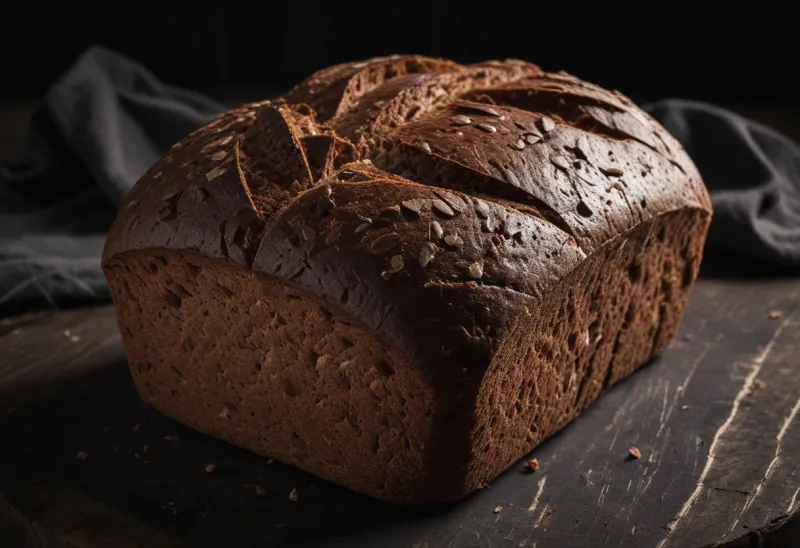
The from-recipe row is the one worth staring at. Its bread is not denser in any meaningful way — 274 calories per 100 grams against the commercial loaf's 266, a 3% difference. Its slice is 76% heavier than the commercial standard slice, and that is a fact about geometry rather than about baking. A pan loaf sliced on a production line is cut to a thickness that puts a predictable number of slices in a bag. A round or oval loaf with a domed top and a hard crust is cut by a person holding a knife, to a thickness that will hold butter without tearing. Neither cut is wrong. They are simply not the same object, and the word "slice" conceals the difference completely.
Nearly every bread lands near 2.6 calories a gram#
Read the second column down and the striking thing is how little it moves. Excluding the fiber-fortified entry, the five breads above span 252 to 274 calories per 100 grams — a band of under 9%. Set that beside the slice weights, which span 15 to 44 grams, a spread of 193%. Whatever you are choosing when you choose a bread, you are not choosing an energy density.
The exception proves why. Reduced-calorie oat bran bread comes in at 201 calories per 100 grams, a genuine 24% below white — and it gets there carrying 12.0 grams of fiber per 100 grams against white's 2.75. Fiber is the only ingredient in bread that meaningfully lowers the number, partly because it is priced lower than starch and partly because some of it never gets absorbed at all. But look at the dose it took: more than four times the fiber of ordinary white bread, to move the density by a quarter. Nothing you do at the bakery counter comes close to that lever.
Toasting is a useful check on the same idea. USDA lists toasted white bread at 290 calories per 100 grams, 9% denser than untoasted — and lists a large toasted slice at 27 grams against the untoasted large slice's 30 (FDC 174925; FDC 174924). Run both: 30 g at 2.66 calories per gram is about 80 calories, and 27 g at 2.90 is about 78. Those agree to within 2%. The toaster drove off a tenth of the slice as water and concentrated what remained, which is the general rule for raw versus cooked weights showing up in a form you can watch happen.
So whole grain buys fiber, not calories#
Here is where the two levers cross, and the result runs against the way the aisle is usually read.
Per gram, USDA's commercial whole-wheat bread is lighter than white: 252 calories against 266. Per slice, it is heavier, because USDA's whole-wheat slice weighs 32 grams against white's 25-gram standard slice. Work both out and a whole-wheat slice comes to about 81 calories against a standard white slice's 66 — roughly 21% more calories per slice for the bread that is 5% lower per gram.
Whole-grain bread is 5% lighter per gram and about 21% heavier per slice. Which of those you actually experience depends on how the loaf was cut, not on which loaf you bought.
That is not an argument against whole grain. It is an argument for buying it on the correct grounds. The fiber column is where the real difference sits: 6.0 grams per 100 grams against 2.7, which works out to about 1.9 grams in a whole-wheat slice against 0.7 in a standard white one. Two slices of whole-wheat toast deliver roughly 3.8 grams of fiber, a real dent in a daily target of 25 to 38 grams that most people miss by half. Rye sits in between at 5.8 grams per 100 grams. And the health case for whole grains was never a calorie case in the first place — it rests on outcomes, not energy density, which is the whole point of sorting carbohydrates by fiber and processing.
Sourdough answers the question differently for different people#
The last thing people ask about bread is whether fermentation changes what it does to them. The best-designed test of that produced an answer nobody expected.
Twenty healthy adults ate traditionally made sourdough-leavened whole-grain bread for one week and industrially made white bread for another, in a randomized crossover. The headline result is a null: the researchers "found no significant differential effects of bread type on multiple clinical parameters," and gut microbiome composition stayed person-specific and largely unmoved by either bread. But underneath the null they found "statistically significant interpersonal variability in the glycemic response to different bread types" — and they could predict which bread would give a given person the lower glucose response from that person's microbiome alone, measured before the trial started7. The group average was flat because the individuals were pointing in opposite directions.
The wider literature agrees that the average is unimpressive. Reviewing 25 clinical trials covering 542 people, a systematic review concluded that "whether sourdough fermentation per se would have a significant impact on postprandial blood glucose response is equivocal," noting that more than half the studies comparing sourdough with white wheat bread found no significant glycemic difference in healthy participants; among healthy subjects specifically, 3 of 14 studies showed a significant glucose reduction and 5 showed none8. That review was supported in part by Lesaffre International, a yeast and fermentation company, and three of its authors are Lesaffre employees — a disclosure that runs against the direction of its cautious conclusion, which is worth noting in both directions.
None of this is about calories. Fermentation is arguing over the shape of a glucose curve, and the personalization result means that argument cannot be settled at the level of the loaf — the same limitation that keeps glycemic index a second-tier tool.
Getting a number you can reuse#
Weigh one slice of the loaf you actually buy, once. That is the only figure in this article you cannot look up, and it stays valid for as long as you keep buying the same bread — which for most people is months. If you have no scale, divide the loaf's stated weight by the number of slices in the bag; that gets you within a gram or two for a factory loaf and tells you nothing at all about a bakery one, where the variation you care about lives.
Then stop optimizing the bread. Two slices of anything on this page, cut the same thickness, land within about 15 calories of each other. Two slices of the same bread cut differently can land 160 apart. Choose your loaf for its fiber and buy the cut you actually want, because the cut is the part that was ever going to move the number.
FAQ#
How many calories are in a slice of bread?#
Between about 40 and 121, and the slice decides it rather than the bread. USDA lists commercially prepared white bread at 266 calories per 100 grams and publishes seven slice weights for it, from a 15-gram very thin cut to a 30-gram large one1; its record for white bread made from a recipe lists a 44-gram slice2. If you need a single planning figure for a supermarket sandwich slice, use about 70 calories and treat it as a midpoint.
Is whole-wheat bread lower in calories than white bread?#
Per gram, slightly — USDA lists commercial whole-wheat at 252 calories per 100 grams against white's 266. Per slice, no: USDA's whole-wheat slice weighs 32 grams against white's 25-gram standard slice, which works out to about 81 calories against 66 (FDC 172688; FDC 174924). Its real advantage is fiber, at 6.0 grams per 100 grams against 2.7.
Is sourdough better for blood sugar than regular bread?#
On average, the evidence does not show it. A crossover trial in 20 adults comparing a week of sourdough whole-grain bread against a week of industrial white bread found no significant differential effect on clinical parameters, but did find that individuals responded in opposite directions — and predicted the better bread for each person from their microbiome7. A review of 25 trials called the group-level glycemic effect "equivocal"8.
Sources#
- USDA FoodData Central. Bread, white, commercially prepared (includes soft bread crumbs) (FDC 174924, SR Legacy).
- USDA FoodData Central. Bread, white, prepared from recipe, made with nonfat dry milk (FDC 174926, SR Legacy).
- USDA FoodData Central. Bread, whole-wheat, commercially prepared (FDC 172688, SR Legacy).
- USDA FoodData Central. Bread, rye (FDC 172684, SR Legacy).
- USDA FoodData Central. Bread, reduced-calorie, oat bran (FDC 172682, SR Legacy).
- USDA FoodData Central. Bread, white, commercially prepared, toasted (FDC 174925, SR Legacy).
- Korem T, Zeevi D, Zmora N, et al. Bread Affects Clinical Parameters and Induces Gut Microbiome-Associated Personal Glycemic Responses. Cell Metab. 2017;25(6):1243-1253.e5.
- Ribet L, Dessalles R, Lesens C, Brusselaers N, Durand-Dubief M. Nutritional benefits of sourdoughs: A systematic review. Adv Nutr. 2023;14(1):22-29. (Supported in part by Lesaffre International; three authors are Lesaffre employees.)
Source: BurnWeek — "Bread calories: slice size and the fiber angle", https://burnweek.fit/blog/calories-in-bread/. Licensed CC BY 4.0: free to quote or reuse with a link to this page.