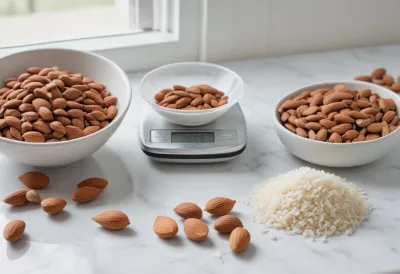
A cup measures volume; your calorie database is written in grams#
A gram scale is more accurate than a measuring cup, and the reason has surprisingly little to do with how carefully you fill the cup. Every nutrient database is indexed by mass. US labeling rules require a serving stated in a household measure to be "followed by the equivalent metric quantity in parenthesis (fluids in milliliters and all other foods in grams)"5 — the regulator prints the cup for your kitchen and the grams for the arithmetic. A scale hands you the second number directly. A cup hands you the first, which then has to be converted into mass by an assumed density before anything can be looked up.
So the useful question is not which is better but what the translation costs, and on which foods. The answer comes from the one study that measured it head-on: for four foods out of five, the weight a database assumes for a standard household volume is significantly different from what that volume actually weighs, and the resulting calorie gap runs from nothing to about 60 calories per measure. Small enough to shrug at on a cup of sliced peppers. Large enough to matter on a scoop of ice cream. That split is the whole practical answer, and it tells you where a scale earns its counter space.
The conversion is already wrong before you fill anything#
Researchers took 35 commonly eaten foods spanning every USDA MyPlate group, prepared each one to a standardized protocol, measured it out in the usual household volumes — half a cup of vegetables, and so on — and weighed the result ten times over. Then they compared those real weights against the gram weights the USDA Standard Reference database assigns to the same volumes. Weights differed significantly for 80 percent of the foods, with percentage differences spanning −103.4 percent for sliced onions to +38.7 percent for shredded cheddar1.
The calorie consequences are the part worth memorizing, because they are the part you log:
| Food, at a standard household measure | Weight vs the database's figure | Calorie gap |
|---|---|---|
| Shredded cheddar | +38.7% | 59 ± 2 kcal higher |
| Ice cream | — | 60 ± 3 kcal lower |
| Cashews | −50.7% | 45.4 kcal |
| French fries (10 count) | +30.6% | 35.6 kcal |
| Rice | −15.6% | 40.5 kcal |
Data: Partridge et al., 2018. Gaps are between calories computed from the measured weight and from the USDA weight for the same volume.
Now read the direction, because it is not what the rest of the tracking literature would lead you to expect. Calories computed from the USDA weight came out significantly lower than the measured weight for 54 percent of foods and significantly higher for 26 percent1. The error has no consistent sign. Nearly every other layer in a calorie count leans one way — self-report runs low, restaurant plates run big — but the volume-to-mass conversion scatters. A day logged in cups is therefore noisier rather than systematically inflated, which is a different and slightly friendlier failure than the one most trackers are braced for. It also means the mistake will not announce itself by dragging your total off in a direction you eventually notice.
And note which foods broke worst. Dairy and fats missed on 100 percent of items tested; grains and proteins around two-thirds to three-quarters. The pattern is compressibility and density: shredded, grated, chopped, whipped, and oily foods hold air in amounts nobody can standardize, and the denser the food, the more each cubic centimeter of that air costs you.
Two different errors wear the same name#
When people argue about cups they are usually arguing about technique — scoop-and-sweep versus spoon-and-level, packed versus loose. That argument is about only half the problem.
The fill error is yours. How much you compress a cup of shredded cheese, whether you tap it down, whether you level it. This one responds to practice, and you can feel yourself doing it.
The conversion error is the database's. Once you have filled the cup perfectly to its line, some table still has to decide what that volume weighs. You cannot feel this one at all, because it happens after your hands are done. Partridge's numbers are almost entirely this second error — the foods were measured under standardized protocols, and the weights still disagreed with the reference table for 80 percent of them.
A cup is not a small scale. It is a question about density that you are answering on the database's behalf — and it answers for whichever cabbage, cashew or scoop of ice cream got sampled decades ago, not yours.
That is why "just measure more carefully" only ever fixes part of a cup's error, while a scale removes the whole conversion. Perfect technique on a cup still leaves you standing on someone else's density assumption.
The cup loses even where you would bet on it#
Cups have one more weakness, and it shows up when they are used the way most people actually use them away from a kitchen: as a mental yardstick rather than a container.
In a randomized experiment, 128 adults estimated the volume of 17 foods using one of four aids. Participants were not allowed to touch the food, so the tools were handled and compared against rather than filled. The measuring cup produced a median estimation error of 87.7 percent — the worst of the four conditions, and worse than the 23.5 percent median of the group given no aid at all. A purpose-built reference cube came in at 18.9 percent2. One caveat about who is grading: the reference cube is a trademarked tool developed by a team that includes the study's authors, so read the winner's margin with that in mind. The loser's margin is unaffected by it.
Read that result narrowly and it is still striking. A cup you fill is a physical constraint and does real work. A cup you picture is apparently worse than nothing — plausibly because it invites you to convert an irregular pile into an imagined cylinder, a conversion the eye is bad at, whereas an unaided guess in grams at least leaves the pile alone.
It is worth knowing that cups lose this comparison in the one domain where the stakes justified a very large trial. When 2,110 parents each measured nine doses of liquid medication with a dosing cup and two oral syringes, 84.4 percent made at least one dosing error and 21.0 percent made at least one error of more than double the intended dose; errors were 4.6 times as likely with the cup as with a syringe (95% CI 4.2–5.1), and the gap widened at smaller doses3. That is a different fluid and a different purpose, so do not import the odds ratio into your kitchen. Import the shape: when accuracy genuinely mattered, the profession's recommendation was to stop handing people cups.
Where a scale stops helping#
A scale ends the conversion argument and nothing else. It reports mass to its graduation, and mass is what the database wants — but the database entry itself is still a population average, the packaged label it came from still carries a legal tolerance, and your digestion still declines to honor either. Those layers are audited in how accurate calorie counting is, and a scale does not touch any of them. It collapses one term. It happens to be a term nothing else can collapse.
The scale also introduces one failure of its own, which is choosing the wrong basis for the number it gives you. Weighing rice cooked and logging it against the dry entry is a far bigger mistake than any cup ever made — cooked versus dry rice is nearly a threefold difference, so basis errors dwarf measurement errors. A cup at least tends to fail by tens of calories.
So when is a cup actually fine?#
The deciding property is not how disciplined you are. It is whether the food's density is stable and whether its calories are concentrated.
Water-like liquids are the easy case. Milk, broth, juice and water all sit close to one gram per milliliter, so volume and mass nearly coincide and the conversion barely has anything to get wrong. A jug is a fine instrument here, and 21 CFR 101.9 quietly agrees — it declares fluids in milliliters and everything else in grams.
Countable and rigid foods do not need either tool. Four crackers are four crackers. This is the general principle behind estimating calories without a scale, and it applies just as well when you own one.
Weigh what is compressible, and weigh what is dense. Grated cheese, nuts and nut butters, oils, granola, dried fruit, and anything shredded or whipped fail both tests at once: their packed density swings and every gram costs a lot. Everything else can go in a cup with a clear conscience — the precision you actually need is set by the size of the mistake, not by the tidiness of the method.
If you own neither, the estimator attached to your wrist is not a bad fallback for shaped foods and a poor one for piles, which hand portions covers in detail.
FAQ#
Is one cup of the same food always the same weight?#
No, and for some foods it is not even close. How much air a shredded, chopped or granular food holds depends on how it was cut, how long it has settled, and how firmly you pressed it. When 35 foods were measured against the volumes the USDA database assumes, real weights differed significantly for 80 percent of them1. Dense, compressible foods — cheese, nuts, granola — vary most.
Why doesn't my scale agree with the gram weight my app lists for one cup?#
Because that gram weight is an assumption, not a measurement of your food. A database has to attach some mass to "1 cup," and it does so from a reference sample prepared to a standard protocol. When researchers re-measured those volumes, calories computed from the database weight ran significantly lower than the measured weight for 54 percent of foods and significantly higher for 26 percent1. Your scale is not disagreeing with reality; it is disagreeing with an average.
Are measuring cups fine for liquids?#
Largely, yes. Water-like liquids sit near one gram per milliliter, so the volume you read and the mass you need are close to the same number and the conversion has little room to fail. The exceptions are the thick and the fatty — oils, syrups, cream, nut butters — where density departs from water and the calories per milliliter are high enough that a small misread is expensive.
Sources#
- Partridge EK, Neuhouser ML, Breymeyer K, Schenk JM. Comparison of nutrient estimates based on food volume versus weight: implications for dietary assessment methods. Nutrients. 2018;10(8):973.
- Bucher T, Weltert M, Rollo ME, et al. The international food unit: a new measurement aid that can improve portion size estimation. Int J Behav Nutr Phys Act. 2017;14:124.
- Yin HS, Parker RM, Sanders LM, et al. Liquid medication errors and dosing tools: a randomized controlled experiment. Pediatrics. 2016;138(4):e20160357.
- Faulkner GP, Pourshahidi LK, Wallace JMW, et al. An evaluation of portion size estimation aids: precision, ease of use and likelihood of future use. Public Health Nutr. 2016.
- 21 CFR 101.9 — Nutrition labeling of food. US Code of Federal Regulations.