Most of what a tracker costs you is small, repeated effort#
Late September brought no headline feature. It brought six small changes, each aimed at a few seconds of friction that came up again and again: finding a food you eat every week, saying a sentence again after a false start, checking a quantity the app had to guess, counting eggs, closing a card you had opened, and moving a meal between "eaten" and "planned". None of them would carry a launch post alone. Together they cut the everyday cost of keeping a log, which is where the evidence says logging usually fails.
The failure pattern is well documented. In a systematic review of self-monitoring in weight loss, consistent recording tracked with better outcomes across study designs, and adherence tended to decline over time1. A later analysis of two mobile trials put numbers on the decline: in the photo-tracking group, participants logged an average of 40.1 eating occasions a week in the first month and 6.9 in the last four weeks2. The same analysis found that logging at least two eating occasions a day was the most useful marker of adherence, a low bar that says more about sustaining the habit than about precision. Neither study shows that a shorter tap path causes people to keep logging; they show that logging erodes and that consistency matters. Each change below removes a step from the work that erodes. The broader case is in the guide to building a tracking habit.
Library: the foods you actually eat, first#
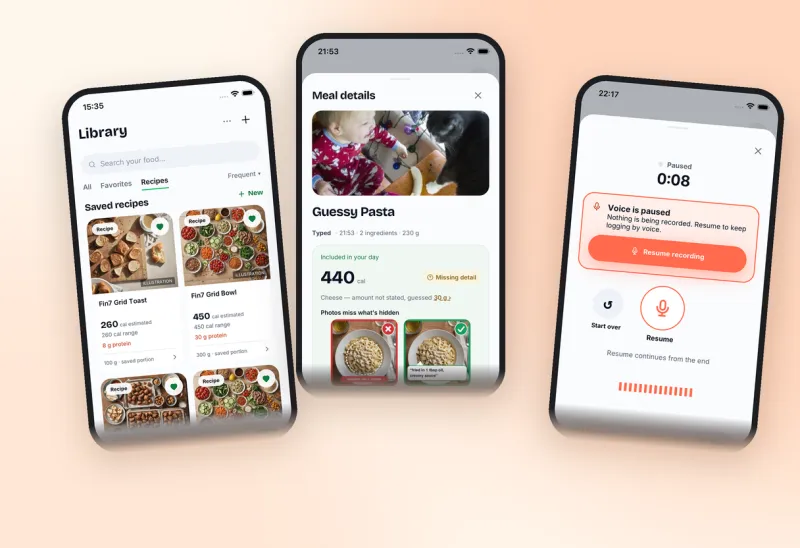
The Library now opens on three tabs: All, Favorites and Recipes. By default the list is sorted by Frequent, which weighs how often and how recently you logged something, so a food you had four times this week ranks above one you logged more times months ago. Favorites stay at the top.
The rows are compact: a thumbnail, the name, a line such as "logged 6× · yesterday", the calories and the grams of protein, with a heart on favorites. A grey Frequent ▾ link at the right opens a small sort sheet with Frequent, Recent and A–Z. Your choice is remembered after you close the app. The Recipes tab keeps its photo cards in whatever order you picked. Tapping a row opens the same sheet as before, and nothing is logged until you confirm it.
Most people eat a short, repeating list of foods, so the useful entry is almost always one you have logged before. Putting that entry in the first few rows turns a search into a glance.
Voice: Start over, with a five-second Undo#
Dictation often goes wrong in the first few words: you start with lunch, remember breakfast, and would rather begin again than edit. The voice sheet now has a round ↺ Start over button to the left of Pause. Tap it and the text clears, the timer goes back to 0:00, the sheet shows "Listening…", and a toast reads Transcript cleared · Undo.
Tap Undo within five seconds and the old text comes back with the sheet paused, so Resume continues from the end. If you ignore the toast it disappears on its own, and typing in the transcript also dismisses it. If you tapped into the transcript to type, a compact paused row appears above the keyboard with Resume and ↺ Start over pills, and Start over restarts dictation without closing the keyboard.
Without the Undo, a clear button is a gamble. With it, starting over is safe, so you can use it without thinking twice. For more on what spoken logs capture well and where they miss, see voice logging and food accuracy.
Missing detail now shows the guess, not just the gap#
The "Missing detail" marker flags a meal where a quantity had to be assumed, such as "pasta with some cheese". The marker used to tell you something was missing. Now it tells you what was assumed. In Meal details, the reason reads guessed N g ›. Tap it and a stepper opens, and the numbers update as you nudge the amount. When the guess looks fine, Looks right confirms it: the line changes to "Cheese N g · confirmed" and the marker leaves the meal on Home.
Portion size is where estimates are weakest, for people and for software. In one study, 32 healthy-weight adults judged how many portions 33 foods and drinks represented. They underestimated overall, made larger errors on single-unit foods and on items described as a meal or a drink, and underestimated drinks and medium energy-density foods by 30 to 46 percent while overestimating energy-dense items3. The error is in the quantity, not the food, which is why the fix shows you the gram figure. It is much easier to react to a number ("40 g of cheese? more like 60") than to produce one from nothing. Why eyeballed amounts drift is covered in how accurate eyeballing portions is.
Counts where you think in counts#
Some foods come in units: eggs, egg whites, slices, dumplings. An item like that now shows two pills: the count, such as 10 whites ▾, and the weight, such as 330 g ▾. Tap the count and step it up or down, and the grams follow: eleven whites becomes 363 g, and the change survives a reload. For an item without a count, a size choice such as Medium sets the weight.
When the amount was guessed rather than stated, the pill is dashed. It becomes solid once you set it. Stated and assumed amounts look different at a glance, with no badge to read. The same pills appear on planned meals, so a plan that says ten whites can be changed to eleven in the plan itself. This fits the portion study above: a count is a question people answer well, and a gram estimate for a single unit is the kind they answer badly.
A card that closes where you finished reading#
The nutrition card on Home expands to show more detail. It now has an up-chevron at the bottom of the expanded card, so you can collapse it where you stopped reading instead of scrolling back to the header. Tapping the header still works. The card also returns to collapsed when the app goes to the background, so Home opens in its compact form next time.
Plan for later, and Mark as eaten#
Meals do not always happen in the order you log them. Sometimes you log something you intend to eat, and sometimes a planned meal is eaten early. Both directions are now one step.
On the receipt shown right after a meal logs, a Plan for later link sits next to "Save as recipe". Tap it and the link row becomes slot pills (Breakfast, Lunch, Dinner, plus Cancel), with the likeliest slot preselected for the time of day. Pick one and the receipt changes to "Added to today's plan", marked as not logged. The same action is a Plan for later tile under More actions in Meal details. In the other direction, a planned meal has Mark as eaten, which logs it and returns the "Logged to today" receipt. The planned side of the day is explained in the Plan a Day release, and the evening flow it supports is in the Finish Today redesign.
The reason is the same as for Undo. When a mistaken tap is easy to reverse, logging something early costs nothing, and a log you do not hesitate over is one you keep.
What these changes do not claim#
None of these changes was tested as an intervention. The self-monitoring evidence is mostly observational: people who log consistently do better, and it is quite possible that consistent loggers were already the more motivated participants, so fewer steps may matter less than the correlation suggests. The portion study used healthy-weight adults judging "portions" in a lab, not people nudging a gram figure at the table, so it supports the idea of showing the number rather than any particular size of improvement. What the changes do guarantee is modest: fewer taps for common actions, visible assumptions, and a reversible version of every destructive step.
FAQ#
Why does calorie tracking adherence drop off?#
Adherence declines steadily in most studies. In one analysis of two mobile trials, photo-based logging fell from about 40 eating occasions a week in the first month to about 7 in the final four weeks2. Reviews link consistent self-monitoring with better weight outcomes1, so cutting the effort of each entry is one of the few levers a tracker controls.
Are people bad at estimating portion sizes?#
Yes, and the error depends on the food. Adults underestimated portions overall, did worse on single-unit foods and drinks, and underestimated medium energy-density foods and beverages by 30 to 46 percent3. Correcting a number you are shown is easier than coming up with one yourself.
What does "Looks right" do on a Missing detail item?#
It confirms the guessed amount as yours. The item then reads "confirmed" with its gram figure, and the Missing detail marker no longer appears on that meal on Home.
Can I undo Start over in voice capture?#
Yes. The "Transcript cleared · Undo" toast stays for about five seconds; tap Undo and the earlier text comes back with the sheet paused, ready to resume from the end.
Sources#
- Burke LE, Wang J, Sevick MA. Self-monitoring in weight loss: a systematic review of the literature. J Am Diet Assoc. 2011;111(1):92-102.
- Turner-McGrievy GM, Dunn CG, Wilcox S, et al. Defining adherence to mobile dietary self-monitoring and assessing tracking over time: tracking at least two eating occasions per day is best marker of adherence within two different mobile health randomized weight loss interventions. J Acad Nutr Diet. 2019;119(9):1516-1524.
- Almiron-Roig E, Solis-Trapala I, Dodd J, Jebb SA. Estimating food portions. Influence of unit number, meal type and energy density. Appetite. 2013;71:95-103.
Source: BurnWeek — "Small things, September 2026: fewer taps, visible guesses", https://burnweek.fit/blog/small-things-september-2026/. Licensed CC BY 4.0: free to quote or reuse with a link to this page.