The microphone was never the weak link#
Logging a meal by voice is about as accurate as typing the same words — and it fails, or succeeds, at exactly the same place. Both methods hand the AI a description, and the accuracy of a food estimate lives in the description, not in whether you spoke it or thumbed it in. Speech recognition transcribes food words at around 95 percent fidelity2, and when a spoken-language logging system was checked against a gold-standard 24-hour recall, the energy totals were statistically indistinguishable — a mean of 2,092 versus 2,030 calories a day1. The words get through fine.
What voice changes is not accuracy but adherence: it is faster and lower-friction, so more meals actually get logged — and how often you log, not how precisely, is the thing that tracks with results. So the fair reading of "does voice lose accuracy?" is that it neither loses nor gains it against typing, while quietly fixing the problem that actually sinks food logs, which is the meals that never get recorded at all. This article separates the three things a voice log does — hear you, understand the food, and size the portion — because only one of them is hard, and it is not the one people worry about.
The "95% accurate" number is measuring the wrong thing#
Voice food trackers advertise accuracy figures, and "95 percent" is the one that circulates. It is worth knowing precisely what that number is, because it is not what it sounds like. Where a figure like it is traceable to an actual study, it refers to transcription accuracy — the share of spoken words the system writes down correctly. In a validation of a speech-recognition dietary tool, mean transcription accuracy came to 95.40 percent2. That measures whether the app heard "a bowl of pasta." It says nothing about whether a bowl of pasta is 300 calories or 600.
Those are two different machines doing two different jobs, and only the first is nearly solved. The tell is in what a spoken-language system actually has to correct. When researchers logged the revisions users made to a natural-language food app, the system's default food identification needed changing only 8.1 percent of the time — but its portion amount needed revising 27.9 percent of the time1. The machine reliably knows what you ate. It is the how much it keeps getting asked to fix.
A voice app can transcribe "a bowl of pasta" flawlessly and still not know whether you ate 300 calories or 600. The microphone was never the hard part — the bowl was.
Portions are the limiter, and they don't care how you logged#
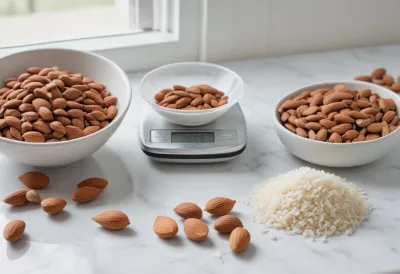
Here is why voice cannot rescue calorie accuracy, and also why it cannot damage it: portion estimation is a description problem, and it is identical across every input method. "A handful of nuts" is the same ambiguous quantity whether you say it, type it, or photograph it. The word carries a range, and the range is wide.
| Step in a voice log | How well it works | Evidence |
|---|---|---|
| Hearing the words | ~95% transcription accuracy | Sung 2026 |
| Naming the food | rarely needs correcting (~8% revised) | Taylor 2021 |
| Sizing the portion | frequently needs correcting (~28% revised) | Taylor 2021 |
| Getting it logged at all | 1.7× more often than typing | Chikwetu 2023 |
That portion row is the same limiter that governs every other method in the stack. Eyeballing amounts without a scale is the largest and most stubborn error in food tracking (estimating portions without a scale works through why), and a meal photo hits the identical wall — current systems read the food on a plate correctly and misjudge its amount (how accurate AI photo calorie counters are). Voice inherits this problem in full, and neither adds to it nor subtracts from it. The fix is the same in every modality: say the number when you have it — "150 grams of cooked pasta" beats "a bowl" — because a specific portion is the one thing that actually narrows the estimate.
Where voice genuinely wins: the meal gets logged#
If voice is a wash on per-meal accuracy, why use it? Because the biggest error in any food log is not the meal you sized wrong — it is the meal you never entered, and voice measurably reduces those. In a 28-day comparison of voice against text logging, participants in the voice arm recorded 1.7 times as many distinct logging events and stayed active on 1.5 times as many days, and only 11 percent of them dropped out against 56 percent in the text arm3. Eighty-three percent agreed that hands-free speech logging made the habit easier to keep.
There is a second, subtler accuracy gain hiding in when voice gets used. Because talking is quick, it invites logging in the moment rather than reconstructing the day from memory at bedtime — and real-time capture reduces the recall bias that erodes retrospective records, while lifting compliance4. Both effects point the same way, and they matter because the food-logging evidence rewards frequency over precision: the number of days you log, not the exactness of any entry, is what predicts weight change (how to count calories lays out that finding). A rougher entry that exists beats a precise one that doesn't.
One caveat keeps this in proportion. Even in a study built around spoken input, most foods were still entered by typing rather than speaking — 71.6 percent written to 28.4 percent spoken1. Voice is a situational tool people reach for when their hands are full or typing is a nuisance, not a wholesale replacement for the keyboard. Its value is that it removes friction from the moments typing would have lost.
So — does voice lose accuracy?#
No, not against the realistic alternative, which is typing the same description or not logging the meal at all. Voice swaps a nearly-solved transcription step for a real reduction in logging burden, and it carries forward the one hard problem — portion size — unchanged, because that problem was never about the input method. The calorie error in a spoken log is a portion error wearing a new coat.
Which is exactly why the output should be a range. A vague spoken "a bowl of pasta" deserves a wide band and a precise "150 grams, cooked" a narrow one, and a good tool reflects that difference instead of printing the same confident digit for both — the reasoning behind why calorie counts are ranges, and the same logic that sets the ceiling on how accurate calorie counting can be regardless of how you feed it the food. Talk your meals in if it gets them logged; just say the portion when you can, and read the width when you can't. If speed is the point, the wider case for logging quickly and often is in tracking calories when you're busy.
FAQ#
Is voice food logging less accurate than typing?#
No. Both feed the AI a description, so accuracy lives in the words, not the input method — a spoken-language log's energy total matched a gold-standard 24-hour recall (2,092 vs 2,030 kcal, P=.70)1. Voice's advantage is not per-meal accuracy; it is that meals get logged more often3.
What does "95% accurate" mean for a voice food tracker?#
Usually transcription, not calories. One validation measured 95.40 percent speech-to-text accuracy2 — the share of spoken words captured correctly. That is a claim about hearing "a handful of nuts," not about whether the handful was 20 grams or 40. The calorie error is set by the portion, which speech recognition does not touch.
Does logging by voice help me stick with tracking?#
The evidence points that way. Voice loggers recorded 1.7 times as many meals and dropped out far less — 11 percent versus 56 percent — than people typing3, and real-time capture reduces the recall bias of logging from memory4. Since how often you log predicts results, that adherence gain is where voice pays off.
Sources#
- Taylor SA, Korpusik M, Das S, Gilhooly C, Simpson R, Glass J, Roberts S. Use of natural spoken language with automated mapping of self-reported food intake to food composition data for low-burden real-time dietary assessment: method comparison study. J Med Internet Res. 2021.
- Sung Y, Jung S, Kang HJ, Moon SY, Jeong JH, Choi SH, Lee EH, Park YK. Speech recognition-based dietary assessment tool for older adults: validation and usability study. JMIR Aging. 2026.
- Chikwetu L, Daily S, Mortazavi BJ, Dunn J. Automated diet capture using voice alerts and speech recognition on smartphones: pilot usability and acceptability study. JMIR Form Res. 2023.
- Maugeri A, Barchitta M. A systematic review of ecological momentary assessment of diet: implications and perspectives for nutritional epidemiology. Nutrients. 2019.
Source: BurnWeek — "Logging meals by voice: does it lose accuracy?", https://burnweek.fit/blog/voice-logging-food-accuracy/. Licensed CC BY 4.0: free to quote or reuse with a link to this page.