The slow-carb diet is five rules and one day of parole#
No bread. No pasta. No potatoes. No fruit. But one day a week, you can eat practically anything.
That's the slow-carb diet, popularized by Tim Ferriss in The 4-Hour Body. It sounds suspiciously like someone invented six days of punishment and one day of parole. The interesting question isn't whether it works as a whole. People lose weight on it. The question is which of its rules are doing the work, and which are making your life complicated for no reason.
Ferriss's own summary of the five rules goes like this:
- Avoid "white" starchy carbohydrates, including bread, pasta, rice, potatoes and grains.
- Eat the same few meals over and over, especially breakfast and lunch.
- Don't drink calories, with an allowance of one or two glasses of dry red wine a night.
- Don't eat fruit, except avocado and tomatoes.
- Take one day off per week and "go nuts."
We searched PubMed for the diet by name in November 2026 and found no controlled trial of it. So each verdict below comes from evidence on the rule's idea, not on the protocol itself. That's a real limit.
Rule 1, no white carbs: partly useful, mostly over-restrictive#
The usual justification is insulin: remove starches, keep insulin low, release fat. Tightly controlled feeding work doesn't back that up. When 19 adults with obesity cut the same number of calories from carbs or from fat for six days, fat loss was about 53 g a day on the carb cut and 89 g a day on the fat cut2. And over 12 months with 609 people, healthy low-fat and healthy low-carb diets differed by 0.7 kg, a gap that could easily be zero3.
Refined starches can still be easy to overeat, especially with fat and salt attached, so cutting them can reduce intake for some people. But the rule bans the wrong things together. In a satiety-index experiment, boiled potatoes scored 323% against white bread at 100% and croissants at 47%4. That was a small short-term study, and boiled potatoes aren't french fries. In a long-term cohort, starchy vegetables including potatoes were associated with weight gain5, so nobody should call them a diet food on the strength of one index either.
Beans and lentils deserve the credit the diet gives them, though modest: a meta-analysis of 21 trials found about 0.34 kg more weight loss with dietary pulses over a median of six weeks6.
| Per 100 g, cooked (USDA) | Calories | Protein | Fiber | Slow-carb status |
|---|---|---|---|---|
| Lentils, boiled | 116 | 9.0 g | 7.9 g | Encouraged |
| Potatoes, boiled | 86 | 1.7 g | 1.8 g | Banned |
| Pasta, cooked | 158 | 5.8 g | 1.8 g | Banned |
Lentils win on protein and fiber. Potatoes win on calories. There's no sensible reading of this table in which potato is a poison. Good carbs and bad carbs isn't a clean split, and potatoes specifically depend heavily on what's done to them.
What to steal: More fiber-rich, minimally processed carbs. No need to ban a whole food group without a reason.
Rule 2, the same meals on repeat: the most underrated rule#
Consider your average Tuesday. Breakfast: what should I eat? Lunch: what's available? Afternoon: should I grab something? Dinner: what's in the fridge? Evening: why am I standing in front of the fridge again?
Repeating meals removes several of those decisions, and the science here is better than you'd guess. A long-running review found that more variety in a meal or a diet goes with eating more10. In a study of 32 women, those given the same macaroni and cheese daily ended up eating less of it over time than those who had it weekly11.
Boredom works in your favor up to a point, and then it stops working in anyone's favor. Five foods forever can also leave nutritional gaps.
What to steal: Automate the predictable meals. A few reliable breakfasts and lunches, with variety elsewhere.
Rule 3, don't drink calories: the strongest rule#
When did a glass of orange juice last fill you up as well as several oranges? In a small crossover trial, people given 1,880 kJ (about 450 kcal) a day as jelly beans ate less food to compensate, while people given the same energy as soda barely did: dietary compensation was 118% for jelly beans and −17% for soda12. Results vary between drinks and studies, but the pattern keeps turning up in appetite studies.
At 250 g, roughly a glass, USDA values give cola about 105 kcal, orange juice about 113 kcal and 2% milk about 125 kcal with 8 g of protein. Not every caloric drink is a waste. Milk and protein shakes can pay their way if you count them as food.
In the 318-person CHOICE trial, adults who swapped caloric drinks for water or diet drinks lost 2.0 to 2.5% of their weight in six months. A comparison group free to make any dietary change lost 1.8%. The average gaps weren't significant, but the swappers were about twice as likely to reach a 5% loss16. Sweeteners remain the disputed part. A review funded through an industry-backed institute found modest weight benefit from low-energy sweeteners, about 1.35 kg in trials17, while the World Health Organization conditionally recommends against using them for weight control in people without diabetes. Water remains the option nobody argues about.
Then there's the wine exception. Two 150 g glasses of red wine come to about 255 kcal by our arithmetic from USDA data, every night, on the diet whose rule is not to drink calories.
What to steal: Default to water, unsweetened tea and black coffee. Count nutritious drinks as food, not as invisible calories. And wine counts too.
Rule 4, no fruit: the rule with nothing behind it#
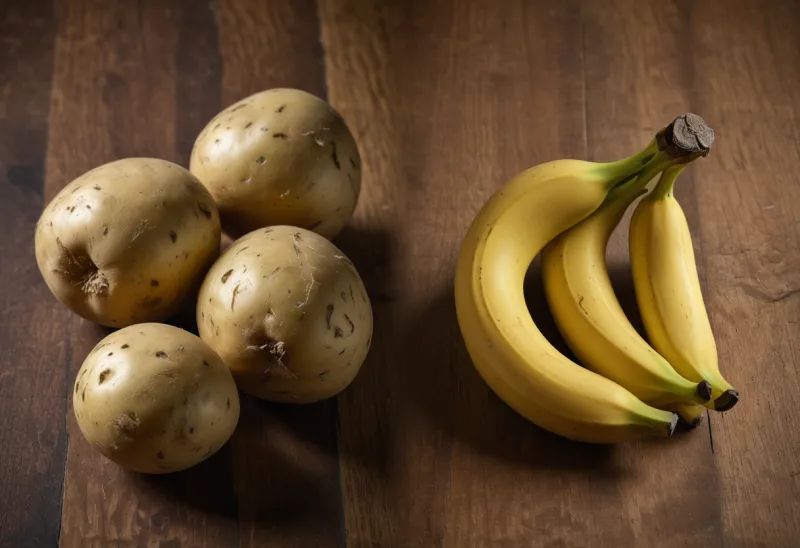
This is where the diet starts to lose us. Yes, fruit contains fructose. No, that doesn't make an apple equivalent to candy. Per USDA figures, 100 g of apple has 52 calories and 2.4 g of fiber, and a banana has 89 calories and 2.6 g.
In three long US cohorts totaling 133,468 people, each extra daily serving of fruit went with about half a pound less body weight over four years, and more for berries and for apples and pears5. That's observational. Fruit eaters differ from non-fruit-eaters in many ways, and some authors list food-industry ties. It doesn't prove fruit causes weight loss. It does make a universal ban very hard to defend.
Unlimited juice and dried fruit are a different story, which Rule 3 and a calorie count already cover.
What to steal: Almost nothing. Eat whole fruit and adjust portions to your needs.
Rule 5, the weekly cheat day: optional, and easy to overdo#
Pizza? Sure. Ice cream? Absolutely. A breakfast buffet that requires architectural planning? Apparently acceptable.
The psychological appeal is obvious, and knowing nothing is permanently forbidden helps some people stay consistent. But we found no evidence that a weekly blowout gives a lasting metabolic advantage. The nearest research concerns structured breaks at maintenance calories, not "go nuts," and the larger of those trials found no difference in fat loss22. Refeeds are a separate question from a cheat day.
The arithmetic is simple, and unforgiving. Here's an illustrative person with a maintenance of 2,400 kcal eating 1,800 kcal for six days, which banks a 3,600 kcal deficit.
| Day-off intake | Above maintenance | Deficit left for the week |
|---|---|---|
| 2,400 kcal | 0 | 3,600 kcal |
| 4,000 kcal | 1,600 | 2,000 kcal |
| 5,400 kcal | 3,000 | 600 kcal |
| 6,000 kcal | 3,600 | 0 |
This is simplified energy accounting, not a prediction of fat loss. It does show why the same diet can work well for one person and stall another. The difference may be entirely Saturday.
What to steal: Plan foods you enjoy without treating them as rewards you've earned. One big meal costs far less than a day with no limit, and we've run those numbers.
Why it can look faster than it is#
Early losses on this kind of diet can be dramatic, and part of that is water. Glycogen is stored with roughly three to four parts water, so cutting carbs drops weight quickly without an equal drop in fat23. In a tightly controlled study of 17 men moved to a ketogenic diet at matched calories, fat loss didn't speed up24. Those findings concern low-carb eating generally, not this protocol.
So here is the whole diet rebuilt from the parts that hold up: protein at most meals; beans, lentils and vegetables; the same few convenient meals; mostly calorie-free drinks; fruit, potatoes, rice or pasta when they fit; treats without a designated day of amnesty. We just created a reasonably balanced eating pattern without banning bananas. Revolutionary.
You can also follow every slow-carb rule and still eat more than you burn. Olive oil, nuts, meat and beans all have calories. Pasta on Wednesday isn't why that happens, and science isn't going to call the police.
FAQ#
Does the slow-carb diet burn fat faster than other diets?#
Nobody has shown that. We found no controlled trial of the diet itself, and related research on low-carb eating finds similar fat loss when calories and protein are similar.
Why does the slow-carb diet ban fruit?#
Ferriss's rule treats fruit as a sugar source, with avocado and tomatoes excepted. Long-term cohort data links more whole fruit with less weight gain, which doesn't prove benefit but gives a ban little support.
Is a weekly cheat day good for your metabolism?#
There's no good evidence of a lasting metabolic benefit from a weekly unrestricted day. A big enough one can also cancel the week's deficit.
Can you eat potatoes and still lose fat?#
Yes, as long as your overall intake stays below what you burn. Boiled potatoes scored very high on satiety in one small experiment, while fried forms and heavy toppings change the calorie picture a lot.
Sources#
- Ferriss T. How to Lose 100 Pounds on The Slow-Carb Diet: Real Pics and Stories. The Blog of Author Tim Ferriss, 12 July 2012. Primary statement of the diet's rules, not evidence for them.
- Hall KD, Bemis T, Brychta R, et al. Calorie for calorie, dietary fat restriction results in more body fat loss than carbohydrate restriction in people with obesity. Cell Metab. 2015;22(3):427-436.
- Gardner CD, Trepanowski JF, Del Gobbo LC, et al. Effect of low-fat vs low-carbohydrate diet on 12-month weight loss in overweight adults and the association with genotype pattern or insulin secretion: the DIETFITS randomized clinical trial. JAMA. 2018;319(7):667-679.
- Holt SH, Miller JC, Petocz P, Farmakalidis E. A satiety index of common foods. Eur J Clin Nutr. 1995;49(9):675-690.
- Bertoia ML, Mukamal KJ, Cahill LE, et al. Changes in intake of fruits and vegetables and weight change in United States men and women followed for up to 24 years: analysis from three prospective cohort studies. PLoS Med. 2015;12(9):e1001878.
- Kim SJ, de Souza RJ, Choo VL, et al. Effects of dietary pulse consumption on body weight: a systematic review and meta-analysis of randomized controlled trials. Am J Clin Nutr. 2016;103(5):1213-1223.
- USDA FoodData Central. Lentils, mature seeds, cooked, boiled, without salt (FDC 172421, SR Legacy).
- USDA FoodData Central. Potatoes, boiled, cooked without skin, flesh, without salt (FDC 170440, SR Legacy).
- USDA FoodData Central. Pasta, cooked, unenriched, without added salt (FDC 168928, SR Legacy).
- Raynor HA, Epstein LH. Dietary variety, energy regulation, and obesity. Psychol Bull. 2001;127(3):325-341.
- Epstein LH, Carr KA, Cavanaugh MD, Paluch RA, Bouton ME. Long-term habituation to food in obese and nonobese women. Am J Clin Nutr. 2011;94(2):371-376.
- DiMeglio DP, Mattes RD. Liquid versus solid carbohydrate: effects on food intake and body weight. Int J Obes. 2000;24(6):794-800.
- USDA FoodData Central. Beverages, carbonated, cola, regular (FDC 174852, SR Legacy).
- USDA FoodData Central. Orange juice, raw (FDC 169098, SR Legacy).
- USDA FoodData Central. Milk, reduced fat, fluid, 2% milkfat (FDC 171267, SR Legacy).
- Tate DF, Turner-McGrievy G, Lyons E, et al. Replacing caloric beverages with water or diet beverages for weight loss in adults: main results of the Choose Healthy Options Consciously Everyday (CHOICE) randomized clinical trial. Am J Clin Nutr. 2012;95(3):555-563.
- Rogers PJ, Hogenkamp PS, de Graaf C, et al. Does low-energy sweetener consumption affect energy intake and body weight? A systematic review, including meta-analyses, of the evidence from human and animal studies. Int J Obes. 2016;40(3):381-394.
- World Health Organization. WHO advises not to use non-sugar sweeteners for weight control in newly released guideline. 15 May 2023.
- USDA FoodData Central. Alcoholic beverage, wine, table, red (FDC 173190, SR Legacy).
- USDA FoodData Central. Apples, raw, with skin (FDC 171688, SR Legacy).
- USDA FoodData Central. Bananas, raw (FDC 173944, SR Legacy).
- Peos JJ, Helms ER, Fournier PA, et al. Continuous versus intermittent dieting for fat loss and fat-free mass retention in resistance-trained adults: the ICECAP trial. Med Sci Sports Exerc. 2021;53(8):1685-1698.
- Kreitzman SN, Coxon AY, Szaz KF. Glycogen storage: illusions of easy weight loss, excessive weight regain, and distortions in estimates of body composition. Am J Clin Nutr. 1992;56(1 Suppl):292S-293S.
- Hall KD, Chen KY, Guo J, et al. Energy expenditure and body composition changes after an isocaloric ketogenic diet in overweight and obese men. Am J Clin Nutr. 2016;104(2):324-333.
Source: BurnWeek — "Does the slow-carb diet work? Its five rules, tested one by one", https://burnweek.fit/blog/slow-carb-diet-rules-tested/. Licensed CC BY 4.0: free to quote or reuse with a link to this page.