Ethanol is priced at 7 calories a gram, and roughly 6.3 of them are yours#
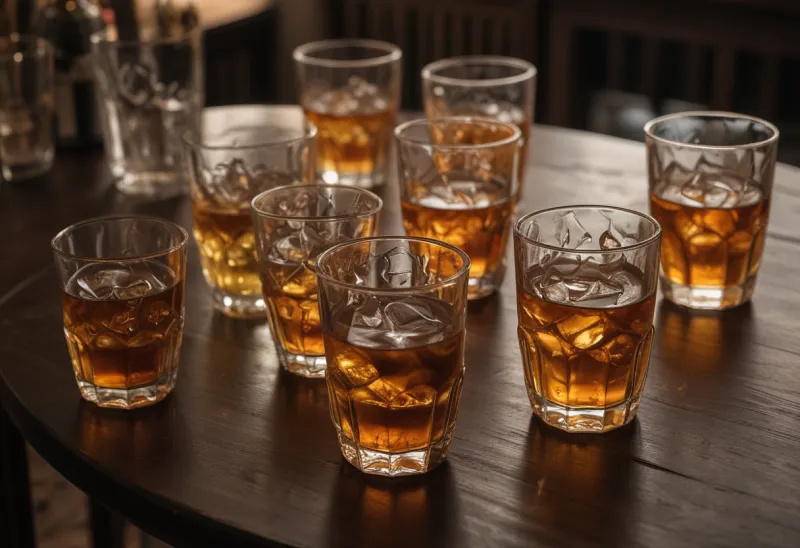
Alcohol gets a conversion factor exactly like the three macronutrients do. The Atwater general system assigns ethanol 29 kJ/g — 7.0 kcal/g rounded, 6.9 unrounded1. A US standard drink is defined as 14 grams of pure alcohol, about 12 oz of beer, 5 oz of wine or 1.5 oz of spirits2. Multiply and one standard drink carries roughly 97 calories of ethanol before anything else in the glass has been counted.
That is the easy half of the answer, and it is where most explanations stop. The harder half is that ethanol behaves unlike any of the three macros the macronutrient accounting was built for. Your body has no storage depot for it, no enzyme that shelves it for later, and no way to excrete a meaningful fraction of it. The only exit is oxidation, so ethanol goes to the front of the queue and every other fuel waits. That queueing is what makes drinking cost you, and it is a completely different mechanism from the one people assume.
The one factor that shrinks when you look closer#
Before the queue, one detail about the 7 itself. The Atwater factors are metabolizable-energy values; there is a parallel system, net metabolizable energy, that prices foods by the ATP they actually yield rather than by the heat they release. Most of the differences between the two systems are modest, and the FAO records ethanol's: 29 kJ/g (7.0 kcal/g) as metabolizable energy against 26 kJ/g (6.3 kcal/g) as net metabolizable energy, a difference of 10 percent — a gap the FAO attributes to "thermogenesis following alcohol consumption"1.
So alcohol is a slightly expensive fuel to process, and the printed 7 does not deduct that cost. Ten percent of 97 calories is under 10 calories a drink — worth knowing, not worth planning around, and the same order as the processing cost of every other macronutrient. Nobody has ever drunk their way to a deficit on a 10% discount.
Almost none of it becomes body fat#
The folk model says alcohol calories are stored as fat. That has been measured directly, and it is close to backwards.
Eight healthy men drank 24 g of alcohol — under two standard drinks — and were tracked with stable-isotope mass spectrometry alongside indirect calorimetry. Hepatic de novo lipogenesis did light up in relative terms: the fraction of VLDL-triacylglycerol palmitate coming from newly made fat rose from 2 ± 1% to 30 ± 8%. But in absolute terms the pathway produced 0.8 g of fat over six hours, less than 5% of the alcohol ingested. What happened to the rest is the finding: 77 ± 13% of plasma alcohol was converted to acetate, acetate flux rose 2.5-fold, release of fatty acids from adipose tissue fell 53%, and whole-body lipid oxidation fell 73%3.
Alcohol is not converted into your body fat. It is converted into a reason your body fat stays where it is.
Acetate is the mechanism. The liver strips ethanol down to acetate and dumps it into the bloodstream, where it is both an available fuel and a signal to stop mobilizing stored fat. Nothing about this is unique to alcohol as a vice; it is what happens to any substrate the body cannot store and must clear. The energy still counts against you. It counts by displacement rather than by conversion, which is why "alcohol turns into fat" and "alcohol is fattening" can be one false statement and one true one.
Suter's chamber: the displacement, measured over 48 hours#
The displacement had already been quantified at a whole-body level seven years earlier, in the study this topic keeps coming back to. Eight normal-weight men each spent two 48-hour sessions in an indirect-calorimetry chamber, the first day of each session serving as its own control. On day two of one session, ethanol was added on top of their energy requirement; on day two of the other, an equal amount of energy was replaced by ethanol, substituted isocalorically for fat and carbohydrate. The dose was 96 ± 4 g/day, a quarter of daily energy — just under seven standard drinks, by my arithmetic on the 14 g definition rather than the paper's own figure.
Both arms suppressed fat burning. Adding ethanol cut 24-hour lipid oxidation by 49.4 ± 6.7 g/day, a 36 ± 3% reduction (p < 0.001); substituting it cut lipid oxidation by 44.1 ± 9.3 g/day, 31 ± 7% (p < 0.0025). Energy expenditure rose 7 ± 1% in the addition arm and 4 ± 1% in the substitution arm. Carbohydrate and protein oxidation were unchanged4.
The substitution arm is the one that earns its keep. Swap calories one-for-one — take fat and carbohydrate out, put ethanol in, hold the total constant — and fat oxidation still falls by about a third for the day. That is a genuine metabolic asymmetry, and it is worth being precise about what it does and does not license. Suppressed oxidation over 24 hours is not a measurement of fat gained; the authors' own conclusion is scoped to "habitual consumption of ethanol in excess of energy needs," which is the surplus case, not the swap case. A single evening's drinking shifts which fuel you burn far more than it shifts what you weigh in a month.
The ethanol in a glass is arithmetic. The glass is not.#
Here is the part of alcohol logging that is genuinely tractable. Ethanol content is fixed by volume and proof, so it can be computed rather than looked up: millilitres × ABV × 0.789 g/mL gives grams, and grams × 6.9 gives calories. Every figure in the right-hand columns below is that calculation, not a database entry.
| Drink | Volume | ABV | Ethanol | Ethanol calories | Standard drinks |
|---|---|---|---|---|---|
| 12 oz regular beer | 355 mL | 5% | 14 g | ~97 | 1.0 |
| 5 oz table wine | 148 mL | 12% | 14 g | ~97 | 1.0 |
| 1.5 oz spirits | 44 mL | 40% | 14 g | ~97 | 1.0 |
| 16 oz craft IPA | 473 mL | 7% | 26 g | ~180 | 1.9 |
| 9 oz restaurant wine pour | 266 mL | 14% | 29 g | ~203 | 2.1 |
The first three rows are the definition doing its work: a beer, a wine and a shot are interchangeable because the US standard drink was constructed to make them so, at 14 g of alcohol each2. The last two rows are what people actually order. A strong pint and a generous restaurant pour are each about two standard drinks, and they arrive looking like one.
And this table is a floor, not a total. Residual sugars in beer, sweetness in wine, juice and syrup in a cocktail all sit on top of the ethanol figure and vary by product. What the arithmetic buys you is a number you cannot be far wrong about — which is the useful part of logging a drink at all, since the pour size is the term you genuinely cannot see. The rest is covered in how to log alcohol drinks.
Drinking does not make you eat less. It makes you eat more.#
If alcohol's calories displaced food calories, the queueing above would matter much less. They do not. A systematic review pooled 22 crossover and randomized trials in 701 adults comparing an alcohol dose against a non-alcoholic control, and found that alcohol raised food energy intake by 343 kJ (95% CI 161 to 525) and total energy intake by 1,072 kJ (95% CI 820 to 1,323). Its blunt summary: studies "consistently demonstrated no compensation for alcoholic beverage energy intake"5. Converting those to calories — my arithmetic, at 4.184 kJ per kcal — that is about 82 extra calories of food and about 256 extra calories in total.
Read the two numbers together and the structure is clear: roughly three-quarters of the extra intake is the drink itself, arriving entirely un-offset, and the remaining quarter is additional food that the drink somehow bought. The timing of that extra food is specific. Reviewing the experimental literature, Yeomans found that studies testing intake within an hour of an alcohol preload consistently show higher food intake than energy-matched controls, while the stimulatory effect is not evident once the test meal is delayed beyond an hour — and that over the longer run "energy ingested as alcohol is additive to energy from other sources"6.
A drink before dinner and a drink with dinner are therefore not the same event, which is a rare case in appetite research of a mechanism narrow enough to act on. It also puts alcohol in the same category as the other quiet contributors to calories that stall weight loss without appearing in a food log.
The uncertainty is not in the 7 — it is in the count#
Every number above is more precise than the number people actually get wrong. Ethanol's energy value has an error bar of a few percent; the number of drinks does not. Compared against tax and shipment data, self-reported alcohol consumption in US public health surveys "generally only accounts for 30%–60% of presumed consumption from per capita alcohol sales," with one national survey system covering 31.3% unadjusted7.
Those surveys are asking a simpler question than a food log does — how many drinks, not how large — and they still capture between a third and two-thirds of what was sold. Some of that gap is who answers surveys, but a large share is straightforward recall: the fourth glass topped up from a shared bottle, the double poured as a single, the round nobody counted. The practical consequence is that precision belongs on the count and the pour, not on the calorie factor. Estimate the volume and the ABV, run the two multiplications, and treat the mixer as the loose term — the same triage you would apply to any food where the portion, not the density, is what moves the number.
Which is the shape of the whole topic. Alcohol is a real energy source at close to twice the price of a gram of sugar, it is not stored as fat in any quantity worth discussing, it stops you burning the fat you have while it clears, and it fails to displace a single bite of the food it is drunk with. Nothing in that list is a reason to treat a glass of wine as a moral event. It is a reason to count it as what it is: a fuel with a knowable floor, poured by someone who was not measuring, and one that also interacts with the night's sleep in ways the calorie figure never sees.
FAQ#
How many calories are in one standard drink?#
About 97 from the alcohol itself. A US standard drink is defined as 14 g of pure alcohol2, and ethanol's conversion factor is 6.9 kcal/g unrounded1. Anything else in the glass — residual sugar in beer, juice or syrup in a cocktail — is added on top, and a 16 oz craft beer or a restaurant wine pour is often close to two standard drinks rather than one.
Does alcohol turn into body fat?#
Barely any of it does. After 24 g of alcohol, the hepatic fat-synthesis pathway produced 0.8 g of fat over six hours — under 5% of the dose — while 77 ± 13% of plasma alcohol was converted to acetate instead3. The weight effect runs through suppression rather than conversion: the same study measured a 73% drop in whole-body lipid oxidation and a 53% drop in fatty acid release from fat tissue.
Do alcohol calories count the same as food calories?#
Almost, with two asterisks. Ethanol is priced 10% lower on a net-metabolizable-energy basis than on the standard one, because processing it is thermogenic1 — worth under 10 calories a drink. And they compound differently at the table: across 22 trials, alcohol added about 82 calories of extra food on top of the drink's own energy, with no compensatory reduction anywhere5.
Sources#
- FAO. Food energy — methods of analysis and conversion factors. FAO Food and Nutrition Paper 77, Chapter 3: energy conversion factors for alcohol, ME and NME values. 2003.
- National Academies of Sciences, Engineering, and Medicine. Review of Evidence on Alcohol and Health. National Academies Press, 2025.
- Siler SQ, Neese RA, Hellerstein MK. De novo lipogenesis, lipid kinetics, and whole-body lipid balances in humans after acute alcohol consumption. Am J Clin Nutr. 1999;70(5):928-936.
- Suter PM, Schutz Y, Jequier E. The effect of ethanol on fat storage in healthy subjects. N Engl J Med. 1992;326(15):983-987.
- Kwok A, Dordevic AL, Paton G, Page MJ, Truby H. Effect of alcohol consumption on food energy intake: a systematic review and meta-analysis. Br J Nutr. 2019;121(5):481-495.
- Yeomans MR. Effects of alcohol on food and energy intake in human subjects: evidence for passive and active over-consumption of energy. Br J Nutr. 2004;92 Suppl 1:S31-S34.
- Esser MB, Sherk A, Subbaraman MS, et al. Improving estimates of alcohol-attributable deaths in the United States: impact of adjusting for the underreporting of alcohol consumption. J Stud Alcohol Drugs. 2022;83(1):134-144.
Source: BurnWeek — "How alcohol calories work — the 'fourth macro'", https://burnweek.fit/blog/alcohol-calories-explained/. Licensed CC BY 4.0: free to quote or reuse with a link to this page.