Naked food barely absorbs oil. The coating does.#
Pour two tablespoons of oil into a pan, cook 300 grams of courgette in it, and the courgette will absorb roughly three grams. Not a third of the bottle's worth, not half — about a tenth of what you poured. In the reference tables that European dietary surveys use to work out what a cooked dish actually contains, plain vegetables, mushrooms, lean fish and unbreaded beef all take up about 1 gram of fat per 100 grams of ingredient when fried. Pork chops and oily fish take up nothing at all1.
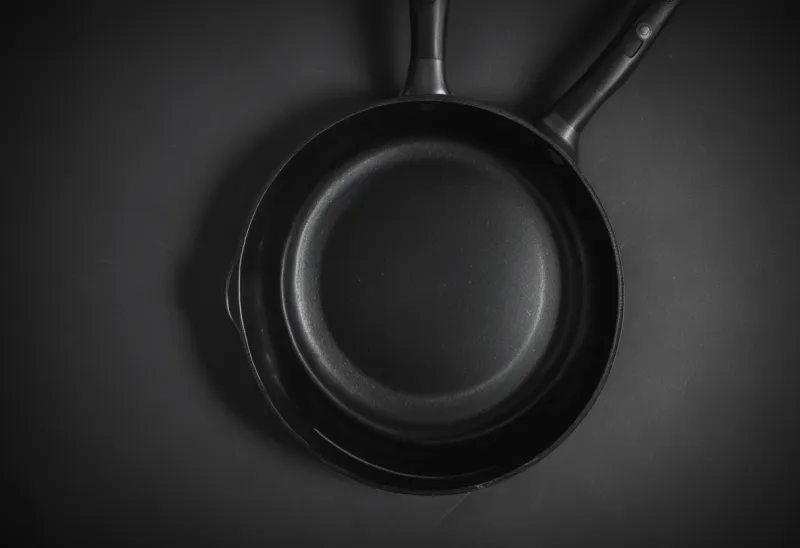
Which means the question most people ask about cooking oil — how much did the food soak up? — is the small half of the problem. The other 24 grams did not evaporate. They are still in the pan, and whether they end up in your dinner depends entirely on what you do with the pan next. That single decision is worth more calories than every absorption factor in this article combined, and no lab has measured it, because it happens in your kitchen and not theirs.
The table dietary surveys quietly run on#
A fat uptake factor is the number a food-composition database uses when a recipe says "fry in oil": it estimates how many grams of the cooking fat end up inside the food, expressed per 100 grams of the ingredients you started with. Without one, every fried dish in a national diet survey would be logged as if the pan were dry.
The most complete published set comes from Antal Bognár at Germany's Federal Research Centre for Nutrition, compiled from the cooking-science literature plus the centre's own unpublished analyses. The numbers are blunt — whole grams, category averages — and Bognár is explicit that no spread is published alongside them. They are a best single guess for a survey, not a distribution.
| Dish, fried in fat | Fry in pan | Deep fry |
|---|---|---|
| Pork chop | 0 | 0 |
| Oily fish (mackerel, herring) | 0 | 0 |
| Beef or veal, unbreaded | 1 | 1 |
| Lean fish (cod, plaice, sole) | 1 | 1 |
| Root and bulb vegetables, plain | 1 | 1 |
| Broccoli, courgette, peppers, green beans | 1 | 1 |
| Mushrooms | 1 | 1 |
| Breaded kohlrabi or onion | 5 | 5 |
| Breaded chicken | 5 | 4 |
| Breaded veal or beef escalope | 6 | 5 |
| Fried egg | 5 | — |
| Scrambled egg, egg pancake | 10 | — |
| Pancake batter | 7 | 7 |
Grams of fat taken up per 100 g of ready-to-cook ingredients. Source: Bognár, 2002, tables 2, 3, 5, 6, 13, 20, 22, 26–28, 33, 38. Recipes are German; factors are category averages.
Read down that table and the variable that matters is not the heat, the pan, or the oil. It is whether the food has a coating. A plain kohlrabi takes 1 gram per 100; bread the same kohlrabi and it takes 5. The food is not the sponge. The crumb is.
That is also why the fried-food calorie problem is really a coating problem — the thing your eye reads as "one fried vegetable" is a vegetable plus an absorbent shell, and estimating calories in fried foods turns almost entirely on how much shell there is.
The fryer deposits slightly less than the pan, for the same cutlet#
Here is the result that reverses most people's intuition. Take one dish — a breaded veal escalope — and follow it across the table's three methods: pan 6, oven 6, deep fry 5. A breaded chicken cutlet: pan 5, oven 5, deep fry 4. In both cases the deep fryer, the method everyone assumes is the greasy one, leaves less fat in the food than the frying pan does.
The mechanism is plausible, and it is mine rather than Bognár's, since a table of factors does not explain itself. Oil enters fried food mostly during cooling, not during frying, and it stays within roughly the outer millimetre of the surface2. A fryer basket lifts the food clear and the excess runs back into the bath before it can be drawn in. A pan has no basket and no bath: whatever is clinging to the cutlet when the heat goes off has nowhere to run except back into the crumb.
Two cautions before anyone rearranges their kitchen around this. The gap is one gram per 100 — exactly one unit of the table's own resolution, so the direction is more trustworthy than the size. And it is a claim about the food, not about the meal: the deep fryer wins on absorption while using a litre of oil you will discard, and the pan loses on absorption while using 25 grams you might tip onto the plate.
The number you actually need is not in any uptake table#
Run the arithmetic on that stir-fry properly. Two tablespoons is about 27 grams of oil. Fat carries 9.0 kcal per gram5, so you poured roughly 240 calories into the pan. The courgette's uptake factor of 1 g per 100 g says it absorbed about 3 grams — about 27 calories. The subtraction is mine, and it leaves around 213 calories unaccounted for.
Those 213 calories are not a rounding error or a modelling assumption. They are a visible puddle. If you tip the pan out over the rice, you ate them. If you lift the vegetables out with a slotted spoon and put the pan in the sink, you did not. If you deglazed and made a sauce, you ate most of them. Nothing in the food-science literature can tell you which of those happened.
The uptake tables answer a question about the food. Your calorie log is asking a question about the bottle — and the difference between the two answers is whatever is still in the pan.
This is why oil behaves so unlike everything else you log. A homemade meal's calorie count is usually uncertain because you do not know the quantities. Here you know the quantity precisely — you poured it — and the uncertainty is in the destination. It is the one hidden-calorie source where measuring more carefully at the stove genuinely fixes the problem, which is not true of most of the calories people forget.
What happens when someone actually measures it#
A 2026 trial cooked vegetable patties — broccoli, carrot, onion, oat flour, egg white — four ways and analysed the fat, reported as grams per 100 g of dry weight3.
| Patty | Raw | Baked | Air-fried | Deep-fried |
|---|---|---|---|---|
| Plain | 5.58 | 6.02 | 6.20 | 22.41 |
| With 2.5 mL olive oil mixed in | 16.98 | 18.74 | 12.38 | 30.88 |
Three things fall out of it. Baking and air-frying a plain patty moved its fat by less than a gram — dry heat does not add fat, it only concentrates what is there. Deep-frying quadrupled it. And the air-fried enriched patty came out at 12.38 against a raw value of 16.98: oil that was already inside the food left it. The authors do not comment on that row, it is one small study of one food, and dry-weight percentages are easy to misread — so treat it as a hint that food is not a closed container, not as a finding.
The fourth thing is arithmetic of my own. The plain patty picked up 16.8 points of fat in the fryer; the oil-enriched one picked up only 13.9. A food already carrying fat had less room for more, which is the same reason oily fish and pork chops sit at zero in Bognár's tables.
Estimating it without a mass balance#
Sort the dish into one of three cases before you log anything.
Poured and served. Stir-fries, sautéed vegetables tipped out with the pan juices, scrambled eggs, anything where you build a sauce in the pan. Essentially all of the oil reaches the plate. Log what you poured — the whole 240 calories — and stop thinking about absorption.
Poured and left behind. A chop or steak seared and lifted out, vegetables roasted on a tray and plated with tongs. The food took its uptake factor; the film stayed. A reasonable range runs from the uptake figure to about half of what you poured, and the width of that range is real rather than decorative.
Submerged. Deep-frying. The bath is not your denominator — you are not eating a litre of oil. Ignore the bottle entirely and use uptake per 100 grams of finished food, which is where the coating question does all the work.
The one habit worth building is measuring the pour, once, so it stops being a guess. Weigh what comes out of the bottle for a week of ordinary cooking and you will have a personal number to reuse — roughly what a systematic approach to tracking cooking oils and fats is built on. Oil is the ingredient where a five-second weighing buys more accuracy than an hour of database archaeology, because the error it removes is 200 calories wide and everything else you are arguing about is 30.
None of this makes the count exact, and it is not supposed to. Calorie counting is accurate enough to steer by without being accurate; oil is simply the place where the widest single band in your day is also the easiest one to narrow.
FAQ#
How many calories of oil does a home stir-fry actually add?#
Between about 30 and 240, depending on the pan rather than the food. Two tablespoons is roughly 27 grams and 240 calories at 9 kcal per gram. The vegetables themselves absorb about 1 gram per 100 grams of ingredient, so a large portion takes up perhaps 30 calories' worth. Everything else is in the pan — and a stir-fry is the case where the pan gets tipped onto the plate, so assume most of it counts.
Why does breaded food absorb so much more oil than plain food?#
Because the coating is the absorbent part. In Bognár's tables a plain root vegetable takes up 1 gram of fat per 100 g of ingredient and the same vegetable breaded takes 5; batter for a pancake takes 7. Oil sits in the porous outer layer created as water leaves, so a food with a starchy, porous crust has somewhere to put it and a smooth, dense one does not.
Does switching to a different oil lower the calories absorbed?#
The energy density does not change — every culinary fat is close to 9 kcal per gram, so a tablespoon of olive, sunflower or coconut oil lands within a few calories of the others. How much of it a food takes up is a different question, and it is an active research area: reviews of alternative frying media exist precisely because the fat's composition and viscosity do alter uptake. But the effect sizes are a food-industry lever, not a home-kitchen one, and they are far smaller than the difference between tipping the pan out and not.
Sources#
- Bognár A. Tables on weight yield of food and retention factors of food constituents for the calculation of nutrient composition of cooked foods (dishes). Berichte der Bundesforschungsanstalt für Ernährung, BFE-R-02-03, Karlsruhe, 2002
- Mahmud N, Islam J, Oyom W, Adrah K, Adegoke SC, Tahergorabi R. A review of different frying oils and oleogels as alternative frying media for fat-uptake reduction in deep-fat fried foods. Heliyon. 2023;9(11):e21500
- Bustamante A, Valle C, Echeverría F, et al. The Addition of Extra-Virgin Olive Oil Enhances the Antioxidant Capacity, Nutritional Quality, and Sensory Attributes of Vegetable Patties Prepared Using Different Cooking Methods. Foods. 2026
- Ramírez-Anaya JP, Samaniego-Sánchez C, Castañeda-Saucedo MC, Villalón-Mir M, López-García de la Serrana H. Phenols and the antioxidant capacity of Mediterranean vegetables prepared with extra virgin olive oil using different domestic cooking techniques. Food Chemistry. 2015;188:430-438
- FAO. Food energy — methods of analysis and conversion factors. Chapter 3: Calculation of the energy content of foods — energy conversion factors. FAO Food and Nutrition Paper 77, 2004
Source: BurnWeek — "How much cooking oil actually ends up in your food?", https://burnweek.fit/blog/calories-lost-in-cooking-oil/. Licensed CC BY 4.0: free to quote or reuse with a link to this page.