Work out which night-eating problem you have before you pick a fix#
Most late-night eating is not a disorder. It is a long evening, a kitchen you walk past, and a pattern that has been rehearsed enough times to run without your input — and for that, the working plan is to redistribute your calories earlier, put physical friction between you and the food, and stop treating 10pm as a test of character. That plan is below, in order.
But a minority of night eating is something clinically defined, and it is worth two minutes to rule out, because the plan is different. The consensus research criteria describe a core pattern of abnormally increased evening and nighttime intake shown by either eating at least 25% of your daily calories after the evening meal, or waking to eat at least twice a week. Awareness of the episodes is required, as is distress or impairment, plus three of five additional modifiers, sustained for at least three months1. If that describes you, this is a matter for a clinician, and there is a treatment literature — the last section covers what it has actually moved.
Whether late calories matter at all, and why the research on that splits, is settled in does eating late at night make you gain weight. This page assumes you have decided they matter for you and want them to stop.
Move calories earlier — but move them, don't add them#
This is where most advice goes wrong, and the evidence is unusually clear about why.
When a fixed daily intake was redistributed, front-loading won. Women with overweight or obesity and metabolic syndrome were randomized to two isocaloric ~1,400 kcal diets for 12 weeks: one loaded at the front (700 kcal breakfast, 500 lunch, 200 dinner), the other at the back (200 / 500 / 700). The breakfast group showed greater weight loss and a greater waist reduction, with mean triglycerides falling 33.6% while the dinner group's rose 14.6%. Across meal challenges, their daily glucose, insulin, ghrelin and hunger scores all ran lower and their satiety scores higher2.
Now the trials that told people to start eating breakfast. Pooling 13 randomized controlled trials, participants assigned to eat breakfast consumed about 260 kcal a day more than skippers (mean difference 259.79 kcal/day; 95% CI, 78.87 to 440.71) and ended up 0.44 kg heavier (95% CI, 0.07 to 0.82) — leading the authors to warn that breakfast might not be a good weight-loss strategy3.
| What the trial asked | Design | Result |
|---|---|---|
| Move a fixed 1,400 kcal toward breakfast | Isocaloric randomized, 12 weeks2 | More weight and waist lost; hunger down, satiety up |
| Tell people to start eating breakfast | 13 RCTs pooled3 | +260 kcal/day; 0.44 kg heavier than skippers |
Those look like opposite verdicts on the same advice, and they aren't. One trial moved calories within a fixed total; the other appended a meal to whatever people were already eating. Both results are what you would predict from their designs, and together they produce a sharper instruction than either alone: front-loading is a redistribution, not an addition. If tomorrow's bigger breakfast doesn't come out of tonight's dinner, you have just built a longer eating day — which is the exact thing you're trying to shorten. The general case against breakfast as a weight lever is made in is breakfast really the most important meal.
Practically: decide the size of dinner first, then let breakfast and lunch absorb what you took out of it. Reversing that order is how the redistribution quietly becomes an addition.
Make the evening's food harder to eat and the day's food more filling#
Two levers change the size of the pull before you have to resist it.
The first is composition. Jakubowicz's front-loaded group didn't just weigh less; they reported lower hunger and higher satiety throughout the day, which is the mechanism doing the work rather than the clock. Protein is the macro with the strongest per-calorie effect on fullness, laid out in why protein keeps you full longer — and if a planned evening snack is genuinely part of your pattern, making it a real protein dose rather than a token one is covered in high-protein snacks. A dinner that leaves you satisfied is a cheaper intervention than an evening spent negotiating.
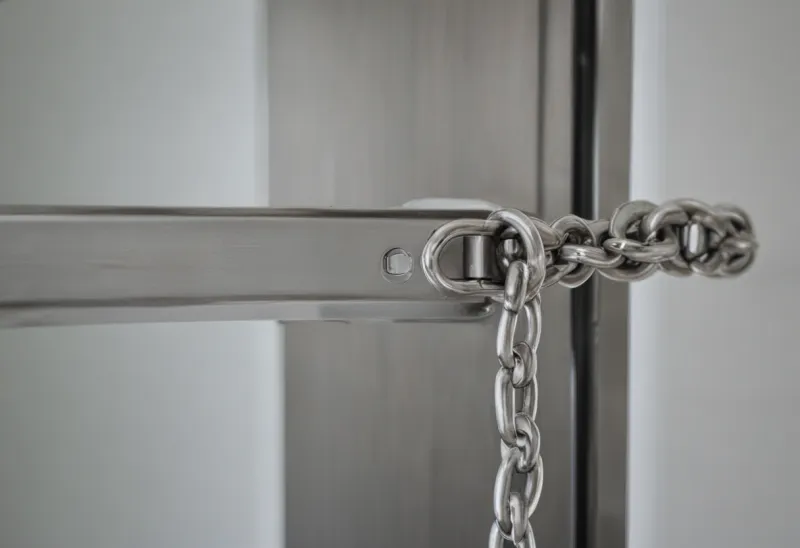
The second is friction, and here the clinical literature is refreshingly unembarrassed about how physical it gets. The behavioral management of night eating uses stimulus control in the literal sense: signs on the refrigerator, a chair positioned in the hallway between bedroom and kitchen, and in one described case a chain locking the refrigerator shut. Alongside that sit self-monitoring, structured regular mealtimes to correct the delayed eating pattern, standardized bed and wake times, cognitive work on the belief that you need to eat in order to fall asleep, and relaxation techniques as an alternative to eating5.
A chain on the refrigerator sounds absurd until you notice what it concedes: that the clinicians who work on this expect the 11pm version of you to lose an argument the 6pm version would win easily. Every tactic on that list moves the decision out of the impaired moment — the same logic that makes in-the-moment food willpower a bad thing to plan around.
Fix the sleep, because a long evening is mostly a sleep problem#
The simplest reason late calories exist is that you were awake to eat them, and the second-simplest is that being short on sleep changes what you reach for and how well you resist it. Both of those legs are the cluster's core argument, audited hormone by hormone in how sleep controls your hunger hormones.
What matters for this playbook is that regularizing bed and wake times appears on the clinical tactic list alongside the fridge chain — not as general wellness advice, but as part of the treatment. A stable bedtime shortens the window in which night eating is even possible, and it does so without requiring a single act of restraint. Of all the moves here, it is the one that removes the opportunity rather than fighting the impulse.
What treatment actually moved, and what a realistic target looks like#
The one published psychotherapy trial gives you something better than encouragement: numbers to aim at. Twenty-five patients completed ten sessions of cognitive behavior therapy for night eating syndrome, with intake and awakenings computed from weekly food and sleep records. The share of daily calories eaten after dinner fell from 35.0% to 24.9%; nocturnal ingestions fell from 8.7 to 2.6 per week; weight fell from 82.5 to 79.4 kg; and the symptom-scale score fell from 28.7 to 16.3, all at p < 0.00014.
Read the design honestly before you read the numbers. This was an uncontrolled pilot in 25 people with no comparison group, so some of that improvement belongs to regression to the mean and to the simple effect of being closely monitored for ten weeks — the authors say as much, calling for a controlled trial. Nobody has since run a large one.
What the numbers are still good for is calibration. Notice that successful treatment did not take after-dinner intake to zero. It took it from 35% to 25% — a ten-point shift — and cut night waking by about two thirds rather than eliminating it. If your target is never eating after 8pm again, you have set a bar the best available treatment did not clear. Notice too that the trial's own outcome measure was a percentage of daily calories arriving after dinner, which is a number you can only produce if what you log carries a timestamp; a plain daily total cannot tell you whether your evenings are improving.
The first week, in order#
- Measure before you change anything. For seven days, log what you eat with the time attached. You are looking for one number — the share of your calories landing after dinner — and one pattern: whether the late intake is genuine hunger following a small dinner, or grazing that starts at a fixed cue like sitting down on the sofa.
- Shrink dinner last, not first. Move 200–300 calories from the evening into breakfast and lunch, keeping the daily total the same. If your total goes up in week one, you have appended instead of redistributed.
- Put protein at every daytime meal, so the front-loaded calories actually buy you satiety rather than just arriving earlier.
- Add one physical obstacle, not a rule. Whatever the food is, it should require a trip you would notice yourself taking.
- Set a wake time and hold it, including at the weekend. The bedtime follows it, and the evening shortens on its own.
- Re-measure in week three. A drop of ten points in after-dinner share is the size of change a full course of treatment produced. Getting most of the way there with a redistributed day and a closed kitchen is a good outcome, not a partial failure.
The pattern took months to build and it is maintained by a specific set of cues; expect it to loosen over weeks, and expect the occasional late night to survive all of this. What ends a night-eating habit is not a perfect evening. It is a day arranged so that the evening has less to do.
FAQ#
How do I know if my night eating is an actual disorder?#
The research criteria are specific: eating at least 25% of your daily calories after the evening meal, or waking to eat at least twice a week, with awareness of the episodes, genuine distress or impairment, three of five additional features, and a duration of at least three months1. Eating a late snack most nights does not meet that bar. A week of timestamped logging will tell you which side of the 25% line you are on, and that is worth knowing before you decide how hard to work on it.
Why am I hungry at night even after a full dinner?#
Often because the day in front of it was too light rather than the dinner being too small. In the isocaloric trial, women whose fixed 1,400 kcal was loaded toward the morning reported lower hunger and higher satiety across the whole day than women eating the same calories loaded at dinner2. A large late meal on top of an underfed day tends to be followed by more eating, not less. Cue-driven grazing is a separate case, and you can tell it apart because it arrives at a place and a time rather than after a gap without food.
Is a kitchen curfew enough on its own?#
Rarely, and it is the least durable piece if you use it alone, since it asks for restraint at exactly the hour restraint is scarcest. It works far better paired with the two things that reduce what it has to hold back: calories redistributed earlier in the day, and a physical obstacle between you and the food. The clinical tactic list puts stimulus control, regular mealtimes and standardized sleep timing together for that reason5 — a curfew is the fence, not the plan.
Sources#
- Allison KC, Lundgren JD, O'Reardon JP, et al. Proposed diagnostic criteria for night eating syndrome. Int J Eat Disord. 2010;43(3):241-247.
- Jakubowicz D, Barnea M, Wainstein J, Froy O. High caloric intake at breakfast vs. dinner differentially influences weight loss of overweight and obese women. Obesity (Silver Spring). 2013;21(12):2504-2512.
- Sievert K, Hussain SM, Page MJ, et al. Effect of breakfast on weight and energy intake: systematic review and meta-analysis of randomised controlled trials. BMJ. 2019;364:l42.
- Allison KC, Lundgren JD, Moore RH, O'Reardon JP, Stunkard AJ. Cognitive behavior therapy for night eating syndrome: a pilot study. Am J Psychother. 2010;64(1):91-106.
- Berner LA, Allison KC. Behavioral management of night eating disorders. Psychol Res Behav Manag. 2013;6:1-8.
Source: BurnWeek — "How to stop late-night eating for good", https://burnweek.fit/blog/how-to-stop-night-eating/. Licensed CC BY 4.0: free to quote or reuse with a link to this page.