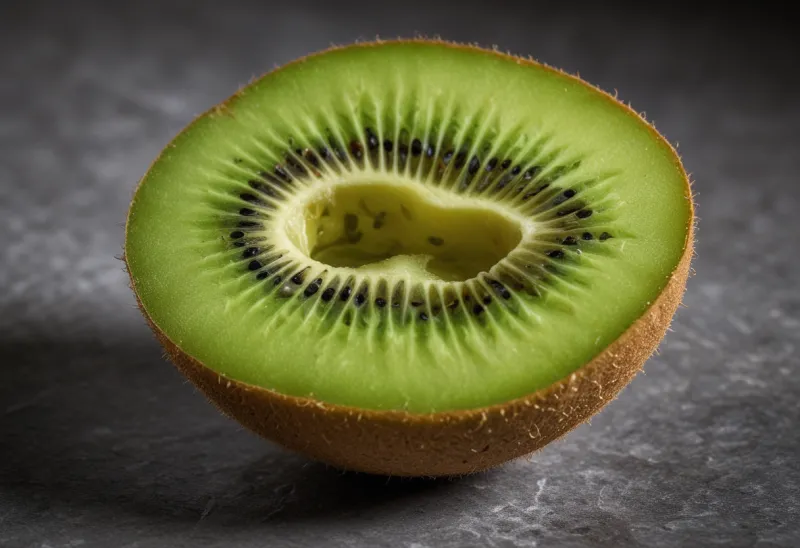
No single food has been shown to fix sleep. Four have been properly tested.#
The honest state of this literature is that no food has demonstrated a reliable, replicated effect on sleep in the way a drug trial would demonstrate one. What exists is a handful of small studies on four candidates — tart cherry juice, kiwifruit, magnesium and tryptophan — each of which has been amplified into a confident recommendation somewhere between the journal and your search results. The studies are real. They are also smaller, shorter and more fragile than the pages citing them let on, and two of them do not test a food at all.
So the useful answer is layered. Tryptophan and magnesium have measurable effects at doses that come from capsules rather than plates. Tart cherry has a small trial in people who already slept fine. Kiwifruit has the most-quoted number in the entire category and no control group to compare it against. Meanwhile the intervention with the best evidence in this whole area is not a food at all — it is the composition of your overall diet, which is covered separately and which nobody markets because you cannot put it in a bottle.
| Candidate | Primary trial | n | The design problem | What it supports |
|---|---|---|---|---|
| Tart cherry juice | Howatson, 2012 | 20 | Healthy sleepers, 7 nights | A small effect in people without sleep problems |
| Kiwifruit | Lin, 2011 | 24 | No control group at all | Nothing that can be attributed to the fruit |
| Magnesium | Mah & Pitre, 2021 | 151 (3 trials) | Very low GRADE quality; supplement doses | Possibly faster sleep onset, at 320–729 mg |
| Tryptophan | Sutanto, 2022 | 4 trials pooled | Only one outcome moved; ≥1 g needed | Less waking during the night, at capsule doses |
Tart cherry: twenty people who already slept well#
The tart cherry story rests on a randomized, double-blind, placebo-controlled crossover trial — a good design — in which 20 volunteers drank either a Montmorency tart cherry juice concentrate or placebo for seven days. Urinary melatonin rose significantly, and so did time in bed, total sleep time and sleep efficiency1.
Three things constrain what that buys you. The participants were healthy volunteers, not people with insomnia, so the trial cannot speak to fixing a sleep problem — it shows a shift in people who did not have one. Twenty participants over seven nights is a pilot, and the result has not been replicated at scale. And one of the three sleep outcomes that improved was time in bed, which is a scheduling behavior rather than a physiological capacity; when time in bed and total sleep time rise together, a change in when people went to bed is at least as good an explanation as a change in what their brains were doing. That reading is mine, not the authors', and the paper does not adjudicate it.
One note on disclosure, since this is a category where product interests are dense: the intervention was a specific commercial concentrate, and the funding statement was not visible in the records I could open. That is a reason to check the disclosures yourself before treating a single 20-person trial as settled, not an accusation.
Kiwifruit: the famous 42% came from a study with nothing to compare against#
This is the number that has propagated furthest, and it deserves the closest look. Twenty-four adults with self-reported sleep problems (22 women, 2 men) ate two kiwifruit an hour before bed every night for four weeks. Afterwards, their Pittsburgh Sleep Quality Index score fell 42.4%, waking after sleep onset fell 28.9%, sleep onset latency fell 35.4%, and total sleep time and efficiency rose 13.4% and 5.41%2.
The design is named plainly in the paper's own abstract: a "free-living, self-controlled diet design." There was no placebo group and no control group. Every participant knew they were eating kiwifruit for their sleep, every measurement was a before-and-after on the same people, and the participants were recruited because they were sleeping badly — the condition under which regression toward the mean produces improvement on its own, before you add four weeks of paying deliberate attention to your bedtime.
A 42% improvement with nothing to compare it against is not a 42% improvement. It is what happens to a group of poor sleepers over four weeks of being studied, with kiwifruit present in the room.
None of this makes the finding worthless — the authors were appropriately cautious, concluding only that further investigation "may be warranted." It makes the finding uninterpretable as evidence that the fruit did anything. Fifteen years on, the replication that would settle it has not arrived, while the 42% has been repeated into the status of a fact.
Magnesium: a real signal, graded very low, at doses food doesn't deliver#
Magnesium is the one with a genuine meta-analysis behind it, and the result is more interesting than either its promoters or its debunkers allow. Pooling three randomized trials in 151 older adults with insomnia, sleep onset latency was 17.36 minutes shorter after magnesium than placebo (95% CI −27.27 to −7.44, p = 0.0006)3.
Seventeen minutes is not trivial if you lie awake. But the reviewers graded the evidence low to very low and wrote that "the quality of literature is substandard for physicians to make well-informed recommendations," while noting that magnesium is cheap and safe enough that the trials may still support trying it. That is an unusually candid pair of sentences, and worth reading as written rather than as either endorsement or dismissal. The review declared no funding and no competing interests — an audit worth performing in both directions, and here it comes back clean.
The part that matters for a food article is the dose. The trials used 320 to 729 mg of elemental magnesium daily, in oxide and citrate tablets, split across two or three doses, in adults over 55 with diagnosed insomnia. That is a supplement protocol. "Eat magnesium-rich foods for better sleep" borrows the credibility of this evidence while describing a completely different exposure, in a population the trials did not include.
Tryptophan works at a gram, which is a capsule and not a meal#
The tryptophan–serotonin–melatonin pathway is the mechanism invoked whenever anyone recommends milk, turkey or nuts before bed, and the pathway itself is uncontroversial. The question is whether food delivers enough tryptophan to move it.
A systematic review and meta-regression collected 18 articles and could pool 4. Tryptophan supplementation reduced wake time after sleep onset — the meta-regression slope worked out to roughly 81 fewer minutes of wakefulness per gram — with doses of 1 g or more clearly more effective than lower doses. No other sleep component moved: not total sleep time, not sleep latency, not sleep efficiency4.
Two conclusions follow, and they point opposite ways. Tryptophan genuinely does something, narrowly, at a gram or more — which is a supplement dose, not a portion of food, and the trials pooled were supplementation trials. And the mechanism most often cited to justify eating specific foods before bed turns out, when tested, to require an amount that eating does not conveniently provide. The pathway is real. The dietary version of the argument is the part that has not been demonstrated.
What has evidence is the diet, not the food#
Step back from the four candidates and a pattern is visible: every one of these is an attempt to find a discrete object that fixes a distributed problem. The better-supported finding in this area runs the other way — what you eat across a whole day tracks the architecture of the following night, with higher fiber going with more slow-wave sleep and more saturated fat going with less, in a small controlled inpatient study5 that another article in this cluster examines in detail. It is a modest, single-study result too, and it does not become a hero food no matter how it is packaged — but it points at a dietary pattern rather than at an item, which is where fiber targets and overall diet quality do their work.
No food fixes chronic sleep loss, because chronic sleep loss is not a nutrient deficiency. Seventeen minutes of sleep onset is a real number and it is not a substitute for an hour in bed.
That is the framing worth keeping. If you are sleeping badly, the interventions with the strongest trial support are behavioral and environmental — caffeine timing, evening light, temperature, schedule regularity — and they are collected in practical ways to sleep better. Melatonin as a supplement is a separate question with its own reasonable, narrow case. Eating a kiwi will not hurt you and might help; the correct confidence to hold about it is low, and it should sit somewhere after the things that have been properly tested. Where sleep and eating genuinely interact with force, the arrow runs the other way — from a short night into the next day's appetite, which is the pillar's whole subject.
FAQ#
Does tart cherry juice actually help you sleep?#
The evidence is one small, well-designed trial. Twenty healthy volunteers drinking tart cherry concentrate for seven nights had raised urinary melatonin and significant increases in time in bed, total sleep time and sleep efficiency1. They were not people with sleep problems, the trial ran a week, and it has not been replicated at scale — so it is a promising pilot rather than a demonstrated remedy.
Is there any food that works like a sleeping pill?#
No. The largest effect in this literature belongs to supplemental tryptophan, which reduced wake time after sleep onset at doses of 1 g or more and changed no other sleep outcome4. Magnesium supplements shortened sleep onset by about 17 minutes on very-low-quality evidence3. Both are supplement protocols, and neither approaches pharmaceutical effect sizes.
Should I take magnesium for sleep?#
The review that pooled the trials landed on a genuinely mixed verdict: the literature is too poor to support a confident recommendation, but magnesium is inexpensive and safe enough that the existing randomized evidence may support trying it at under 1 g daily in divided doses3. Note the trials were in adults over 55 with insomnia, so the finding may not transfer. Supplement decisions are worth raising with your doctor, particularly alongside other medications.
Sources#
- Howatson G, Bell PG, Tallent J, Middleton B, McHugh MP, Ellis J. Effect of tart cherry juice (Prunus cerasus) on melatonin levels and enhanced sleep quality. Eur J Nutr. 2012;51(8):909-916.
- Lin HH, Tsai PS, Fang SC, Liu JF. Effect of kiwifruit consumption on sleep quality in adults with sleep problems. Asia Pac J Clin Nutr. 2011;20(2):169-174.
- Mah J, Pitre T. Oral magnesium supplementation for insomnia in older adults: a systematic review & meta-analysis. BMC Complement Med Ther. 2021;21(1):125.
- Sutanto CN, Loh WW, Kim JE. The impact of tryptophan supplementation on sleep quality: a systematic review, meta-analysis, and meta-regression. Nutr Rev. 2022;80(2):306-316.
- St-Onge MP, Roberts A, Shechter A, Choudhury AR. Fiber and saturated fat are associated with sleep arousals and slow wave sleep. J Clin Sleep Med. 2016;12(1):19-24.
Source: BurnWeek — "Do any foods actually help you sleep?", https://burnweek.fit/blog/best-foods-for-better-sleep/. Licensed CC BY 4.0: free to quote or reuse with a link to this page.