Ten eating habits that don't require a second job#
Most nutrition advice sounds suspiciously like a second job. Count everything. Avoid everything. Prepare everything. Eat at exactly the right time. And apparently, never look at a croissant again.
These ten habits ask for less. No detox teas, no forbidden foods, and no need to become the person who brings a kitchen scale to a wedding. Each one comes with a small thing to try tomorrow and a plain note on how strong the evidence is, because "backed by a large review" and "a cheap experiment worth a week" are different promises.
Habits 1 to 3: what goes on the plate#
1. Eat protein with most main meals#
Protein is not reserved for people who own three shaker bottles and refer to chicken as "fuel." It helps maintain muscle and can make a meal last longer, though the second effect is smaller than the marketing suggests.
The muscle evidence is solid for people who lift. A meta-analysis of 49 trials and 1,863 participants found that added protein increased resistance-training gains in fat-free mass by an average of 0.30 kg, with no further gain above roughly 1.6 g per kg of body weight per day2. The appetite evidence is modest: a review of protein and weight management found greater fullness without a clear drop in intake at the following meal, and pointed to sticking with the diet as the main reason long studies disagree1.
You don't need a protein shake every three hours. Eggs, Greek yogurt, cottage cheese, tofu, chicken, fish, beans, lentils, or tempeh all do the job.
Try this tomorrow: look at your usual breakfast. If it has no decent protein source, add one.
2. Make vegetables the easy option#
Everybody knows vegetables are healthy. The problem is that vegetables require washing, peeling, chopping, and cooking, while cookies require opening a package.
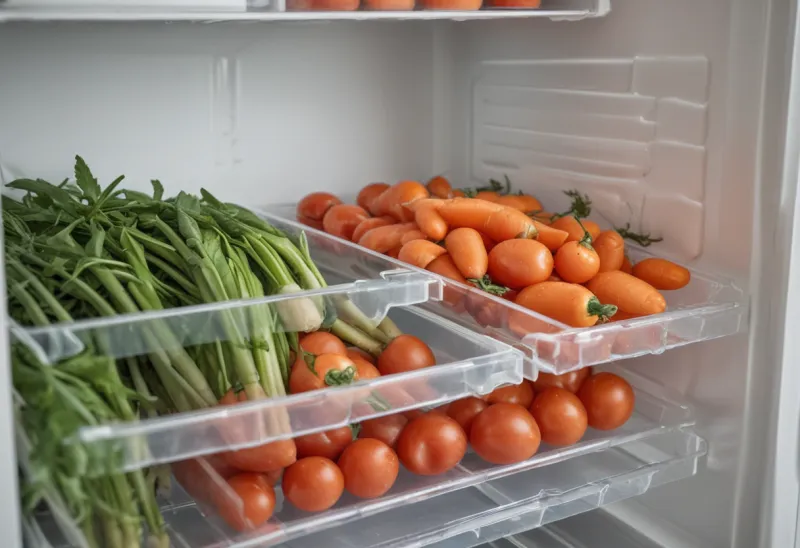
Cookies have an unfair UX advantage. So take it away. Keep washed cucumbers, carrots, or cherry tomatoes at eye level in the fridge. Buy frozen vegetables, which don't judge you for forgetting them. Roast one big tray and use it across several meals. The alternative is the bottom drawer, where a forgotten cucumber is quietly developing its own civilization.
The usual population target comes from the World Health Organization: at least 400 g of fruit and vegetables a day for everyone older than 108. Treat it as a direction, not a weigh-in.
Try this tomorrow: add one handful of vegetables to a meal you normally eat without them.
3. Build meals that actually last#
A lunch consisting of three lettuce leaves and positive thinking is unlikely to carry anyone until dinner. As a flexible starting point, make about half the plate vegetables or fruit, about a quarter a protein-rich food, and about a quarter whole grains, potatoes, or another starchy food, then add some fat because food is supposed to taste like something.
That split is a template, not a formula. Different meals, activity levels, and dietary needs call for different portions.
Try this tomorrow: upgrade one meal by adding what it lacks instead of removing something you enjoy.
Habits 4 to 6: how you eat it#
4. Drink water before you automatically reach for a snack#
Sometimes you're hungry. Sometimes you're thirsty. Sometimes you're bored during a meeting that should have been an email. And sometimes you just want chocolate. All of these are possible, and only one of them is about water.
Water doesn't erase hunger or burn fat. The most-cited trial here gave 84 adults with obesity 500 ml of water 30 minutes before main meals, and they lost 1.3 kg more over 12 weeks, an effect its authors called preliminary, and the adjusted result narrowly missed statistical significance3.
So keep it simple. If you want a snack and aren't sure why, have some water and see how you feel. If you're genuinely hungry, eat. Water is not a substitute for lunch.
Try this tomorrow: put a bottle of water wherever you spend most of your day.
5. Eat slowly enough to notice you're full#
Your stomach does not send a push notification saying, "Congratulations, you have reached 87% fullness."
This is one of the better-supported habits on the list. Across 22 studies, slower eating lowered energy intake, with a standardized difference of 0.45 (95% CI 0.25 to 0.65), though hunger afterward didn't differ4. Whether that turns into lasting weight loss is a separate question.
Sit down when you can. Put the fork down occasionally. Pause halfway through and ask whether you're still hungry. You don't have to count every chew. You're eating dinner, not defusing a bomb.
Try this tomorrow: give one main meal 15 to 20 minutes if your day allows it. This is an experiment, not a mandatory timer.
6. Learn what your usual portions contain#
A tablespoon of peanut butter can quietly become three. A little olive oil can become a lot of olive oil. And that "small handful" of nuts? Apparently, you have the hands of a professional basketball player.
You don't need to weigh every cucumber. Dense foods are where eyeballing costs you, and how far off eyeballing runs has its own literature. The arithmetic below uses USDA energy values; the pours are illustrative, and the calories are our own calculation from those values.
| Food (kcal per 100 g, USDA) | The portion in your head | The portion on the spoon | Difference |
|---|---|---|---|
| Peanut butter (590) | 16 g, about 94 kcal | 48 g, about 283 kcal | +189 kcal |
| Olive oil (884) | 13.5 g, about 119 kcal | 27 g, about 239 kcal | +120 kcal |
| Mixed nuts (594) | 30 g, about 178 kcal | 60 g, about 356 kcal | +178 kcal |
Your eyes are excellent cameras. They're less reliable kitchen scales. Weigh your usual serving once, and you've learned something you keep without ever doing it again.
Try this tomorrow: pick one food you eat often and compare your guess with its actual weight.
Habits 7 and 8: your kitchen and your week#
7. Make the good option the default#
Willpower is unreliable, especially at 10:30 PM when you're tired, hungry, and standing in front of the fridge wearing one sock. Design your kitchen for the person you are at 9 PM, not the person you imagine you'll be at 7 AM.
That means a short list of meals you can cook without thinking, a few ingredients prepared in advance, and convenient backup options for busy days. You don't need 21 identical chicken-and-rice containers every Sunday. Unless that's your hobby. We respect hobbies.
Try this tomorrow: make one nutritious food easier to reach than it was yesterday.
8. Think in weeks, not perfect days#
You ate more than planned at a birthday party. Congratulations. You attended a birthday party.
One high day doesn't undo a good stretch, just as one salad doesn't make you healthy. A 2,000-calorie daily target is also 14,000 across seven days, and whether the daily spread matters has been tested directly. The target still has to suit you, and a big day shouldn't lead to skipped meals or punishment workouts the day after. Return to normal and carry on.
Try this tomorrow: swap "Was yesterday perfect?" for "What does the last two weeks look like?"
Habits 9 and 10: what you do afterward#
9. Enjoy treats without a moral crisis#
Cake isn't evil. Pizza isn't a personal failure. Ice cream doesn't sentence you to a day of penance on a treadmill.
Rigid rules make eating more stressful, and for some people they feed a cycle of restriction and overeating, which is the all-or-nothing pattern. Eat treats deliberately rather than automatically, and don't grade yourself "good" or "bad" by what you ate. Same pizza. Less drama.
Try this tomorrow: eat something you enjoy without calling it "cheating." Food is food. Your character remains intact.
10. Watch trends and adjust gently#
Your weight can move from one morning to the next because of water, salt, carbohydrates, and digestion, which is why the scale jumps around. A single weigh-in is a data point, not a verdict.
If weight is your goal and weighing doesn't bother you, weigh under similar conditions and compare several weeks. Notice energy, hunger, and training too, and change portions gradually when the pattern asks for it. Some people benefit from regular weighing, and others find it stressful. It's a tool, not a requirement.
Try this tomorrow: if you already record your weight, look at the longer trend instead of yesterday's number.
Please don't adopt all ten tomorrow#
That would be an excellent way to turn simple eating into another exhausting self-improvement project. Pick one or two, practice them until they become ordinary, and only then add another. Count days practiced, not days perfect. At the end of a week, ask one question: did this make my life easier? If yes, keep it. If no, change it or try a different one. Habits take longer to settle than the popular numbers suggest, so a missed day isn't a reason to start over.
The best eating habits aren't the most impressive ones. They're the ones you can follow on a Monday morning, a stressful Wednesday, a lazy Sunday, and during a holiday where every bakery seems personally determined to tempt you.
FAQ#
Which good eating habit should I start with?#
Start with the one that removes the most daily friction for you. For many people that's adding protein to breakfast or keeping vegetables ready in the fridge, but the real test is whether you'd still do it next week. The habit you keep is worth more than the one with the best study behind it.
Do these habits work without counting calories?#
Often, yes, but none of them guarantees a particular result. Habits like slower eating and better meal composition can change how much you eat without any arithmetic. If your weight trend still isn't moving the way you want after several weeks, a short period of measuring what you eat will tell you more than adding another rule.
How much fruit and vegetables should I aim for each day?#
The World Health Organization advises at least 400 g of fruit and vegetables a day for everyone older than 10. That's a population target rather than a personal prescription, so use it as a direction. Adding one handful to a meal you already eat is a realistic first step.
Sources#
- Leidy HJ, Clifton PM, Astrup A, et al. The role of protein in weight loss and maintenance. Am J Clin Nutr. 2015;101(6):1320S-1329S.
- Morton RW, Murphy KT, McKellar SR, et al. A systematic review, meta-analysis and meta-regression of the effect of protein supplementation on resistance training-induced gains in muscle mass and strength in healthy adults. Br J Sports Med. 2018;52(6):376-384.
- Parretti HM, Aveyard P, Blannin A, et al. Efficacy of water preloading before main meals as a strategy for weight loss in primary care patients with obesity: RCT. Obesity (Silver Spring). 2015;23(9):1785-91.
- Robinson E, Almiron-Roig E, Rutters F, et al. A systematic review and meta-analysis examining the effect of eating rate on energy intake and hunger. Am J Clin Nutr. 2014;100(1):123-51.
- USDA FoodData Central. Nuts, mixed nuts, dry roasted, with peanuts, salt added (FDC 168599, SR Legacy).
- USDA FoodData Central. Oil, olive, salad or cooking (FDC 171413, SR Legacy).
- USDA FoodData Central. Peanut butter, reduced sodium (FDC 169869, SR Legacy).
- World Health Organization. Healthy diet. Fact sheet. 2026.
Source: BurnWeek — "10 Good Eating Habits That Actually Make Your Life Easier", https://burnweek.fit/blog/good-food-habits/. Licensed CC BY 4.0: free to quote or reuse with a link to this page.