The log that happens inside the conversation you were already having#
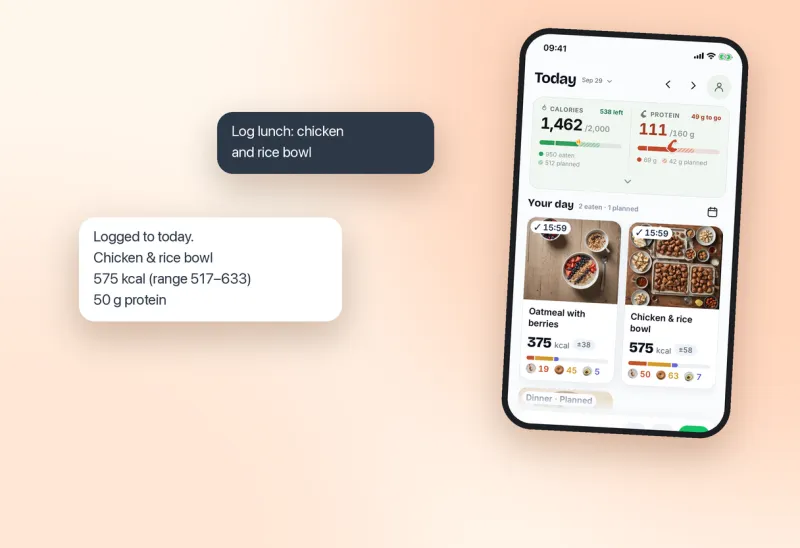
BurnWeek is now a published app in the ChatGPT directory. Version 1.0.0 is live, which means that in a chat you were already having you can write "log a chicken burrito and a coke" and the meal lands in your BurnWeek account, with a calorie range, a protein figure, and today's running total rendered as a card right there in the thread. No app switch, no form, no picking a database entry called "Burrito, chicken, fast food, 1 item".
That is the whole feature, and it is worth being plain about why a tracker would want it. The hard part of food logging has never been arithmetic. It is the thirty seconds between finishing a meal and having it written down, and every step in those thirty seconds is a place where the log does not happen. The pillar on mindful eating with numbers makes the general case that a one-sentence log is the cheapest possible act of attention. This release moves that sentence into a place many people are already typing.
Adherence is the outcome that actually moves, and friction is what sets it#
The evidence for self-monitoring is strong in one direction and weak in another. A systematic review of 22 studies reported that people who recorded what they ate lost more weight, while being candid that the evidence level was weak because of the methods available: homogeneous samples, reliance on self-report, and no objective measure of whether people actually recorded what they ate1. Tracking helps the people who keep tracking. The interesting question is what keeps them tracking.
The cleanest answer comes from a trial that held the intervention constant and changed only the recording medium. 128 overweight volunteers were randomized to log the same self-monitoring program by smartphone app, by website, or on paper. At six months the app group had recorded a mean of 92 days of dietary data against 35 for the website and 29 for the paper diary, and retention was 93 percent against 55 and 53 percent2. The content of the diary was the same in all three arms. Three times the adherence came from the medium being closer to hand.
A post hoc analysis of a separate six-month program pointed the same way. Participants who chose an app to self-monitor physical activity recorded it 2.6 days a week against 1.2 for non-app users, and among the diet-logging methods, app users reported lower energy intake than paper-journal users at six months3. These are not randomized comparisons of media and should not be read as one; they are a second observation that the tool people already have open is the tool they use.
A chat window is, for a growing number of people, the thing already open. The claim here is modest and it is the only one the evidence supports: moving the log one step closer to where you already are is the kind of change that has historically improved adherence, and adherence is the variable with a track record of moving weight. We have no user numbers to show for this release, and will not invent any.
What the app actually does in a chat#
Six things, and they are deliberately few.
Log a meal from a sentence. "Log 200 g skyr and a banana" is a complete instruction. The text goes to the estimator, which returns the components, their portions, a calorie range and a protein figure, and the result comes back as a card: the meal, the range, the protein, the day's total.
See what is left today. Asking what is left returns the day card — eaten so far, remaining calories, protein against target — the same numbers the phone app shows, because they are the same records.
Adjust the grams. If the estimate assumed 150 grams of rice and it was closer to 250, say so, or tap Edit grams on the card. The component is re-priced and the totals move. This is the same inline correction the app has always had, which exists because a range you can correct is more useful than a number you cannot.
Undo the last meal. One instruction, on the card or in words.
Look at the week, and work with your saved recipes and plans, so a meal you eat often is one phrase rather than a re-description.
What none of these do is calculate calories inside the assistant. Every log goes to the same estimator the phone app uses; the assistant receives a finished estimate and renders it. That boundary is the point. A general-purpose model asked to guess the calories in a burrito will produce a confident number that varies between conversations. The app's own estimator gives the same number for the same words, and can be corrected in a way that persists. The assistant is a keyboard and a display. The scale and connector post makes the matching point from the other end: the channel changes the friction, not the accuracy.
Signing in takes a six-digit code emailed to you, and that first sign-in is what creates the account. Meals logged in the chat are waiting in the phone app when you open it, because there is one account and one day behind both.
It is a connector, not a ChatGPT feature#
The app people can now install from the directory is a thin wrapper around something more general: BurnWeek runs a Model Context Protocol server. MCP is an open protocol for letting an assistant call tools on a server it did not write, and ChatGPT is one client of it. Claude is another. So is any assistant, editor, or agent that can add an MCP connector.
This matters for a reason beyond breadth. A tracker that exists only as an app in one company's directory is one product decision away from disappearing. A tracker that exposes its logging as a protocol endpoint is available from whatever assistant you end up using, including ones that do not exist yet, and the listing in any given directory is just a convenience — a route in, not the thing itself. The tools are the same ones described above whichever client calls them, because there is one server behind all of them.
There is a practical consequence too. Logging a meal from an assistant is a text-only channel, which is exactly the channel the portion literature is hardest on: people judging amounts in words, with nothing weighed. A 2013 study that asked 32 adults how many portions each of 33 foods represented found beverages and medium-energy-density foods underestimated by 30 to 46 percent4. Typing "a coke" into a chat inherits that error in full. The connector does not pretend otherwise; it is why the grams are editable and the range is wide when the words are vague.
A range, in a medium that rewards false confidence#
Every estimate the app returns has three numbers behind it: a low, a likely, and a high. The card in the chat shows the range, not a single figure, and it does that on purpose.
The reason is that a single figure would be a lie about the size of the error, and the error is large. In the study that made the point most sharply, obese adults reporting diet resistance were measured against doubly labelled water: they underreported their actual intake by an average of 47 percent and overreported physical activity by 51 percent, with no metabolic abnormality involved5. That is the error a food log lives inside. A review of mobile momentary diet assessment methods frames the design problem the same way: the methods worth building are the ones that cut recall bias and participant burden at the same time, because those are the two failure modes6.
A calorie range is an honest description of that uncertainty rather than an apology for it. "620 to 780" tells you something a bare 700 does not: that the number is good enough to steer a day and not good enough to argue about a hundred calories. When you narrow the input — a weight, a barcode, a named recipe — the range narrows with it, so its width describes your log rather than standing as a permanent disclaimer. The ranges explainer has the arithmetic, and the accuracy piece has the error budget.
This is also the discipline that makes the connector safe to use. An assistant is an unusually persuasive way to receive a number; it writes in fluent sentences and does not hedge unless it was built to. By returning a range the app keeps the uncertainty visible in the one medium most likely to smooth it away.
FAQ#
How do I add BurnWeek to ChatGPT?#
It is a published app in the ChatGPT directory as version 1.0.0. Add it, sign in with the six-digit code emailed to you, and the first sign-in creates your BurnWeek account. Meals logged in chat appear in the phone app.
Does ChatGPT calculate the calories?#
No. Every log is forwarded to BurnWeek's own estimator, which returns the components, the calorie range, and the protein; the assistant renders that result. Ask a general-purpose model directly and you get a different, more confident number each time.
Does this work with Claude or other assistants?#
Yes. The connector is a Model Context Protocol server, and the ChatGPT app is one client of it. Any MCP-capable assistant can connect to the same server and call the same tools against the same account.
Why does it show a range instead of one number?#
Because the error in self-reported intake is large enough that a single number would misrepresent it — underreporting of nearly half of actual intake has been measured against doubly labelled water. The range narrows when the input is more specific, so its width tells you how much of the meal was actually pinned down.
Can I fix an estimate that came out wrong?#
Yes. Adjust the grams of any component from the chat, in words or from the card, and the totals recompute. The correction persists on the record in the app, the same as an edit made on the phone.
Sources#
- Burke LE, Wang J, Sevick MA. Self-monitoring in weight loss: a systematic review of the literature. J Am Diet Assoc. 2011.
- Carter MC, Burley VJ, Nykjaer C, Cade JE. Adherence to a smartphone application for weight loss compared to website and paper diary: pilot randomized controlled trial. J Med Internet Res. 2013.
- Turner-McGrievy GM, et al. Comparison of traditional versus mobile app self-monitoring of physical activity and dietary intake among overweight adults participating in an mHealth weight loss program. J Am Med Inform Assoc. 2013.
- Almiron-Roig E, Solis-Trapala I, Dodd J, Jebb SA. Estimating food portions. Influence of unit number, meal type and energy density. Appetite. 2013.
- Lichtman SW, et al. Discrepancy between self-reported and actual caloric intake and exercise in obese subjects. N Engl J Med. 1992.
- Schembre SM, et al. Mobile Ecological Momentary Diet Assessment Methods for Behavioral Research: Systematic Review. JMIR Mhealth Uhealth. 2018.
Source: BurnWeek — "Log a meal without leaving the chat: BurnWeek is a published ChatGPT app", https://burnweek.fit/blog/chatgpt-app-launch/. Licensed CC BY 4.0: free to quote or reuse with a link to this page.