A log you never look back at is only half of self-monitoring#
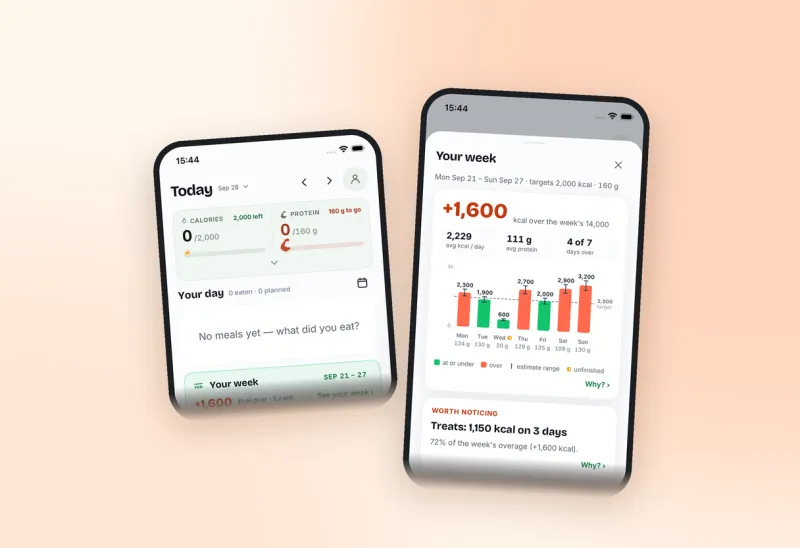
Since September 23, 2026, every Monday brings a short report called "Your week". It reads the seven days you just logged and hands back a handful of cards: what went well, what is worth noticing, one thing it learned about how you eat, how the week compares with earlier ones, and sometimes a possible focus for the week ahead. It is the first surface in the app that looks backward on purpose.
The reason to build it is that logging and reviewing are two different behaviors, and the research on self-monitoring has always assumed both. Writing a meal down is data collection. Turning a week of entries into something you can act on is feedback. Most trackers are good at the first and leave the second to you, which in practice means it rarely happens. The case for reviewing a log at all, and how to do it by hand, is in how to review your food log; this post is about the version the app now does for you once a week.
What self-monitoring research actually measured#
The best-known review of the field pooled 22 studies of dietary, activity and weight self-monitoring and found a significant association between self-monitoring and weight loss in almost all of them1. The authors were careful about what that means. The studies were mostly observational within trials, adherence to monitoring was measured in different ways, and the people who log consistently may differ from those who do not in ways the log does not cause. Hold the causal claim loosely.
What the review does settle is that consistency matters more than detail. Later work on electronic food logs found the same shape: in a 6-month program, the people who lost the most logged on more days, and the time they spent logging fell over the months rather than rising2. The habit that pays off is frequent and brief. A weekly review fits that pattern only if it asks almost nothing of you, which is the constraint the report was designed around.
Feedback is one of the techniques that carries the effect#
When researchers took apart 122 healthy-eating and physical-activity interventions and coded which behavior-change techniques each one used, self-monitoring stood out. Interventions that combined self-monitoring with at least one other technique from the same self-regulation family, such as setting a goal, getting feedback on performance, or reviewing goals, were significantly more effective than the rest3. The finding is a meta-regression across heterogeneous programs, so the effect sizes are pooled estimates rather than the result of one clean trial. The direction, though, is what the product needed: recording helps most when something closes the loop.
A daily tracker already covers goal setting. The weekly report is the feedback and goal-review half. It does not tell you what to do; it shows you what you did, compared with your own targets and your own earlier weeks, and offers at most one thing to try.
Why weekly, and not every day#
Weighing research offers the nearest analogy for cadence. A systematic review of self-weighing found that more frequent weighing was consistently associated with better weight outcomes, and most of the studies that checked for psychological harm did not find it4. In a randomized trial, daily weighing plus weekly feedback on the trend produced more loss than a delayed-intervention control5. The pattern that keeps showing up is frequent measurement with a periodic summary.
Food logs work the same way. A single day is too noisy to judge: a dinner out, a birthday, or a long run can move it by hundreds of calories, and reading meaning into one day is how a bad Tuesday becomes a bad week. Seven days smooth that out while still being recent enough to remember. The broader case for looking at a week of intake rather than a single day is in weekly vs daily calorie tracking; the app itself stays daily, and the report is the one place it zooms out. The guide on how often to weigh yourself covers the scale side of the same idea.
| Evidence | What it found | What the report does with it |
|---|---|---|
| Burke 2011 | Self-monitoring tracks with weight loss across 22 studies | Builds only on what you logged; no extra entry asked |
| Harvey 2019 | More logging days, less time per log, more loss | Arrives on its own each Monday; reading takes a minute |
| Michie 2009 | Self-monitoring plus feedback or goal review works best | Went well, Worth noticing, and one optional focus |
| Zheng 2015, Steinberg 2015 | Frequent measurement with periodic feedback helps | Daily logging, weekly summary |
What arrives on Monday#
A card on Today, Monday to Wednesday. It shows last week's balance against your target, a line like "kcal over · 5 cards", and "See your week ›". Tap it and read the report, and the card goes away. If you do not open it by Thursday, it steps aside anyway; the report stays in History.
Email and push, if you want them. The report can also arrive by email and as a notification. Both are toggles in Profile → Weekly report, and turning them off changes nothing else.
The headline. The sheet opens with the week's balance against your target, shown as a range rather than a single figure, because the meals it adds up are estimates and the total carries their uncertainty. Under it sit your average daily calories and average protein, and a bar for each of the seven days, drawn low, likely and high, so a day that was probably fine but possibly over looks like exactly that.
Went well. Things that held up, in plain language: more days hitting your protein target than your usual, a new food that kept showing up, or a steady run of logged days.
Worth noticing. Things that moved, without a verdict attached: treat days up compared with recent weeks, or one day of the week that tends to run higher than the others. An over week is a number over, drawn in the same type as a number under.
Something we learned. One observation about how you eat that a single day could not show, such as which meal tends to carry most of your protein.
Compared with earlier weeks. How this week sits against the ones before it, so a small drift reads as a drift rather than as noise.
Possible focus. Sometimes, not always, the report suggests one thing for the coming week. If it involves a meal, "Plan it for Tuesday ›" puts it into the plan with one tap, using the same planning you already know from Plan a Day. You can ignore it; nothing tracks whether you did.
"Why?" on every card. Each card has a small "Why? ›" expander that shows the numbers behind it, so a claim like "treat days up" comes with the days it is counting.
Past weeks in History. A "Weekly reports" pill in History opens a list of earlier weeks, each with its dates, a one-line summary and its balance.
The numbers come from your log, not from AI#
Every figure in the report, from the balance to the protein average to the bars, is computed from the meals you logged, and the report's footer says so. Nothing in it is generated text dressed up as a measurement. That matters for feedback: a summary you cannot trace back to your own entries is easy to dismiss, and the "Why?" expander is there so you never have to take a card on trust.
The report also inherits the app's rules about tone. It leads with what went well, it has no grades, streaks or red verdicts, and the evening-side reasoning for that, including why guilt tracks with worse outcomes, is in the Finish Today redesign post.
Where a weekly review can mislead#
The self-monitoring evidence is strongest for logging itself, and weaker for automated summaries of it; most of the feedback in the trials above came from people, such as coaches and interventionists, not from an app. A weekly review delivered by software may do less than one delivered by a person who knows you. A report built from a log is also only as good as the log: a week with several half-logged days produces a report about the half you logged. The guide to untracked days covers how to think about those gaps. And not every feedback trial succeeds: one randomized trial of a self-weighing intervention found no significant difference in weight loss compared with a control6. Feedback helps on average. It is not guaranteed to help you.
FAQ#
Does reviewing your food log help with weight loss?#
Self-monitoring is consistently associated with weight loss across studies1, and interventions that pair it with feedback or goal review tend to work better than those without3. The evidence is mostly associational, so treat a weekly review as a reasonable aid rather than a proven cause.
Why a weekly report instead of a daily one?#
A single day is noisy; one meal out can move it by hundreds of calories. Seven days are long enough to show a pattern and recent enough to remember what happened, which matches the frequent-measurement, periodic-feedback pattern in the self-weighing trials5.
Can I turn off the weekly report email or notification?#
Yes. Profile → Weekly report has separate Email and Push toggles. The report itself still appears in the app on Today (Monday to Wednesday) and in History.
Is the report written by AI?#
No. Every number is computed from the meals you logged, and the footer of the report says so. Each card's "Why?" expander shows the figures behind it.
Sources#
- Burke LE, Wang J, Sevick MA. Self-monitoring in weight loss: a systematic review of the literature. J Am Diet Assoc. 2011;111(1):92-102.
- Harvey J, Krukowski R, Priest J, West D. Log Often, Lose More: Electronic Dietary Self-Monitoring for Weight Loss. Obesity (Silver Spring). 2019;27(3):380-384.
- Michie S, Abraham C, Whittington C, McAteer J, Gupta S. Effective techniques in healthy eating and physical activity interventions: a meta-regression. Health Psychol. 2009;28(6):690-701.
- Zheng Y, Klem ML, Sereika SM, Danford CA, Ewing LJ, Burke LE. Self-weighing in weight management: a systematic literature review. Obesity (Silver Spring). 2015;23(2):256-65.
- Steinberg DM, Bennett GG, Askew S, Tate DF. Weighing every day matters: daily weighing improves weight loss and adoption of weight control behaviors. J Acad Nutr Diet. 2015;115(4):511-518.
- Madigan CD, Jolly K, Lewis AL, Aveyard P, Daley AJ. A randomised controlled trial of the effectiveness of self-weighing as a weight loss intervention. Int J Behav Nutr Phys Act. 2014;11:125.
Source: BurnWeek — "Your week, every Monday: the weekly report", https://burnweek.fit/blog/weekly-report-launch/. Licensed CC BY 4.0: free to quote or reuse with a link to this page.