The binding constraint is protein per calorie, not amino acids#
The practical plan for hitting a protein target without animal foods is short, and it is not the one most guides give you. Stop worrying about combining proteins at every meal — that concern is settled and the answer is no. Instead treat protein as a share of your calories and raise it deliberately: a plant-based day that reaches a training-level target has to run roughly 18 to 20 percent of its energy as protein, against the 12.6 percent a typical vegan actually eats. You get there by anchoring every meal on a concentrated source — soy foods, seitan, legumes, or a plant protein powder — rather than by hoping the beans in a mixed dish add up.
That framing matters because the two problems people expect are not the ones they meet. Amino acid quality, which dominates the internet's advice, turns out to be comfortably solved in real plant-based populations. Total protein density, which almost nobody discusses, is where plant diets actually run short — because the foods carrying plant protein also carry carbohydrate, fat and fiber along with it. Plant vs animal protein covers whether the source changes what the protein does once you have eaten it; this is about getting it eaten.
What plant-based eaters actually consume#
Start with real numbers rather than hypotheticals. In the EPIC-Oxford cohort, protein intake as a share of energy ran about 17.2 to 17.6 percent in meat-eaters, roughly 14 percent in lacto-ovo-vegetarians and 12.8 to 13.1 percent in vegans1. A detailed amino acid analysis of 392 men from the same cohort — 98 per diet group, aged 30 to 49 — put median protein at 15.0 percent of energy in meat-eaters and 12.6 percent in vegans2.
A four-point gap in percent of energy sounds trivial. It is not. On a 2,200 kcal day, 12.6 percent is about 69 g of protein and 17.5 percent is about 96 g — a 27 g difference, or nearly a whole extra meal's worth of protein, arising from nothing but the composition of the diet. (That conversion is our arithmetic on their percentages, using 4 kcal per gram; the cohort reported shares, not grams per person.)
So the deficit is real and it is a quantity problem. Which makes it worth being precise about the quality problem everyone actually worries about.
The lysine gap is real — and it clears the requirement anyway#
Lysine is the amino acid plant diets are genuinely short of, and the raw comparison looks alarming. Across those 392 men, geometric mean lysine intake ran 5.01 g/day in meat-eaters, 4.14 in fish-eaters, 3.76 in vegetarians and 2.82 g/day in vegans — a shortfall of roughly 44 percent against meat-eaters. Methionine showed the same pattern: 1.67 g/day versus 0.882.
Now put a requirement next to it. The WHO/FAO estimated average requirement for lysine is 30 mg per kg of body weight per day. Scaled to body weight, EPIC-Oxford's lacto-ovo-vegetarians took in 58 mg/kg and its vegans 43 mg/kg — comfortably above it, which is why a review of protein and amino acids in vegetarian diets concludes that "an insufficient intake of lysine is not therefore expected in these populations"1.
That is the whole lysine story in two numbers: 44 percent below meat-eaters, and 43 percent above the requirement. Both are true. The gap is measurable and it is not a shortage. The authors do name the scenario where it becomes one — a diet where a very high proportion of protein comes from cereals alone — and describe it as unrealistic in developed countries.
Which disposes of protein combining as a mealtime chore. The same review states there is no evidence that single plant proteins need to be supplemented with others in the same meal, and that "a reasonable variety of sources over the course of the day appears to be appropriate"; combining within a meal is a practical convenience if total protein is low, not a metabolic requirement1. The classic pairings still work — rice is low in lysine and high in methionine, pea the reverse — they just don't need a stopwatch. Complete vs incomplete proteins works through the chemistry.
One disclosure belongs beside this, because the conclusion is convenient for a particular industry: the review's lead author is the scientific leader of a research contract with Terres Univia, the French interbranch organization for plant oils and proteins, for which the paper records he receives no fee, and the work had no external funding1. Unpaid and disclosed is about as clean as an interest gets, and the underlying intake data come from an independently funded cohort — but the standard applies here the same way it applies to a dairy-funded paper.
Do plant eaters need a higher target?#
This is where a popular number deserves scrutiny. Fitness guidance often tells vegans to add 10 to 20 percent to their protein target. That figure is an extrapolation, not a finding, and the sources usually cited for it do not contain it.
For the general population the evidence points the other way. A meta-regression of nitrogen balance studies found no difference in either the slope or the intercept between animal, vegetable and mixed protein sources, which implies total protein requirement is similar on plant-based and animal-based diets — so there is no separate, higher RDA for vegetarians1. Digestibility supports that: measured for raw, minimally heated plant sources, soy isolate, pea isolate, wheat flour and lupine run 89 to 92 percent, against 91 percent for eggs, 90 to 94 for meat and 95 for milk protein. A few percentage points is not a different requirement.
For athletes the picture is honestly unresolved, and the most recent review says so rather than inventing a multiplier. It gives vegan athletes the same targets as everyone else — 1.2 to 1.6 g/kg/day for endurance, at least 1.6 g/kg/day for resistance training — and adds only that "it is feasible that optimal daily protein intake could be (modestly) higher for the vegan athlete, to what extent is not clear"3. Note the funding, in both directions again: every author of that review discloses support from Marlow Foods, a mycoprotein manufacturer with a direct commercial interest in non-animal protein.
So: use the standard targets from how much protein per day, aim toward the upper end of your band rather than the lower one, and treat any specific percentage uplift as a hypothesis someone has rounded into advice.
The arithmetic that actually bites#
Here is the number a plant-based eater should have in front of them. It is not grams; it is what those grams cost as a share of the day.
For a 70 kg person eating 2,200 kcal:
| Target | Grams per day | Share of a 2,200 kcal day |
|---|---|---|
| 0.8 g/kg (RDA floor) | 56 g | ~10% |
| 1.2 g/kg | 84 g | ~15% |
| 1.6 g/kg (training) | 112 g | ~20% |
| 2.0 g/kg (deficit, lean) | 140 g | ~25% |
(Grams × 4 kcal ÷ 2,200 — arithmetic, not a measurement. Scale it to your own weight and intake.)
Set that against the 12.6 percent of energy a typical vegan eats and the size of the job becomes obvious: reaching 1.6 g/kg means running a protein share above what the average meat-eater runs, on foods that are structurally worse at delivering it. Nobody drifts into that. It has to be designed.
And it gets harder in a deficit, where calories fall but the gram target rises or holds — precisely the situation where plant-based eaters most often under-eat protein without noticing. Why that matters for what you lose is in protein and muscle preservation while dieting.
Building the day#
The design principle is one concentrated anchor per meal, chosen for protein per calorie rather than protein per 100 grams. The first two columns below are USDA SR Legacy reference values4; the third is our division of one by the other:
| Plant anchor (per 100 g) | Protein | Calories | Protein per 100 kcal |
|---|---|---|---|
| Tofu, firm (calcium sulfate) | 17.3 g | 144 | ~12 g |
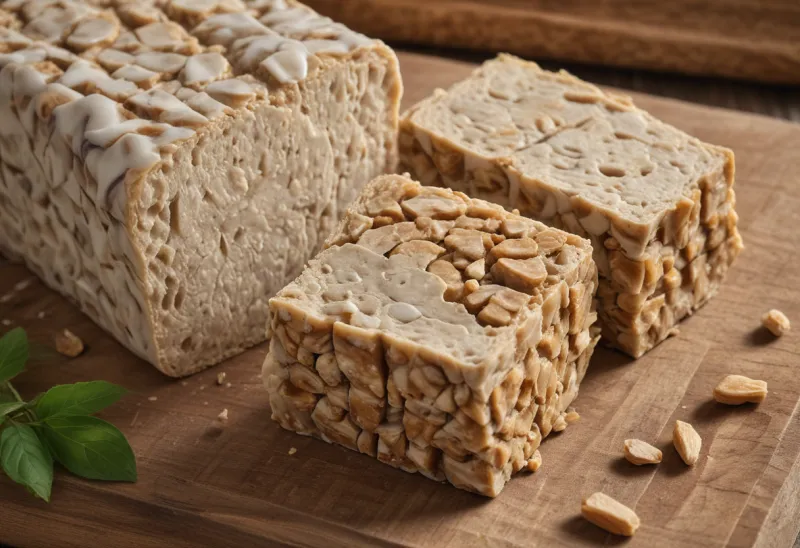
| Tempeh | 20.3 g | 192 | ~11 g |
| Lentils, cooked | 9.0 g | 116 | ~8 g |
The pattern that matters is the ordering, not the decimals. Soy foods roughly split the difference between legumes and lean animal protein on density, which is why they do most of the work in practical plant-based plans — and why the trials that matched vegans to omnivores on protein intake generally leaned on soy to do it. Legumes are excellent food and a mediocre protein anchor on their own: at about 8 g per 100 kcal, reaching 112 g of protein from lentils alone would cost roughly 1,440 calories, most of your day. They earn their place alongside a denser anchor, not instead of one.
Three practical consequences follow:
Anchor first, fill after. Decide the protein source for each meal before the rest of the plate. A grain-and-vegetable meal with legumes stirred through is usually a 10-to-15 g meal wearing a 30 g reputation.
Use isolates without embarrassment if the target is high. The digestibility figures above were measured on raw, minimally heated plant material still carrying trypsin inhibitors; purification removes the non-protein constituents that limit absorbability3. A pea or soy isolate is not cheating, it is the same solution the controlled trials used.
Spread the variety across the day, not the meal. Rice at lunch and lentils at dinner complement each other perfectly well. Cost-effectiveness is a real bonus here rather than a compromise — the budget ranking in cheap high-protein foods puts dried legumes in the same tier as chicken and eggs — and the amino acid ranking that drives source choice is in the best protein sources.
FAQ#
How much protein do vegans actually need per day?#
The same as anyone else. A meta-regression of nitrogen balance studies found no difference between plant, animal and mixed protein sources in the requirement, so there is no separate vegetarian RDA1. Use the standard bands — around 1.2–1.6 g/kg for general health and training, higher in a deficit — and aim at the upper end of yours.
Do you have to combine proteins at the same meal?#
No. There is no evidence that single plant proteins must be paired within a meal; a reasonable variety of sources across the day is sufficient, and within-meal combining is a practical convenience mainly when total protein is low1. Rice at lunch and lentils at dinner complement each other fine.
Is 1.6 g/kg realistic on a vegan diet?#
Yes, but only by design. For a 70 kg person on 2,200 kcal it means about 112 g of protein, or roughly 20% of energy — well above the 12.6% of energy a typical vegan eats2. That requires a concentrated protein anchor at every meal, usually soy foods, seitan or an isolate, rather than legumes scattered through mixed dishes.
Sources#
- Mariotti F, Gardner CD. Dietary Protein and Amino Acids in Vegetarian Diets — A Review. Nutrients. 2019;11(11):2661. (Lead author declares an unpaid research contract with Terres Univia, the French interbranch organization for plant oils and proteins.)
- Schmidt JA, et al. Plasma concentrations and intakes of amino acids in male meat-eaters, fish-eaters, vegetarians and vegans: a cross-sectional analysis in the EPIC-Oxford cohort. Eur J Clin Nutr. 2016;70(3):306-312.
- West S, Monteyne AJ, van der Heijden I, Stephens FB, Wall BT. Nutritional Considerations for the Vegan Athlete. Adv Nutr. 2023;14(4):774-795. (All authors declare funding or studentships from Marlow Foods Ltd.)
- USDA FoodData Central. Agricultural Research Service, U.S. Department of Agriculture. (SR Legacy reference values per 100 g for tofu, tempeh and cooked lentils.)
Source: BurnWeek — "Hitting your protein target on a plant-based diet", https://burnweek.fit/blog/protein-for-vegetarians-and-vegans/. Licensed CC BY 4.0: free to quote or reuse with a link to this page.