Estimate the plate in front of you, not the pot it came from#
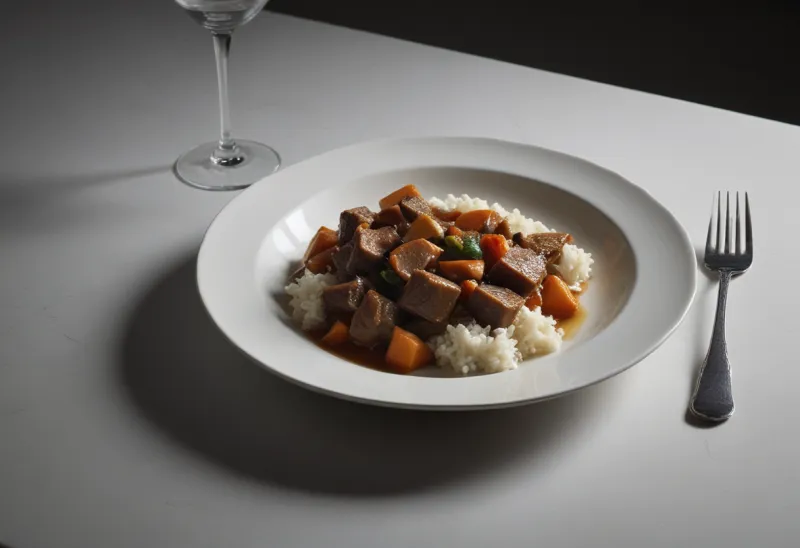
The move that makes a family dinner countable is to stop thinking about the dish and start thinking about the plate. You did not eat a recipe; you ate one ladleful of it, chosen by hand, from a pot that nobody weighed, at a table where four other servings were being drawn from the same surface. So the quantity to estimate is the food on your plate before you started — not the total divided by the number of chairs.
That sounds obvious until you notice how much tracking advice quietly assumes the opposite. "Serves 4" is a claim about the pot. A database entry for beef stew is a claim about a generic portion. Both invite you to log a share, and a share is exactly the thing you have no measurement of. If you cooked the dish, the recipe calculation gives you calories per 100 grams, and from there your plate is one weighing away. If you didn't, the plate is still the unit — you are just estimating an unfamiliar one.
This is not a personal failing to be trained away, incidentally. Shared-dish eating is a recognised open problem in dietary assessment. A review of the methods used to measure it found that visual estimates of food weight correlate well for individually plated meals (r = 0.89) and less well for shared plates (r = 0.84), with error concentrating on quantities under 70 grams, and that the field lacks validated tools for the setting at all3. That review was written about communal eating in low- and middle-income countries rather than about Sunday dinner, so read the diagnosis rather than the numbers: when food is portioned by hand from a central dish, professional dietary assessment gets measurably worse too.
The plate was already bigger before anyone sat down#
Here is the part that changes what you should expect from the total, and it happens before the first bite.
Across two experiments, women served themselves larger meals when they were anticipating eating socially — and crucially, in the condition where they served before the company was present, so they were physically alone at the moment of decision. In the first study the difference was roughly 27 grams (d = 0.26, P = 0.031); in the second it was 43.24 grams when the expected companion was a friend (d = 0.65, 95% CI 15.29 to 71.20) and 47.66 grams when it was a stranger (d = 0.89, 95% CI 18.91 to 76.41)2.
Two details matter for tracking. The first is that the effect is on the served portion, which is the quantity you would estimate and log — so a family dinner does not merely change how much you eat, it changes the object you are looking at when you make the estimate. The second is that the stranger condition worked too, which is worth flagging because it does not match the intake literature below. Anticipating company appears to enlarge the plate regardless of whose company it is; the eating effect is fussier about that. Both studies were in women, in a laboratory, with modest samples, so treat the tens of grams as an order of magnitude rather than a coefficient.
How steeply it scales with headcount is not settled#
That familiar company raises intake is established — the pooled evidence across 42 studies is substantial, and it is specific to people you know rather than to company in general1; what that means for a gathering is worked through in tracking calories at parties. The open question, and the one a family cook actually faces, is whether a table of six is worse than a table of three.
Reanalysing existing food-diary datasets, de Castro and Brewer reported a rising ladder of meal size against the number of people present, as summarised in that same review:
| People present | Meal size vs eating alone |
|---|---|
| 1 other | +28% |
| 2 others | +41% |
| 3 others | +53% |
| 4 others | +53% |
| 5 others | +71% |
| 6 or more | +76% |
Source: de Castro and Brewer's reanalysis, as reported in Ruddock et al., 2019.
Those are large numbers, and they are widely repeated. The same review also lists what happened when the question was asked a different way: three researcher-observed studies found no effect of group size on the energy of foods selected or eaten, one reported that women ate less in larger groups than smaller ones, and an experiment found no difference in intake between groups of four and pairs1.
So what separates them? Almost entirely the method. The steep ladder comes from diary research, where the same participant records both how much they ate and how many people were there. The flat results come from designs where somebody else counted the company, or where group size was assigned by the experimenters.
The steepest dose-response in this literature comes from the one design that asks a single person to report both variables at once.
That is not a reason to dismiss the diary work — it is a large, replicated correlation and the meta-analytic effect for friends survives on other evidence. It is a reason not to walk into a dinner party expecting to eat 76 percent more, and a reason to treat the ladder as a direction rather than a multiplier you apply to your log.
A caution about where some of this literature came from#
If you go looking for research on family-style serving — the bowls on the table, who reaches for what — a large share of the most-cited work traces to a single food-marketing laboratory whose output was substantially withdrawn. JAMA Pediatrics retracted one of that group's papers on children's school-lunch choices outright4, and it was not an isolated correction. None of the findings in this article rest on that body of work, which is a deliberate choice rather than an oversight, and it is worth knowing if you encounter confident claims about serving bowls and family dinners elsewhere.
Working a shared dinner#
Photograph the plate before the first bite. This is the one capture that survives everything else about a family meal — the conversation, the seconds, the interruptions — and it fixes the quantity at the only moment it is well defined. Angle and a size reference do most of the work.
If you cooked it, weigh the pot once. Finished dish on the scale, your bowl on the scale, and your share is the ratio. That single number converts every serving anyone takes from the dish for the rest of the week, and it is the same trick that makes a batch countable.
If you didn't cook it, name the parts and widen. What lands on your plate is an unknown ratio of solids to sauce, set by how deep the spoon went and where in the pot it went — the mixed-dish problem in full. Log a band, not a figure.
Do not log the household total and divide. A family meal is the one occasion where an apparently rigorous method — total the recipe, divide by four — is worse than a rough look at your own plate, because nobody at that table took a quarter. The cook rarely does, the children never do, and the error is a multiplier on everything you carefully summed.
Expect the day to run high, and let it. Between the enlarged serve and the friends effect, a shared dinner is structurally a bigger meal than the same food eaten alone. That is not a tracking error to correct out; it is a real thing that happened, and it is why comparing a Sunday to a Tuesday tells you very little on its own. The broader case for reading the week rather than the meal is in how to count calories.
FAQ#
How do I count calories in a dish everyone is sharing?#
Estimate your own served portion, not a fraction of the recipe. If you cooked the dish, weigh the finished pot and weigh your bowl — your share is that ratio applied to the recipe total. If you didn't, photograph your plate before you start and log a range. Dividing a recipe by the number of people at the table is the step that fails, because nobody actually takes an equal share.
Does the number of people at the table change how much I eat?#
Less reliably than the widely quoted figures suggest. Food-diary reanalyses report meal size rising from +28% with one companion to +76% with six or more, but the same review lists three researcher-observed studies finding no group-size effect, one finding women ate less in larger groups, and an experiment finding no difference between groups of four and pairs1. The steep ladder comes from the design where one person reports both the meal and the company.
Does it help to serve myself before everyone sits down?#
Probably less than you would hope, because the enlargement happens at the moment you anticipate company rather than the moment you see it. Women serving themselves alone, but expecting to eat socially, took roughly 27 to 48 grams more food than when expecting to eat alone2. What serving early does buy you is a clean, photographable plate before anyone starts passing dishes.
Sources#
- Ruddock HK, Brunstrom JM, Vartanian LR, Higgs S. A systematic review and meta-analysis of the social facilitation of eating. Am J Clin Nutr. 2019;110(4):842-861.
- Ruddock HK, Long EV, Brunstrom JM, Vartanian LR, Higgs S. People serve themselves larger portions before a social meal. Sci Rep. 2021;11:11072.
- Burrows T, Collins C, Adam M, Duncanson K, Rollo M. Dietary assessment of shared plate eating: a missing link. Nutrients. 2019;11(4):789.
- Notice of Retraction. Wansink B, Just DR, Payne CR. Can Branding Improve School Lunches? Arch Pediatr Adolesc Med. 2012;166(10):967-968. JAMA Pediatr. 2017.
Source: BurnWeek — "Tracking calories from a shared family dinner", https://burnweek.fit/blog/how-to-track-calories-with-a-family-meal/. Licensed CC BY 4.0: free to quote or reuse with a link to this page.