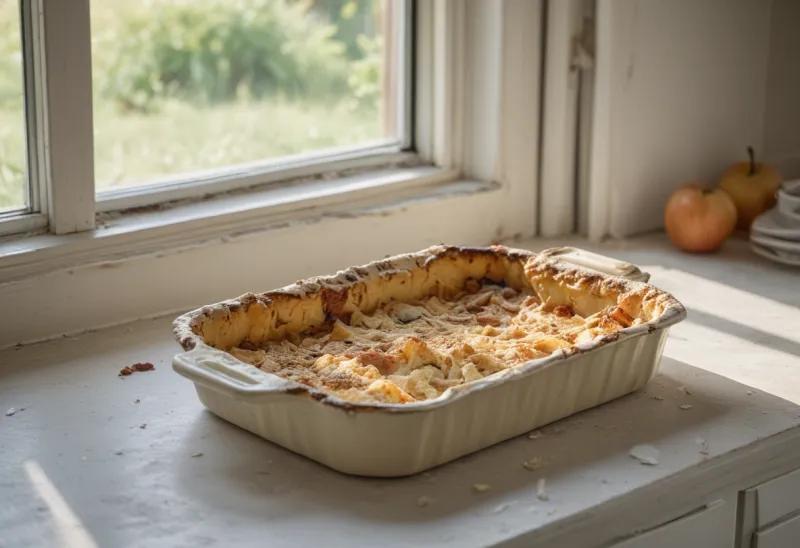
Sum the raw weights, weigh the pot, then divide#
The reliable method for a dish you cooked yourself has four steps and no guessing in the first three: weigh each ingredient raw as it goes in, add up its calories from the database, weigh the finished dish, and divide by however many portions you actually cut. Log your serving as its share of that total, expressed as a range. Nothing here requires you to identify a dish, judge a portion by eye, or trust an entry built to represent somebody else's version of the same recipe.
That is worth stating plainly because home cooking usually gets described as the hardest thing to count. It is the opposite. A recipe is the only meal in your log where the hard measurement has already been taken — by you, on a scale, before anything went in a pan. Every other entry you make is an inference from a finished object. This one is arithmetic on inputs you personally weighed, which is why it deserves a different workflow from the estimate-and-widen approach that the rest of home cooking needs.
Three inputs, and the ingredient list is the easy one#
A recipe calculation has three sources of error, and almost everyone spends their attention on the first while the second and third do the damage.
| Input | How you get it | How wrong it can be | What it costs to fix |
|---|---|---|---|
| Ingredient weights | Scale, before cooking | Small — you controlled it | Seconds per ingredient |
| What leaves the pan with the food | Yield factor, or weighing the dish | Large, and method-specific | One weighing of the finished dish |
| The divisor (portions) | Usually a guess | Large, and it multiplies | One weighing of your plate |
The first row is the one people obsess over and the one with the least room to move. If you weigh 340 g of chicken thigh instead of 350, you have introduced about 1 percent of error into one component of one meal. The third row is where a carefully weighed recipe quietly falls apart, because an error in the divisor is not added to your total — it scales it. Take a quarter of the tray when you actually took a third and every gram you weighed at the start is out by a third, including the ones you were careful about.
The cooking medium is not an ingredient#
Here is the step that separates a recipe calculation from a shopping list, and it is defined precisely in the standards work that European food composition databases run on. A weight yield factor is "prepared dish, including waste (g) ÷ total quantity of ingredients (ready-to-cook) (g)" — and the report is explicit about what does not go into that sum: "Note that the cooking medium (water or fat) is not included in any of the following calculations"1.
That single sentence resolves the argument home cooks have with themselves about oil, and it resolves it conditionally rather than with a rule. The pasta water and the litre of frying oil are cooking media: most of them never enter the food, and counting them as ingredients inflates the total. The tablespoon you swirled into a roasting tray, the oil in a dressing, the butter you finished a sauce with — those are ingredients, because they leave the pan on the plate. The question is never "did I add fat," it is did the fat leave with the food, and you can usually answer that by looking at what is left in the pan.
This calculate-from-ingredients approach is not a home-cook shortcut, incidentally — it is how most cooked entries in national databases are produced in the first place, because direct chemical analysis is "out of reach for high cost"4. You are running the same procedure the compilers run, with one enormous advantage: you know the actual recipe.
The stakes on getting it wrong are measurable. When researchers prepared 150 dishes across grains, meat, fish, egg and vegetable categories using common Chinese cooking methods, and compared the values calculated from ingredients against laboratory analysis of the finished dish, agreement was good enough for many dishes and badly off for others — with the ratio between calculated and detected values falling outside the 0.5-to-2× band often enough that the authors built a database of cooking-method correction factors specifically to close it2. Their raw-to-cooked weight ratios show why the correction is method-shaped rather than food-shaped: steamed rice came out at 0.49 (the cooked pile weighs about twice the raw), deep-fried chicken breast at 1.25 and braised beef brisket at 1.35 (both shed weight, the braise more than the fry).
You do not need their factor tables. Weighing the finished dish measures your own yield directly, for your pan, your heat and your timing — which is strictly better than borrowing a factor, and takes ten seconds. That is also the cleanest way to sidestep the raw-versus-cooked basis problem entirely: you priced the food raw, and the cooked weight is only being used to work out shares.
"Serves 4" is a claim about grams, and a wide one#
Now the divisor. A recipe's serving count feels like part of the recipe, in the way an ingredient quantity is. It is not — it is the author's opinion about how many people the dish should feed, and it varies enormously between authors writing about the same kind of food.
An analysis of 312 main-meal recipes promoted by Australian supermarkets over a year found a mean stated serving of 415 ± 138 g, carrying 583 ± 217 kcal3. The standard deviations are the finding. A third of a standard deviation either side of that mean spans a range of serving sizes that no cook could distinguish by eye, and the energy spread is wider still. The same study found that recipes published as advertorials specified significantly larger servings than editorial ones — 485 ± 154 g against 403 ± 126 — which is a useful reminder that the number after "serves" was set by someone with an agenda about the dish, not by a measurement of it.
European database compilers, facing the same problem professionally, chose a single agreed recipe-calculation procedure knowing it "may sometimes be at the expense of the accuracy of the data," because comparability across everyone using it was worth more.
That trade is the one to copy, and it is the whole argument for the four-step method above. Weighing the finished dish and your own plate gives you a divisor that is measured rather than declared. It will not be the recipe's four servings; it will be your actual share of the actual dish. And because you will compute it the same way every week, whatever residual error survives is an offset that sits in the background of your log instead of a fresh random insult to each entry.
Where the calculation stops paying#
Two limits worth naming, so you spend the effort where it works.
The calculation degrades when the dish separates. A pot with a solid part and a gravy is really two foods, and the EuroFIR procedure handles them as such — computing yield separately for the solid part and the liquid — because drippings and gravy "are not always consumed." If you serve the stew and leave most of the sauce in the pot, your share of the calories is not your share of the mass.
It also degrades on inedible weight. Yield factors have to be adjusted for waste before they mean anything: the EuroFIR worked example takes roasted chicken at 25 percent waste, so a whole bird's cooked weight has to be multiplied by 0.75 to get the edible portion. Weigh the plate rather than the pot for anything with bones, shells or stones, and the problem disappears.
Neither limit undoes the main claim. A dish you cooked from weighed ingredients is the most accurately countable thing you will eat all week, and the reason is boring: somebody measured it, and that somebody was you. Where it goes wrong is almost always the divisor — which is a ten-second weighing, not a research problem. Cook a batch and the same computation covers five meals instead of one, which is the case for treating meal prep as the high-accuracy path rather than the lazy one, and it fits the same rule that governs the whole method: compute roughly, repeat consistently, read the week.
FAQ#
How do I calculate the calories in a recipe I cooked myself?#
Weigh each ingredient raw as it goes in and total its calories from a database; weigh the finished dish; weigh your own serving; then take your serving's share of the total. Count fat that leaves the pan on the food as an ingredient and cooking media that stay behind as neither — the professional yield equation excludes water and frying fat from the ingredient sum1.
Should I trust the recipe's serving count or weigh my own plate?#
Weigh your plate. A serving count is the author's opinion, and across 312 supermarket recipes the stated serving averaged 415 ± 138 g with 583 ± 217 kcal3 — a spread far too wide to inherit blind. Dividing measured dish weight by measured plate weight replaces a declaration with a measurement, and it is the single highest-leverage step in the whole calculation.
Do I have to recalculate a recipe every time I make it?#
No, and this is where recipe counting starts paying real dividends. Save the computed per-serving figure the first time and reuse it, re-weighing only the finished dish each time so the divisor stays honest. Ingredient quantities you follow from your own written recipe barely move between attempts; what moves is how much water left the pan and how you cut the portions, and both of those are captured by one weighing.
Sources#
- Vásquez-Caicedo AL, Bell S, Hartmann B. Report on collection of rules on use of recipe calculation procedures including the use of yield and retention factors for imputing nutrient values for composite foods. EuroFIR D2.2.9, 2007.
- Li N, Cong L, Wang H, et al. Establishing a nutrition calculation model for catering food according to the influencing factors of energy and nutrient content in food processing. Front Nutr. 2024;11:1388645.
- Wademan J, Myers G, Finch A, et al. A Recipe for Success? A Nutrient Analysis of Recipes Promoted by Supermarkets. Int J Environ Res Public Health. 2020;17(11):4084.
- Marconi S, Durazzo A, Camilli E, et al. Food Composition Databases: Considerations about Complex Food Matrices. Foods. 2018;7(1):2.