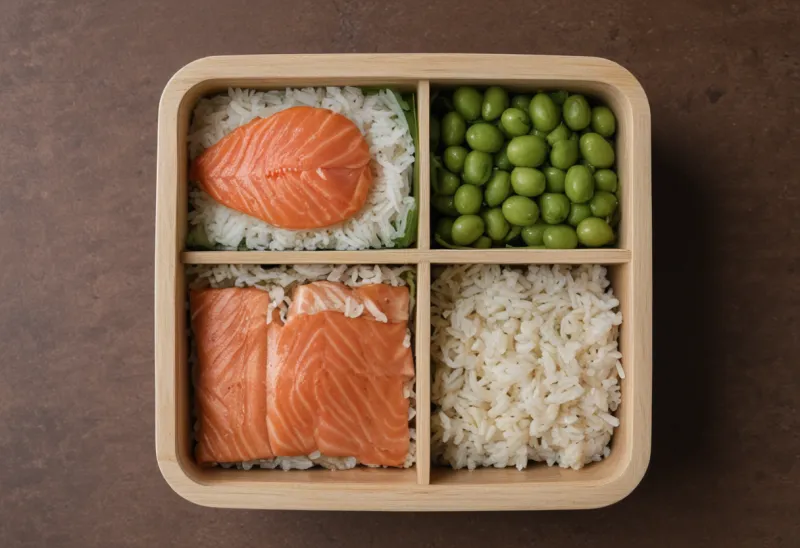
Protein first, calories second, a buffer last#
To plan meals that hit both a calorie goal and a protein goal, place the protein before anything else, fit the remaining calories around it, and hold back a slice of the budget for the eating you did not plan. Done the evening before, it is a short job once your meals are familiar, and during the day you update the record only where reality departed from the plan.
The order is a planning tactic, not a tested rule: calories can be filled by almost anything, protein cannot, so placing protein first shows early whether the day can cover both targets. The rest of this article is the method, a worked example, and the evidence behind each step. If you are new to tracking itself, how to count calories covers the groundwork.
Step 1: split the protein target into three or four anchors#
Start with a daily protein number. A review of higher-protein weight-management diets, written by a panel of protein researchers, concluded that intakes between 1.2 and 1.6 g per kg of body weight per day, and potentially at least about 25 to 30 g per meal, were associated with benefits for appetite and body-weight management1. For how to pick your own figure, see how much protein per day.
Divide that number into three or four meal-sized anchors of roughly 25 to 40 g each. An anchor is simply the protein food each meal is built around: eggs or Greek yogurt at breakfast, a tin of fish or leftover chicken at lunch, tofu or lean meat at dinner. Choosing anchors first turns a vague goal into three or four specific decisions.
Whether splitting protein evenly across meals matters for muscle beyond hitting the daily total is less clear than it sounds; the trials are summarized in protein distribution across the day. The practical reason for anchors is simpler: a target spread across meals is easier to reach than one left for dinner.
The same review adds a caveat worth keeping. The satiety effect of higher-protein meals is described as "modest", and acute feeding trials did not show that it reduced intake at the next meal. Over longer periods, improvements showed up mainly in people who actually adhered to the higher-protein plan1. Protein-first planning is a way to make adherence easy, not a way to make hunger disappear.
Step 2: budget the rest, then keep 10 percent back#
Count the full calories of each protein food portion, not just its protein: a salmon fillet brings fat, yogurt brings carbohydrate. Multiplying protein grams by 4 kcal would undercount most protein foods. Subtract those food calories and the buffer from the target; the remainder is for the rest of each meal and any snacks.
Then hold something back. The buffer below is our practical recommendation rather than a figure from a trial: about 10 percent of the daily target, left unassigned. Its purpose is to absorb the coffee with milk, the tasting while cooking, and the biscuit at a meeting, the eating that is never on a plan.
Nobody has tested a calorie buffer against a stricter plan, but the research on dietary lapses suggests where to aim a plan. In an ecological momentary assessment study that surveyed 189 adults in a weight-loss trial repeatedly throughout the day for two weeks, lapses came in three kinds: eating a larger portion than intended, eating an unintended food, and eating at an unplanned time. Hunger, deprivation, and boredom each raised the odds of different lapse types. Only one type predicted worse weight loss at the end of treatment: eating at an unplanned time2.
The lapse that tracked with worse weight loss was not eating the wrong thing. It was eating when nothing was planned.
That points at a design choice. A plan with scheduled eating occasions, including a snack if you usually want one, leaves fewer unplanned occasions to fill. A buffer then catches the rest without turning each extra bite into a failure.
A worked example: 1,900 kcal and 130 g protein#
Portions and figures are approximate; weigh or use label servings, total every ingredient including oils, and adjust portions until each meal lands near its allocation.
| Slot | Anchor protein | Planned protein | Planned kcal |
|---|---|---|---|
| Breakfast | 250 g plain Greek yogurt, 40 g oats, 100 g berries, 1 tsp honey | 30 g | 420 |
| Lunch | 120 g cooked chicken breast, 150 g cooked rice, salad with 1 tsp oil | 40 g | 550 |
| Snack | 150 g cottage cheese, one apple | 20 g | 200 |
| Dinner | 130 g salmon fillet, 250 g boiled potatoes, 200 g vegetables | 40 g | 540 |
| Buffer | Unassigned | 0 g | 190 |
| Total | 130 g | 1,900 |
The planned meals already carry the full protein target, so the buffer needs none of its own. Using all 190 kcal brings the day to 1,900; using none leaves it at 1,710; going past it puts you over.
When a planned anchor falls through, swap like for like: replace protein with protein at a similar calorie cost, rather than whatever is at hand. Illustrative swaps (check your labels):
| Planned | Swap | What to watch |
|---|---|---|
| Greek yogurt | Skyr or cottage cheese | Plain versions; sweetened ones add sugar calories |
| Chicken breast | Tinned tuna or turkey | Oil-packed fish carries extra fat |
| Salmon | Tofu or tempeh | Protein per serving differs, so check the label and adjust the portion |
| Eggs | Protein-fortified oats or a shake | A shake is fast but less filling than a meal |
Two more checks before you close the planner. First, is every anchor something you actually have in the fridge, or will buy on the way home? A plan that needs a shop you will not make is a wish. Second, does the day have one meal you will almost certainly eat out or eat with others? Give that slot a generous estimate and a larger share of the buffer. Batch-cooked meals need their own accounting, covered in meal prep calorie counting.
Step 3: log the deviations, not every bite#
Once the day is planned, each planned meal can be treated as already logged. During the day, your only job is to correct the plan where it went differently: a bigger portion, a swapped meal, an unplanned snack. Reusing saved meals cuts repeat entry, though checking portions and recording changes still takes some time.
Deciding before eating also changes what gets chosen. In a small workplace study, 26 hospital employees with overweight or obesity pre-ordered their lunches online after a short mindful-eating training. With price discounts, their lunches contained 144.6 fewer kcal than a comparison group's; in the later phase without discounts, their lunches averaged 114.6 kcal less than at baseline3. The study was small, compared against a delayed-treatment group, and bundled several ingredients (training, discounts, pre-ordering), so it shows what deciding ahead can do, not how much of the effect belongs to the ordering alone. The wider evidence on planning ahead versus logging after is in logging before vs after eating.
A single lapse may also matter less than it feels. In a 10-week app-based program where 121 participants reported lapses as they happened and weighed in weekly, the number of weekly lapses was not associated with percentage weight loss overall4. That is one study and the authors attribute part of the null result to differences in engagement, and it did not test whether correcting the log changes outcomes, but it argues against treating each lapse as a disaster.
Where the planning evidence stops#
The case for planning ahead is solid in outline and thin in detail. A meta-analysis of if-then plans ("implementation intentions") for eating found a medium effect for adding healthy foods (Cohen's d = 0.51) but a weaker one for cutting unhealthy foods (d = 0.29), with some effects likely inflated by weak control conditions5. That asymmetry supports planning what you will eat rather than a list of what you will avoid, a point developed further in our Plan a Day release notes.
The observational picture is similar. In more than 40,000 French adults, people who planned meals had better diet quality and lower odds of obesity, in both women and men6. But in 196 US adults whose homes were inventoried, making a weight-loss attempt was not associated with meal planning or grocery-list use at all, and the authors note that people plan for many reasons, including time management and organization7. Planning is a habit many people already have for reasons unrelated to weight. The method above adds two numbers to it.
No trial has tested this exact sequence (protein anchors, calorie budget, buffer, deviation logging) against another. Each step borrows from a separate line of evidence, and the sequence is our synthesis.
FAQ#
How far ahead should I plan my meals for calorie tracking?#
The evening before is enough for most people. You know what is in the fridge and roughly what the day holds, and a single day is short enough that the plan will mostly survive. Planning a full week works best when meals repeat, such as batch cooking.
Should I plan protein or calories first?#
Protein first. Calories can be filled with almost any food, while protein needs specific choices at each meal. Placing three or four protein anchors first also claims part of the calorie budget, so the rest of the plan falls into place.
How big should my calorie buffer be?#
About 10 percent of your daily target is a practical starting point, not a researched figure. If you routinely use all of it by mid-afternoon, plan an extra snack instead; if you never touch it, shrink it.
What if I eat something that was not in my plan?#
Log the difference and carry on. Unplanned eating is normal, and in one app-based program the weekly number of lapses was not associated with weight loss. Repeated eating at unplanned times is the pattern worth planning around.
Sources#
- Leidy HJ, Clifton PM, Astrup A, et al. The role of protein in weight loss and maintenance. Am J Clin Nutr. 2015;101(6):1320S-1329S.
- Goldstein SP, Dochat C, Schumacher LM, et al. Using ecological momentary assessment to better understand dietary lapse types. Appetite. 2018;129:198-206.
- Stites SD, Singletary SB, Menasha A, et al. Pre-ordering lunch at work. Results of the what to eat for lunch study. Appetite. 2015;84:88-97.
- Goldstein SP, Brick LA, Thomas JG, Forman EM. Examination of the relationship between lapses and weight loss in a smartphone-based just-in time adaptive intervention. Transl Behav Med. 2021;11(4):993-1005.
- Adriaanse MA, Vinkers CD, De Ridder DT, Hox JJ, De Wit JB. Do implementation intentions help to eat a healthy diet? A systematic review and meta-analysis of the empirical evidence. Appetite. 2011;56(1):183-193.
- Ducrot P, Méjean C, Aroumougame V, et al. Meal planning is associated with food variety, diet quality and body weight status in a large sample of French adults. Int J Behav Nutr Phys Act. 2017;14:12.
- Konsor M, Schneider KL, Appelhans BM. Associations Between Weight Loss Attempts, Food Planning, and the Home Food Environment. J Nutr Educ Behav. 2021;53(1):36-42.
Source: BurnWeek — "How to plan meals to hit calorie and protein goals", https://burnweek.fit/blog/how-to-plan-meals-for-calorie-and-protein-targets/. Licensed CC BY 4.0: free to quote or reuse with a link to this page.