About one in eight things you eat has been eaten before#
When 18 US adults photographed every item they selected, ate, and left over across a week — 1,177 food items in all — leftovers turned out to be 12.15 percent of the items and 9.71 percent of the calories they consumed1. Roughly a tenth of intake is food that was cooked on an earlier day and stored. It is also, in most diaries, the least carefully recorded tenth.
The fix is to stop treating a leftover as a new food. You costed this dish once already — when you cooked it, or when you logged the plate it came from. What you do not know is what share of it is on the plate now. So a leftover is an allocation problem, not an estimation problem, and it is solved by division rather than by judgement: your serving's weight over the batch's weight, applied to a number you already trust. That is a strictly easier operation than anything else in a day's log, and it is why leftovers should be your most accurate entries rather than your worst.
They usually are not, for two reasons that have nothing to do with effort.
The container that happened to be free decides the portion#
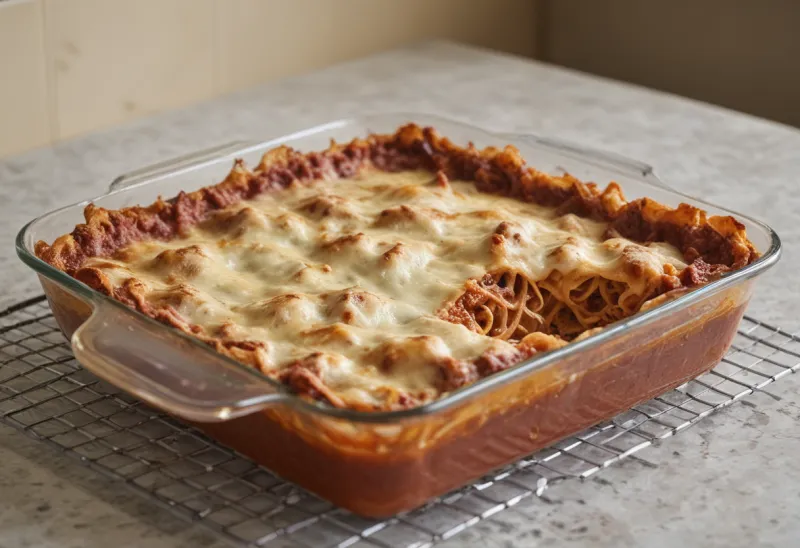
A batch cooked on Sunday gets divided deliberately: five boxes, weighed, logged per 100 grams. That is the meal-prep workflow, and it works because the division is planned. A leftover is the opposite — it is the residue after everybody has served themselves, decanted into whichever container was clean. Nobody decided its size. The tub did.
And then you eat the tub. People treat a single unit as the correct amount to consume: given larger individual items or a larger serving spoon, participants took and ate substantially more, at no cost, with unlimited supply available either way2. The authors' reading is that portion limits work partly because a unit feels complete in itself, not because appetite stops there.
That cuts both ways for a leftover. The good news is that the tub is a boundary, and boundaries are the thing that makes an amount countable. The bad news is that the boundary is arbitrary — it was set by cupboard inventory — so "I ate the leftovers" carries no quantity information at all. Compare that with a slice of pizza or a labelled pack, where the unit at least corresponds to something a manufacturer or a cook intended. The leftover container is a unit with no meaning behind it, which makes it the one packaging in your kitchen you cannot log by counting.
Your eye grades quarters, not grams#
So you fall back on judging a fraction — half the tray, a third of the pot. There is a validation literature on exactly this skill, because school and hospital researchers have spent decades estimating how much of a served meal came back uneaten, and the two best studies reach opposite-sounding verdicts.
| Study | What was judged | Scale | Verdict |
|---|---|---|---|
| Getts et al., 2017 | 748 individual trays, 4 middle and 5 high schools | 0 / 25 / 50 / 75 / 100% remaining | Valid: 45% of foods in almost perfect agreement with weighing, 42% substantial |
| Martins et al., 2014 | 505 primary-school lunches, non-selective aggregated main dish | 6-point Comstock scale | Not as accurate as weighing: mean overestimate 8.0 g, Bland-Altman amplitude 102.6 g |
Read the fourth column and it looks like a straight contradiction. It is not, and the thing that separates them is the question each one asked. Getts asked whether a visual grade lands in the same bin as the weighed value — a categorical agreement question — and the answer was yes, 87 percent of the time to within substantial agreement. Martins asked how many grams off a single estimate is, and reported Bland-Altman limits spanning 102.6 grams on servings that ranged from 88.9 to 283.3 grams. Both are correct. Eyeballing a fraction is good enough to say "about a quarter left" and nowhere near good enough to convert that quarter into a gram figure you then treat as measured.
That is the operating rule for leftovers, and it is unusually clean. Grade in quarters, and never launder the quarter into a precision it does not have. If the tub holds about a third of Sunday's batch, log a third of Sunday's number — and expect that third to be somewhere between a quarter and a half. What you must not do is take your visual third, multiply it by a batch weight, and record the resulting 214 grams as though a scale had been involved.
The scale, obviously, removes the whole problem, and for a leftover it is cheaper than usual: the container is already in your hand and already on its way past the counter. Weigh it once, subtract the tare, and the fraction becomes measured rather than graded. Martins's own conclusion points the same way — visual estimation is defensible for monitoring groups, but the individual-level scatter is what you are living inside.
A second helping is the same problem with no box at all#
Seconds are leftovers that never made it to the fridge, and they fail harder, because they lack even the arbitrary boundary a container provides. Nobody serves themselves a second helping in units. They take "a bit more" — an amount defined only by the fact that it is smaller than the first one.
Unit bias predicts these should be relatively rare, and that is roughly what controlled feeding work finds: when adults were given portions deliberately reduced past the point of looking normal and left free to help themselves to more, the extra they took averaged about 161 kJ — under 40 calories — against the next portion size up, and total meal intake still came out lower5. The broader finding that people don't fully compensate for a smaller plate is covered in portion distortion.
The tracking consequence runs the other way from the intake consequence, though. A second helping is small relative to the meal and enormous relative to how often it gets recorded, because it does not present itself as an eating event: no new plate, no new decision, no new food. It is a continuation of something already in the diary, and diaries are organised by items. This is why seconds concentrate on exactly the days a log is least likely to be complete anyway — the unstructured ones, which is the same clustering behind weekend totals that quietly undo a week's deficit.
The fix is not vigilance. It is a rule with no estimating in it: if you went back to the pot, duplicate the entry you already made and scale it. You logged 350 grams of chilli at 7:04. You went back at 7:19 for roughly half that again. Log the same entry at 0.5×. The number you are reusing was your best guess at the first serving, so the second inherits its accuracy for free, and you have spent no additional judgement. Estimating the second helping from scratch is the mistake — a fresh guess at a smaller, sloppier, unphotographed pile, made after you have already started digesting.
The leftover that gets half-eaten becomes another leftover#
One last pattern from the same US dataset, and it is the one that turns a single entry into a small ongoing liability. Across those 1,177 items, 24.37 percent of everything selected but not fully consumed was kept to become a leftover — 28.06 percent by calories — and leftovers themselves showed a higher probability of being only partly eaten than non-leftover items, by about 9.6 percentage points1. Leftovers were most often vegetables, cheeses, and meats, and they clustered on Mondays and at lunch.
So the typical leftover is not consumed the way a fresh plate is. It is opened, partly eaten, and put back — which means the served amount and the eaten amount diverge more here than anywhere else in your week, and it means one Sunday batch can generate three or four separate entries across the following days, each of them a fraction of a fraction. Roe's team also found the plainest of relationships underneath it: larger meals produced more uneaten food.
Two things follow. First, log at the end of the eating occasion rather than at the start, because for this food category the difference is real. Second, do not try to reconcile the chain. If the batch was 2,400 calories and your four recorded servings come to 1,900, the missing 500 went in the bin, and you should leave it there — a batch total is a supply figure, not an intake figure. Trying to make the arithmetic close is how a reasonable log turns into an anxious one, and the general case for tolerating loose ends is in handling days you didn't track.
A protocol that fits in ten seconds#
- Log the batch once, per 100 grams. Every later serving is then one multiplication, no matter what container it arrives in.
- Weigh the container if it is already in your hand. For a leftover this costs nothing extra, and it converts a graded fraction into a measured one.
- If you can't weigh it, grade in quarters. A quarter, a third, a half. Do not report the result to three digits.
- For seconds, duplicate and scale — never re-estimate. The first serving's number is the best one available, and reusing it costs no judgement.
- Log at the end, not the start. Leftovers are the food most likely to be partly abandoned.
- Let the batch not balance. Waste is not intake.
One genuine wrinkle worth knowing about rather than acting on: cooked starches that have been chilled and reheated are not quite the same food they were on day one, because some starch reorganises into a form that resists digestion. The effect is real and small, and what cooking and cooling do to a food's calories covers it properly. It is not a reason to discount your leftover rice, and it is nowhere near the size of the fraction error you are already carrying.
FAQ#
How do I count calories in leftovers?#
As a share of the entry you already made, not as a fresh estimate. Log the original batch once with its calories per 100 grams, then weigh — or, failing that, grade in quarters — whatever you actually take out of the fridge. This works because the composition question was settled when you cooked; only the division is open, and division is the cheaper of the two problems.
Do I need to log a second helping separately?#
Log it, but don't estimate it separately. Duplicate the entry you made for the first serving and scale it — half again, or the same again. A second helping tends to be modest in size, around 40 calories of extra intake in one controlled comparison5, and enormous in how often it goes unrecorded, because it never looks like a new eating event.
How accurate is eyeballing how much of a dish is left?#
Good at the level of quarters, poor at the level of grams. Judged against weighing across 748 school trays, a 0/25/50/75/100 percent visual scale put 45 percent of foods in almost perfect agreement and another 42 percent in substantial agreement3. But in a separate validation on 505 primary-school lunches, individual visual estimates carried Bland-Altman limits spanning 102.6 grams4. Use the fraction; don't convert it into a weight you then treat as measured.
Sources#
- Roe BE, Qi D, Apolzan JW, Martin CK. Selection, intake, and plate waste patterns of leftover food items among U.S. consumers: A pilot study. PLoS One. 2020;15(9):e0238050.
- Geier AB, Rozin P, Doros G. Unit bias. A new heuristic that helps explain the effect of portion size on food intake. Psychol Sci. 2006;17(6):521-525.
- Getts KM, Quinn EL, Johnson DB, Otten JJ. Validity and interrater reliability of the visual quarter-waste method for assessing food waste in middle school and high school cafeteria settings. J Acad Nutr Diet. 2017;117(11):1816-1821.
- Martins ML, Cunha LM, Rodrigues SSP, Rocha A. Determination of plate waste in primary school lunches by weighing and visual estimation methods: a validation study. Waste Manag. 2014;34(8):1362-1368.
- Haynes A, Hardman CA, Halford JCG, Jebb SA, Robinson E. Portion size normality and additional within-meal food intake: two crossover laboratory experiments. Br J Nutr. 2020;123(4):462-471.
Source: BurnWeek — "How to log leftovers and second helpings", https://burnweek.fit/blog/how-to-log-leftovers/. Licensed CC BY 4.0: free to quote or reuse with a link to this page.