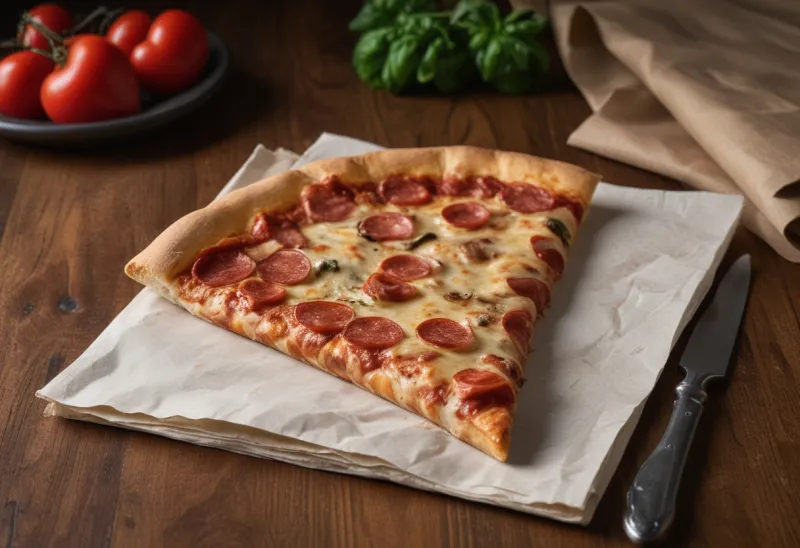
Your body has no cheeseburger alarm#
Most diets start with a list.
- No bread.
- No sugar.
- No eating after 6 PM.
- No pizza.
- No happiness, apparently.
So here's a claim that sounds like a scam: you can lose weight while eating pizza, chocolate, burgers and ice cream. Not because pizza has fat-burning properties. Unfortunately, science hasn't delivered that breakthrough. It's because your body keeps a running energy balance, and no food gets a special ruling.
There's no alarm that goes off when a burger arrives. "Warning. Cheeseburger detected. Activate fat storage." isn't how it works. Eat less energy than you expend over time and you generally lose weight. A burger can fit inside that, and so can pasta.
Food quality still matters. Protein, fiber, vitamins and your overall pattern shape your health, your hunger and how much muscle you keep. Technically you could lose weight eating only doughnuts, but you'd be hungry, short on protein and fiber, and not much fun at dinner. So the real question is how to make the foods you love fit in practice, which is what the rest of this post sets out to do.
What the research supports, and where it gets complicated#
The appeal of this approach rests on a simple idea: a diet you can actually keep doing beats a theoretically perfect one you abandon after two weeks. There's good evidence for the first half of that. In a year-long trial of four very different diets, weight loss tracked how well people stuck with them (r = 0.60), not which diet they were assigned (r = 0.07), and only 50 to 65% of each group completed the year1. A much larger trial of 811 adults likewise found similar weight loss across different macronutrient mixes2.
Whether allowing favorite foods makes a diet easier is less settled than the internet thinks.
| The claim | What we found | Strength |
|---|---|---|
| Flexible eating loses weight as well as rigid dieting | 23 resistance-trained adults lost 2.6 kg on a flexible plan and 3.0 kg on a rigid one over 10 weeks, with no significant difference3 | One small trial |
| All-or-nothing rules go with worse outcomes | Largely observational; our all-or-nothing post goes through it | Association |
| Forbidding a food makes you crave it more | In a two-year trial of 270 people, prescribing restriction of specific foods lowered cravings for those foods4 | Cuts the other way |
That last row is worth sitting with. Some people find that once a food has been gone long enough, they want it less, and a strict rule works fine for them. Flexibility isn't automatically superior. Its strongest case is for people who keep cycling through "perfect, ruined, start again Monday," and for anyone who simply doesn't want to give up pizza to lose weight. That's a perfectly good reason. It isn't a scientific finding.
If you're looking for the easiest diet, that depends on you. So treat what follows as an experiment.
Building a real day around the pizza#
Say your estimated maintenance is 2,400 calories and you're aiming for an average of 2,000. You want pizza for dinner. A couple of slices might run 500 to 700 calories depending on size and toppings. Here's one illustrative day. The numbers are round, for showing the shape rather than for copying.
| Meal | Calories |
|---|---|
| Breakfast: Greek yogurt, fruit, oats | 400 |
| Lunch: chicken, rice, vegetables | 550 |
| Snack: apple and protein-rich yogurt | 200 |
| Dinner: pizza and salad | 700 |
| Chocolate | 150 |
| Total | 2,000 |
You ate pizza. You ate chocolate. You stayed on plan. If you want a rule of thumb, roughly 80% of what you eat can be filling, nutritious staples, leaving around 20% for whatever you love. That number isn't science or a precise formula. It's a convenient way to think about flexibility, and no study established it. No food has to be morally good or bad. Broccoli isn't a virtue. Chocolate isn't a crime.
Lunch is where the room for dinner gets made. Two 650-calorie lunches can behave very differently: a large sugary coffee and a pastry, or chicken or tofu with potatoes, vegetables and fruit. The second usually keeps you full for longer, thanks to its protein, fiber, water and sheer volume, a logic that volume eating takes further. So:
- Include protein regularly. It helps with fullness and, with resistance training, muscle.
- Eat fiber-rich foods. Vegetables, fruit, legumes and whole grains take up room.
- Choose portions on purpose. Two slices with a real side may satisfy you as well as four.
- Don't arrive desperate. Skipping meals to "save calories" backfires for some people.
The goal isn't to suppress hunger through willpower. It's to make your usual meals satisfying enough that you don't need so much of it.
Then zoom out to the week#
Your life isn't identical every day. Monday might be quiet, and Friday might be dinner with friends. A target of 2,000 a day is also 14,000 a week, which can be spread unevenly.
| Day | Calories |
|---|---|
| Monday | 1,850 |
| Tuesday | 1,900 |
| Wednesday | 1,950 |
| Thursday | 1,900 |
| Friday | 2,400 |
| Saturday | 2,200 |
| Sunday | 1,800 |
| Week | 14,000 |
Energy balance accumulates across days, so these seven days are close to equivalent to seven at 2,000. Daily versus weekly balance goes through where that holds and where it doesn't. The spread here is modest on purpose. Weekly budgeting isn't a reason to starve yourself after a big meal, and if the low days start feeling like punishment, it has stopped being flexibility. Our cheat meal numbers show how much a single large meal really costs.
Where the room quietly goes#
Here's an experiment. Before tracking anything, guess how many calories you eat on a typical day. Then write down what you actually eat for a week or two.
You may be surprised, and not necessarily by the pizza. In a classic study of 10 people who believed they couldn't lose weight despite eating little, intake was underreported by an average of 47% and activity overreported by 51%5. That group was selected for the problem, so don't read it as a typical error. But most people have some of the same blind spots, which turn out to be drinks, oils and bites:
| Easy to forget | Amount | Calories (USDA, our arithmetic) |
|---|---|---|
| Olive oil | 13.5 g, about 1 tablespoon | 119 |
| Almonds | 30 g, a handful | 174 |
| Regular cola | 330 g, about a can | 139 |
None of those is bad. They're just where a planned slice of pizza goes to die. A food diary, a spreadsheet or an app can all show you this, and you don't necessarily need to do it forever. If tracking makes you anxious or obsessive, portions, routines and the long-term weight trend are a better fit.
The cake was not a national emergency#
You planned on 2,000. Someone offered a fantastic dessert, and now you're at 2,350. What now?
Nothing dramatic. You enjoyed dessert. Carry on. One day over target doesn't erase your progress, just as one salad doesn't create a six-pack. The real trouble starts with one thought: "Well, I've already ruined it. Might as well finish the cake." You haven't ruined anything. Your next meal is simply your next meal, with no punishment, no fasting and no emergency treadmill session.
And if you're heavier the next morning, water, glycogen, salt and digestion can account for a good part of that. A trend across several weeks tells you something. A single morning tells you what you had for dinner.
Try it for seven days:
- Estimate your needs and pick a moderate deficit, if losing weight is right for you.
- Name three foods you truly enjoy.
- Plan room for them before you're desperate.
- Build filling meals around protein and fiber.
- Track or observe what your portions contain.
- Allow some movement between days without paying back every indulgence.
- Review your hunger, energy, enjoyment and whether you could keep this up, not only the scale.
Then ask one question: could you comfortably eat like this for six months? If the answer is yes, you've found something more useful than another short-term diet. You need a way of eating that works on an ordinary Tuesday, at a birthday party, on vacation, and on the Friday evening when someone orders pizza.
This is general education. Calorie needs vary, and weight loss isn't right for everyone. If you have a history of eating disorders, are pregnant or have a medical condition, get individual guidance rather than following generic targets.
FAQ#
Can you lose weight eating foods you like every day?#
Yes, if your overall intake stays below what you burn. Most people find it easier when the rest of their meals are filling, so there's real room for the food they want.
Is 80/20 eating backed by research?#
Not as a number. It's a handy way of thinking about flexibility, and no study established that 80% and 20% are the right split.
Does banning a food make you crave it more?#
Not reliably. In a two-year diet trial, restriction actually lowered cravings for the restricted foods. People vary, and some still find strict bans harder to live with.
Does a flexible diet work as well as a strict one?#
The little direct evidence shows similar results. One small 10-week trial in trained adults found no significant difference, so the choice is mostly about which one you can keep doing.
Sources#
- Dansinger ML, Gleason JA, Griffith JL, et al. Comparison of the Atkins, Ornish, Weight Watchers, and Zone diets for weight loss and heart disease risk reduction: a randomized trial. JAMA. 2005;293(1):43-53.
- Sacks FM, Bray GA, Carey VJ, et al. Comparison of weight-loss diets with different compositions of fat, protein, and carbohydrates. N Engl J Med. 2009;360(9):859-873.
- Conlin LA, Aguilar DT, Rogers GE, Campbell BI. Flexible vs. rigid dieting in resistance-trained individuals seeking to optimize their physiques: a randomized controlled trial. J Int Soc Sports Nutr. 2021;18(1):52.
- Martin CK, Rosenbaum D, Han H, et al. Change in food cravings, food preferences, and appetite during a low-carbohydrate and low-fat diet. Obesity (Silver Spring). 2011;19(10):1963-1970.
- Lichtman SW, Pisarska K, Berman ER, et al. Discrepancy between self-reported and actual caloric intake and exercise in obese subjects. N Engl J Med. 1992;327(27):1893-1898.
- USDA FoodData Central. Oil, olive, salad or cooking (FDC 171413, SR Legacy).
- USDA FoodData Central. Nuts, almonds (FDC 170567, SR Legacy).
- USDA FoodData Central. Beverages, carbonated, cola, regular (FDC 174852, SR Legacy).
Source: BurnWeek — "Eat what you love, still lose weight: how to budget pizza into a real week", https://burnweek.fit/blog/how-to-eat-foods-you-like-and-lose-weight/. Licensed CC BY 4.0: free to quote or reuse with a link to this page.