A rare gene shows why lean doesn't prove healthy#
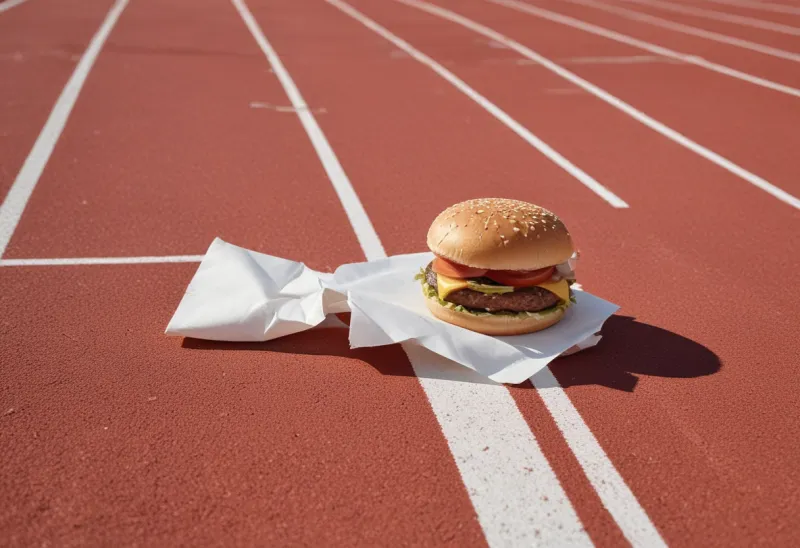
We all know someone like this. They order burgers, eat pizza, never count calories, and somehow stay lean year after year. Meanwhile, someone else watches their portions, exercises regularly and still struggles. The tempting conclusion is that one person won the genetic lottery and the other lost it.
An unusual story shows why that conclusion is too quick. It was reported by David Epstein for ProPublica in 2016, and it's one case, told through a journalist, not a study.
Canadian hurdler Priscilla Lopes-Schliep won bronze in the 100 m hurdles at the 2008 Beijing Olympics. She was extraordinarily muscular, with remarkably little visible fat. To the outside world, she looked like the picture of athletic health.
Then a woman in Iowa saw her photographs. Jill Viles had spent years reading the scientific literature about her own rare condition, a form of muscular dystrophy that also left her with unusually little fat on her limbs. One woman was an Olympic medalist, and the other had muscles that wasted. Viles still saw a familiar pattern, and she kept pushing until a specialist agreed to test.
She was right, in a precise way. Both women have Dunnigan-type partial lipodystrophy, and both carry a change in the same gene, LMNA. They don't carry the identical change, though: the reporting describes Priscilla's as a neighbor of Jill's. That tiny distance seems to help explain why one developed muscular dystrophy and the other didn't.
The reporting adds that her blood fats were well above normal despite a punishing training schedule. The physique everyone admired had been hiding a blood-test problem nobody was looking for.
Before anyone looks at a slim friend and worries, this condition is rare. MedlinePlus puts the estimate of familial partial lipodystrophy somewhere between 1 in 7,000 and 2.3 in a million. It's not why most naturally slim people are slim. But it raises a useful question: what does your body's fat actually do?
Body fat is doing a job#
We often treat fat as something to eliminate. But fat tissue also stores energy safely, releases hormones and keeps excess fat away from places it doesn't belong. When that storage fails in parts of the body, as in lipodystrophy, the results can include insulin resistance, diabetes, high triglycerides, fatty liver and high blood pressure, sometimes in someone who looks remarkably lean.
That doesn't mean ordinary low body fat is unhealthy. It means that body fat, physical fitness and metabolic health are related but separate. A muscular athlete can have abnormal blood lipids. A naturally thin person can have poor cardiovascular fitness. Someone with a higher body fat percentage can be strong and aerobically fit, and a body shape can't tell you which is which.
The mirror doesn't tell the whole story. Blood pressure, blood glucose, blood lipids and family history tell you things it can't.
How much of your weight is genetic?#
Researchers have spent decades comparing twins, siblings and adopted children. The results are consistent in direction and messy in size.
| Study | Who | Finding |
|---|---|---|
| Elks et al., 2012 | Review of 88 twin estimates and 27 family estimates | BMI heritability 0.47 to 0.90 in twins (median 0.75), 0.24 to 0.81 in families (median 0.46) |
| Silventoinen et al., 2017 | 140,379 twin pairs in 20 countries | Heritability falls from about 0.76 in young adults to about 0.58 in old age |
| Stunkard et al., 1990 | Identical twins raised apart | BMI correlation of 0.70 in men, 0.66 in women |
| Stunkard et al., 1986 | 540 Danish adoptees | BMI tracked biological parents, with no relation to adoptive parents |
| Riveros-McKay et al., 2019 | 1,471 thin vs 1,456 severely obese people | Thinness about as heritable as severe obesity on genetic data: 28% vs 32% |
That last row is the one to remember when someone says thinness is all discipline. It runs in families and shows up in DNA, about as strongly as the other extreme.
Now the part people get wrong. A heritability of 0.75 doesn't mean 75% of your weight comes from your genes. It's a statistic about how much of the variation between people in a particular population and time is linked to genetic differences. Height works the same way: strongly heritable, yet childhood nutrition still affects how tall someone grows.
And the environment can change the whole population at once. Loos and Yeo, 2022 note that obesity has tripled in four decades, and human genes don't change that fast. Twin data analyzed by Rokholm et al., 2011 suggest genetic differences become more visible as obesity spreads. So the environment doesn't affect everyone equally, and genes help decide who gets hit hardest.
Genes reach your appetite, not just your metabolism#
When people talk about naturally thin friends, they usually mean a fast metabolism. But body size and activity account for much of the difference there, and resting burn varies less than people assume once you adjust for them.
Much of the action seems to be in the brain. Loos and Yeo describe obesity genetics as acting largely through the brain's control of appetite, and Llewellyn et al., 2023 review a theory built on this: inherited variation in appetite, present from birth, helps determine why some children overeat when food is everywhere and others don't. Say you and a coworker both maintain your weight on 2,400 calories. One of you feels satisfied. The other thinks about food all afternoon. The target is the same, and how hard it is to hit isn't. This is part of why hunger during weight loss feels so different from one person to the next.
Movement varies too. When Levine's team overfed 16 volunteers, spontaneous everyday movement explained much of who stored the extra energy as fat.
Genetics doesn't abolish energy balance. It changes how hard that balance is to keep.
Same burgers, different bodies#
Here's a simplified illustration. These are made-up people, and the differences could come from size, activity, age or genes.
| Illustrative example | Person A | Person B |
|---|---|---|
| Daily intake | 2,500 kcal | 2,500 kcal |
| Daily energy burned | 2,700 kcal | 2,200 kcal |
| Daily balance | -200 kcal | +300 kcal |
Real life isn't that tidy, because energy use adapts over time. But there's a real experiment close to this. Twelve pairs of identical twins each ate an extra 1,000 kcal a day for 84 days under supervision, and they gained anywhere from 4.3 to 13.3 kg. Twins resembled each other far more than they resembled other pairs.
But be careful with what you see at lunch. The friend with the big burger may eat a small dinner. The person with tiny meals may take in plenty through snacks, drinks, sauces and cooking oil. And someone who trains hard may sit for the rest of the day. What you see someone eat isn't what they eat over a week, which is why comparing your diet with theirs tells you so little.
You can't change your genes, but you can change what your family passes down#
Parents with overweight are more likely to have children who develop it, and that alone can't say why, since children inherit both the DNA and the kitchen.
The adult data tilt toward genes. The large twin analysis above found no evidence of environment shared by co-twins affecting adult BMI, and the Danish adoptees resembled their biological parents. So don't take too much blame, or too much credit, for how your adult children turn out.
Childhood looks more movable, and here's a trial rather than a correlation. De Ruyter et al., 2012 randomized 641 mostly normal-weight children to a daily 250 ml sugar-free or sugar-sweetened drink for 18 months. Children on the sugar-free drink gained 6.35 kg, against 7.37 kg, and that's normal growth with about 1 kg less on it. Genes and diet can interact too: in cohorts studied by Qi et al., 2012, the BMI effect of a person's genetic risk score was larger among those who drank more sugary drinks. That result is observational, so it shows a pattern, not a cause.
Your children inherit your genes once. They experience your habits every day. That doesn't mean habits beat genetics. It means routines are the part you can actually influence, so aim them at the family's environment rather than at anyone's weight:
- Audit your defaults. Look at your usual breakfasts, dinners and snacks over a week and choose one recurring habit to change.
- Change what's easily available. Keep fruit, vegetables and yogurt within reach, and make calorie-dense snacks less automatic without banning them.
- Rethink portions. Serve moderate first portions and let everyone ask for more. Teach children to recognize hunger and fullness rather than to clear the plate.
- Make water the default drink. Keep sugary drinks as an occasional thing, not a table fixture.
- Build movement into the routine. Walks, bikes, playgrounds and active games make activity normal, not a chore.
- Lead by example. Model balanced eating and enjoyable activity, without calling foods good or bad or making bodies the topic of dinner.
- Measure the right things. Adults can watch weight trends over weeks. For children, watch growth, energy, fitness and their relationship with food, and leave weight concerns and any diet to professional guidance.
None of this promises the same outcome for everyone. Genetics, medical conditions and medications can still make weight harder for some people.
Stop comparing your body with someone else's#
If your friend eats 3,000 calories a day without gaining, that says nothing about you. They may need more energy, feel full sooner, move more, or eat less than you think.
"Why can they eat that while I can't?" has no useful answer. A better question is what amount of food and movement keeps you at the weight, health and fitness you want. A calculator gives you a starting estimate, and your own weight trend over several weeks will tell you far more than anyone else's target. If you're looking for a place to start, a modest calorie deficit is usually an easier first step than copying someone's plate.
Genes set some of the starting conditions: how hungry you tend to feel, where you store fat, how much you move without noticing. They don't choose your meals, your sleep or your Sunday walk. You don't need someone else's genetics to make progress.
FAQ#
How much of body weight is genetic?#
Twin studies put the heritability of BMI between 0.47 and 0.90, with a median of 0.75, and family studies come in lower. These figures describe differences across a population, so they can't tell you what share of your own weight your genes decide.
Can someone be thin and still be unhealthy?#
Yes. Low body fat and metabolic health are different things, and a slim person can have poor fitness or abnormal blood results. Rare conditions like lipodystrophy are an extreme example. Most slim people don't have them, and a checkup answers this far better than a mirror.
Do overweight parents pass on genes or habits?#
Both. Adoption and twin studies point strongly to genes for adult BMI, with little lasting effect from the shared home. In childhood, habits can still change the course: replacing one sugary drink a day slowed weight gain in a trial of 641 children.
Is a fast metabolism why some people stay naturally thin?#
Only partly. Appetite and everyday movement matter as well, and they are influenced by genes too. People who look like they eat anything often eat less than it seems at other meals, or move more than you notice.
Sources#
- de Ruyter JC, Olthof MR, Seidell JC, et al. A trial of sugar-free or sugar-sweetened beverages and body weight in children. N Engl J Med. 2012;367(15):1397-406.
- Elks CE, den Hoed M, Zhao JH, et al. Variability in the heritability of body mass index: a systematic review and meta-regression. Front Endocrinol (Lausanne). 2012;3:29.
- Epstein D. The DIY Scientist, the Olympian, and the Mutated Gene. ProPublica. 15 January 2016.
- Llewellyn CH, Kininmonth AR, Herle M, et al. Behavioural susceptibility theory: the role of appetite in genetic susceptibility to obesity in early life. Philos Trans R Soc Lond B Biol Sci. 2023;378(1885):20220223.
- Loos RJF, Yeo GSH. The genetics of obesity: from discovery to biology. Nat Rev Genet. 2022;23(2):120-133.
- MedlinePlus Genetics, US National Library of Medicine. Familial partial lipodystrophy.
- Qi Q, Chu AY, Kang JH, et al. Sugar-sweetened beverages and genetic risk of obesity. N Engl J Med. 2012;367(15):1387-96.
- Riveros-McKay F, Mistry V, Bounds R, et al. Genetic architecture of human thinness compared to severe obesity. PLoS Genet. 2019;15(1):e1007603.
- Rokholm B, Silventoinen K, Ängquist L, et al. Increased genetic variance of BMI with a higher prevalence of obesity. PLoS One. 2011;6(6):e20816.
- Silventoinen K, Jelenkovic A, Sund R, et al. Differences in genetic and environmental variation in adult BMI by sex, age, time period, and region: an individual-based pooled analysis of 40 twin cohorts. Am J Clin Nutr. 2017;106(2):457-466.
- Stunkard AJ, Harris JR, Pedersen NL, et al. The body-mass index of twins who have been reared apart. N Engl J Med. 1990;322(21):1483-7.
- Stunkard AJ, Sørensen TI, Hanis C, et al. An adoption study of human obesity. N Engl J Med. 1986;314(4):193-8.
Source: BurnWeek — "Why Some People Can Eat Anything and Never Get Fat", https://burnweek.fit/blog/genetics-and-leanness/. Licensed CC BY 4.0: free to quote or reuse with a link to this page.