Two-thirds of the bowl, a tenth of the calories#
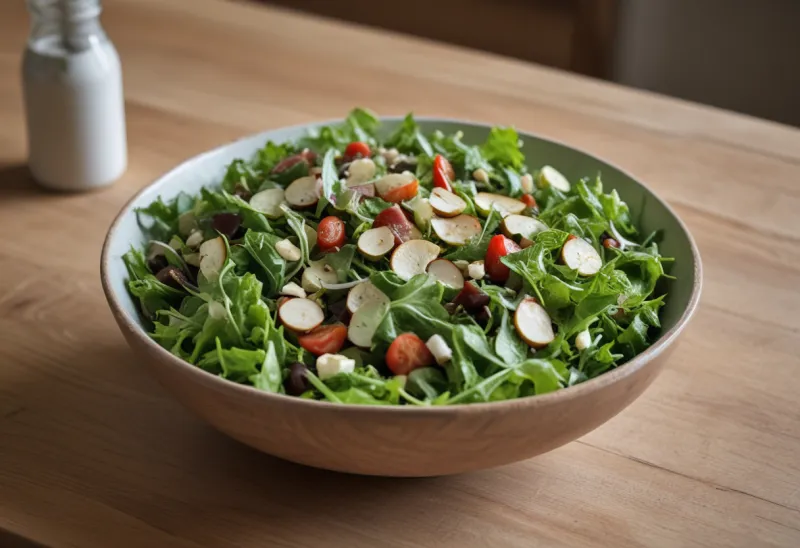
A salad is hard to count because the ingredient filling your field of view is not the ingredient supplying the energy, and the gap is not subtle. When the USDA analysed what Americans actually put in a salad — 24-hour recalls from What We Eat in America, NHANES 2011–2014 — leafy greens showed up in 86 percent of salads at a mean of 70 grams, contributing 22 calories. Dressing showed up in exactly the same 86 percent of salads, at a mean of 33 grams, contributing 103 calories1. Less than half the weight, nearly five times the energy.
So the practical answer for estimating one: ignore the greens, price the additions. At those USDA means, a salad averaged 234 calories for adults and accounted for 11 percent of the day's total energy1 — and if you logged only the vegetables you would have recorded a small fraction of it. Everything difficult about counting a salad follows from that inversion, and none of it requires you to become better at judging a bowl of leaves.
What an American salad is actually made of#
Here is the full ingredient picture from that USDA brief, for individuals aged 1 and over. The right-hand column is my arithmetic on their two columns, not a figure they report — it is simply the energy divided by the amount.
| Ingredient | % of salads | Mean amount | Mean energy | Derived kcal/g |
|---|---|---|---|---|
| Lettuce / leafy greens | 86 | 70 g | 22 kcal | 0.31 |
| Dressing, all types | 86 | 33 g | 103 kcal | 3.1 |
| Tomato | 43 | 62 g | 14 kcal | 0.23 |
| Meat, poultry, fish | 19 | 67 g | 115 kcal | 1.7 |
| Cheese | 25 | 19 g | 64 kcal | 3.4 |
| Croutons | 10 | 9 g | 41 kcal | 4.6 |
| Nuts / seeds | 8 | 14 g | 84 kcal | 6.0 |
| Avocado | 5 | 50 g | 82 kcal | 1.6 |
| Cucumber | 20 | 50 g | 9 kcal | 0.18 |
Data: Sebastian et al., USDA Food Surveys Research Group, 2018. Amounts and energies are means among salads containing that ingredient.
Read the derived column top to bottom and the problem is obvious: a single salad routinely spans a twenty-fold range in calories per gram, from cucumber at 0.18 to nuts at 6.0. No other everyday dish assembles ingredients that far apart in one bowl. A stew is mostly one density; a sandwich is mostly one density. A salad is a scatter plot.
And the additions are not a rounding error on top of a vegetable base — they are the dish. Build a composite salad at USDA's own mean amounts using greens, tomato, cucumber, dressing, cheese and croutons and you get 253 calories in 243 grams, of which the three vegetables supply 45 and the three additions supply 208. My arithmetic, their numbers: the vegetables are 18 percent of the calories and 75 percent of the weight.
The same word, opposite results#
The strongest evidence that this is not a trivia problem comes from a trial that fed people six different things all called salad.
Forty-two women ate lunch in a laboratory once a week for seven weeks. Each lunch opened with a compulsory first-course salad — or, in the control condition, nothing — followed by as much pasta as they wanted. The salads varied only in energy density (0.33, 0.67 or 1.33 kcal/g) and portion size (150 or 300 g), and, in the authors' words, "the energy density of the salad was reduced by changing the amount and type of dressing and cheese"2.
The results ran in both directions. Against having no first course at all, "consuming the low-energy-dense salads reduced meal energy intake (by 7% for the small portion and 12% for the large), and consuming the high-energy-dense salads increased intake (by 8% for the small portion and 17% for the large)"2.
A large salad cut total lunch energy by 12 percent or raised it by 17 percent depending on how much dressing and cheese were on it — a 29-point swing across items sharing a name. Note also the direction of the portion effect: making the salad bigger amplified whichever way it was already pointing. Bigger is better if it is dilute and worse if it is not, which is the opposite of the usual advice to just eat more salad.
Put the two studies side by side and the picture closes. Rolls's experimental lever — dressing and cheese — is precisely the pair that the USDA's national data identifies as carrying the calories. That composite salad above, at 253 calories in 243 grams, works out to about 1.04 kcal/g: sitting between the version that reduced intake and the version that increased it, closer to the middle than most people would guess of a bowl of vegetables.
Why your eye gets this one wrong#
There is a psychological explanation available here — health-branded food invites a bigger serving and a lower calorie estimate at the same time, which is a real and well-measured effect that belongs to the list of tracking mistakes that lean low and to why diners misjudge a 'healthy' restaurant. It is not the mechanism at work here, and reaching for it skips a simpler one.
The simpler one is geometric. Your eye estimates volume, and leaves have the most extreme volume-to-mass ratio of anything you eat — a bowl that looks generously full holds 70 grams. Dressing has close to the opposite property: it is poured, it spreads into a film over an enormous surface area, and within seconds it is not a visible object at all. So the two ingredients that matter most to your estimate are the two your eyes are worst equipped to size, in opposite directions. Nobody misjudges a chicken breast this badly, because a chicken breast stays where you put it.
That also means the fix is not to look harder, and it is not to weigh the lettuce. It is to move the estimate onto the small number of items that carry the energy — which is the general form of the argument for spending your attention on the dense ingredients rather than on everything equally.
Logging a salad, in reverse order#
Log the dressing first, and as its own line. It is the largest single term in the average salad and the one you can most easily correct later. It is also internally variable: when six commercial dressings were chemically analysed, crude fat ranged from 23.25 to 64.15 g per 100 g3 — a small sample from one market, but a near three-fold spread in the one ingredient that matters. At those two extremes, the USDA's mean 33-gram pour delivers roughly 69 to 190 calories from fat alone. "Dressing" is not one entry.
Then count the four dense additions. Cheese, croutons, nuts or seeds, and avocado are the ones with real energy per gram, and they arrive in small enough amounts to be counted rather than judged — a scattering of croutons is nine grams, a handful of nuts is fourteen. Protein deserves its own line too: at 67 grams and 115 calories, meat or fish is the heaviest energy contributor in the USDA table after dressing.
Then log the vegetables, or don't. At 0.18 to 0.31 kcal/g, doubling the greens and the cucumber in the composite above moves the total by about 30 calories. That is smaller than the uncertainty on the dressing, which is why precision there is wasted effort and why the whole dish still deserves a band rather than a number.
Then check the total against the bowl's weight. A salad that comes back at more than about 1.5 calories per gram has more oil, cheese or nuts in it than you have accounted for; one that comes back under 0.5 has almost certainly missed the dressing entirely. That divide-and-check move works on any dish and is set out in full in using calorie density to sanity-check an estimate.
FAQ#
How many calories are in a salad?#
Among US adults who ate one, salads averaged 234 calories and supplied 11 percent of the day's energy1. But the mean hides the shape: leafy greens contributed 22 calories on average and dressing 103, so a salad's total is essentially a question about what was added, not about how much bowl was filled. A dry salad of greens, tomato and cucumber runs well under 50 calories; the same bowl dressed, cheesed and crouton-topped runs past 250.
Does salad dressing really add that many calories?#
More than most people expect. In national US data, dressing appeared in 86 percent of salads at a mean of 33 grams and 103 calories — nearly five times the energy of the greens it was poured over, at less than half the weight1. It is also variable: crude fat across six analysed commercial dressings ran from 23.25 to 64.15 g per 100 g3, so the same 33-gram pour is not the same 103 calories.
Is eating a salad first still a good idea if it's heavily dressed?#
Only if it stays dilute. In a crossover trial, a large low-energy-dense first-course salad cut total lunch energy by 12 percent while a large high-energy-dense one raised it by 17 percent2. Making the salad bigger amplified whichever direction it was already headed, so the strategy of opening a meal with a large low-density course4 depends entirely on the dressing staying light.
Sources#
- Sebastian RS, Wilkinson Enns C, Goldman JD, Hoy MK, Moshfegh AJ. Salad Consumption in the U.S.: What We Eat in America, NHANES 2011-2014. USDA Food Surveys Research Group, Dietary Data Brief No. 19. 2018.
- Rolls BJ, Roe LS, Meengs JS. Salad and satiety: energy density and portion size of a first-course salad affect energy intake at lunch. J Am Diet Assoc. 2004;104(10):1570-1576.
- Yin Y, et al. Physical properties, chemical composition, and nutritional evaluation of common salad dressings. Front Nutr. 2022;9:961958.
- Ello-Martin JA, Ledikwe JH, Rolls BJ. The influence of food portion size and energy density on energy intake: implications for weight management. Am J Clin Nutr. 2005;82(1 Suppl):236S-241S.