A cheat meal, a cheat day and a refeed are three different sizes#
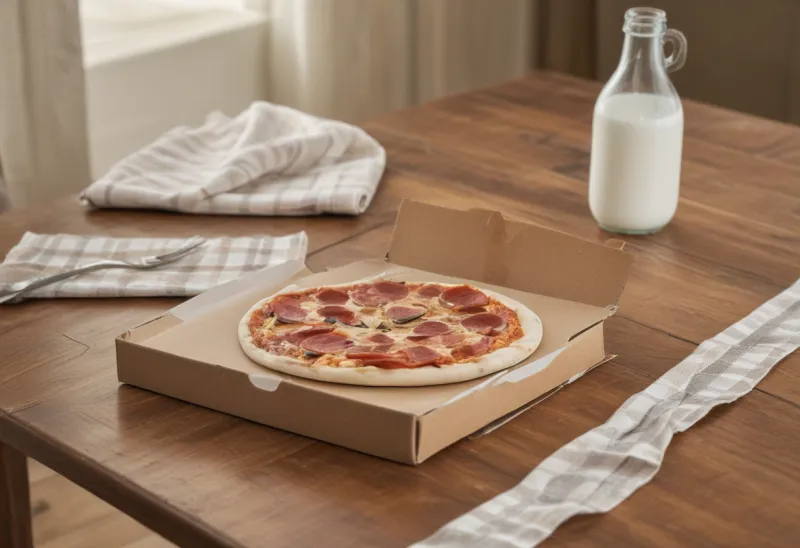
Friday: four slices of pizza, then dessert. Saturday morning: two kilograms up on the bathroom scale. One pizza, one existential crisis.
Most of the panic comes from a mix-up. "Cheat meal" gets used for a dinner out, for 24 hours with no limit, and for a planned higher-carb day that an athlete writes into a program. Those are three different events with very different price tags, and advice about one gets applied to the others all the time. We've already gone through what one big meal actually does to progress. This post is about where the line falls between them.
Run all three through a single illustrative week for someone with a maintenance of 2,500 kcal and a normal target of 2,000. This is our arithmetic, and it's accounting rather than a prediction of fat loss.
| The week | Calories eaten | Weekly deficit |
|---|---|---|
| Seven normal days | 14,000 | 3,500 |
| Five normal days, then a two-day refeed at maintenance | 15,000 | 2,500 |
| Six normal days, one normal day plus a 1,500 kcal dinner | 15,500 | 2,000 |
| Six normal days, one 5,500 kcal free-for-all | 17,500 | 0 |
The third row is why a big dinner doesn't ruin anything. The fourth is why "cheat day" isn't a harmless synonym. It's the same word and the same person, and one version leaves a deficit while the other removes the week.
How big are these in real life? In a national sample of 2,717 Canadian adolescents and young adults, over half had eaten cheat meals in the past year, and 1,000 to 1,499 calories was the most common size reported1. That's a self-reported figure from a young sample, but it sits close to the third row.
"Shock your metabolism" is a story about a sleeping employee#
You've heard this one: have a cheat day to shock your metabolism. Unfortunately, your metabolism isn't a sleeping employee who needs a surprise visit from the boss. It isn't shocked. It's just digesting dinner.
The grain of truth is real and small. Digesting food costs energy, with diet-induced thermogenesis making up 5 to 15% of daily expenditure on a mixed diet, and more food means a bit more of it2. More food costs more to process, but you've still eaten far more than the processing burned.
Where people get confused is the refeed, because it has actual trials behind it, and those trials don't test pizza.
| Cheat meal | Cheat day | Planned refeed | |
|---|---|---|---|
| Written in advance? | Sometimes | Sometimes | Always |
| Size | One meal | Up to a whole day with no limit | Set, usually near maintenance |
| Main macro | Whatever's on the table | Whatever's on the table | Mostly carbohydrate |
| Trials we could find | None for fat loss | None for fat loss | A few, mostly in lean, resistance-trained people |
In a seven-week trial, 27 resistance-trained adults on a roughly 25% cut either dieted continuously or added two high-carb days each week. Fat loss didn't differ between the groups, but the refeed group lost 0.4 kg of fat-free mass against 1.3 kg, and resting metabolism fell 38 kcal against 78 kcal3. Two cautions: the lead author sits on the advisory board of a supplement brand's institute, which the paper says had no role in the study, and a published comment argued on reanalysis that only dry fat-free mass differed4.
The 61-person ICECAP trial gave a cooler answer. One week at maintenance after every three weeks of dieting produced no difference in fat, fat-free mass or resting expenditure compared with continuous dieting, though hunger was lower and satisfaction higher5. Lower hunger is a real benefit, but it's an adherence benefit. There's more on the details in refeed days explained.
None of this extends to an unplanned dinner. Eat the pizza because you enjoy it or because it helps you stick with your plan, not because you expect it to burn fat.
The Saturday-morning number is mostly not fat#
The two-kilogram jump is the part that makes people give up, and it has a boring explanation. A big, salty, carb-heavy meal adds glycogen, which is stored with roughly three to four parts water6. Salt can hold on to more water for a while. And dinner itself still has weight until it has finished moving through you.
Some of it may be fat, if you ate above what you burned. But nobody can tell you the split from one reading, and we won't invent percentages. The scale measures everything. The usual swings are big enough to swallow a single meal, so judge the trend over several days or weeks.
The real size is decided on Sunday#
Here's a scenario many dieters recognize. You plan one slice of cake and eat two. You think, "I've already broken my diet, might as well finish it." Later you order pizza, because the day is ruined. On Sunday you decide you'll start fresh on Monday.
Notice what happened. A meal became a cheat day, the second row of the table became the fourth, and no food did it. Thinking did. All-or-nothing dieting has the research on this pattern.
Weekends are where it shows up in measurements. In a study of 48 adults aged 50 to 60, weighed on consecutive mornings across a year of dieting or daily exercise, the dieters stopped losing on weekends, which helped explain why progress ran slower than expected7. If your own weeks look like that, the math on weekends is worth doing.
The replacement thought is short: "I ate more than planned. My next meal can be normal."
How to keep a big meal the size of a meal#
Five steps, none of them heroic.
- Plan for it. If you know you're going to a restaurant on Saturday, there's no reason to pretend otherwise. Write it into your week.
- Don't arrive starving. Skipping food all day can make it harder to eat the amount you intended. A normal breakfast and a lighter, protein-rich lunch is a more comfortable approach.
- Eat what you actually enjoy. Want pizza? Have pizza. No low-calorie imitation required, and no need to eat until you're uncomfortable.
- Estimate, don't obsess. A restaurant meal might be 800 calories or 1,800, depending on the dish, sauces and drinks. A reasonable estimate is enough.
- Go back to your routine. The next morning, eat normally. You don't need to run 15 kilometers to apologize for cheesecake.
What about paying it back? Say you ate 1,000 calories over. You have a few reasonable options: accept a smaller deficit that week, or spread a modest adjustment across several days if that stays comfortable and nutritionally adequate. If this keeps happening, set a smaller deficit overall that leaves more room. What you want to avoid is alternating between extreme restriction and overeating, because that loop tends to feed itself.
When the label itself is the warning#
The word carries more than arithmetic. In the same Canadian sample, cheat meals were associated with more eating-disorder behaviors and psychopathology, including binge-eating-related behaviors, across genders1. It's a cross-sectional link, so it can't say the meals caused anything, and it's a sample of young people. It's still a good reason not to treat scheduled cheats as universally harmless.
So if you frequently feel unable to control your eating, or feel compelled to punish yourself afterward, that deserves attention from a professional, not stricter arithmetic.
For most people, the simplest fix is to drop the word. Having a burger doesn't make you a bad person. Eating broccoli doesn't automatically make you healthy. A dinner out is a dinner out, a refeed is a programming decision, and a day with no limit is a choice with a calorie bill you can read in the table above. You just eat. Sometimes that's chicken and vegetables. Sometimes it's pizza.
FAQ#
Is a cheat day worse than a cheat meal?#
Usually, because it has more room to grow. A single dinner might add 1,000 to 1,500 calories, while a full unrestricted day can add enough to cancel a typical week's deficit. A modest high-calorie day can still fit in.
Does a cheat meal boost your metabolism?#
Only by the small, temporary amount it costs to digest the extra food, which is far less than the meal itself. The trials behind metabolism claims used planned high-carb refeeds, not unrestricted meals.
Why do I weigh 2 kg more the morning after a big meal?#
Mostly glycogen and the water stored with it, extra salt holding on to fluid, and the food still in your digestive system. Some fat gain is possible, but one reading can't separate it out.
Are cheat meals bad for your relationship with food?#
They can be for some people. A large survey of young Canadians tied them to more eating-disorder behaviors, though it can't show cause. If a planned treat regularly turns into loss of control or guilt, get professional support.
Sources#
- Ganson KT, Cunningham ML, Pila E, Rodgers RF, Murray SB, Nagata JM. Characterizing cheat meals among a national sample of Canadian adolescents and young adults. J Eat Disord. 2022;10(1):113.
- Westerterp KR. Diet induced thermogenesis. Nutr Metab (Lond). 2004;1(1):5.
- Campbell BI, Aguilar D, Colenso-Semple LM, et al. Intermittent energy restriction attenuates the loss of fat free mass in resistance trained individuals. A randomized controlled trial. J Funct Morphol Kinesiol. 2020;5(1):19.
- Campbell BI. A reply to Contrary to the conclusions stated in the paper, only dry fat-free mass was different between groups upon reanalysis. J Funct Morphol Kinesiol. 2020;5(4):86.
- Peos JJ, Helms ER, Fournier PA, et al. Continuous versus intermittent dieting for fat loss and fat-free mass retention in resistance-trained adults: the ICECAP trial. Med Sci Sports Exerc. 2021;53(8):1685-1698.
- Kreitzman SN, Coxon AY, Szaz KF. Glycogen storage: illusions of easy weight loss, excessive weight regain, and distortions in estimates of body composition. Am J Clin Nutr. 1992;56(1 Suppl):292S-293S.
- Racette SB, Weiss EP, Schechtman KB, et al. Influence of weekend lifestyle patterns on body weight. Obesity (Silver Spring). 2008;16(8):1826-1830.
Source: BurnWeek — "Cheat meal, cheat day or refeed: three things that get treated as one", https://burnweek.fit/blog/cheat-meal-vs-cheat-day/. Licensed CC BY 4.0: free to quote or reuse with a link to this page.