One percent of your calories, five percent of your food#
Condiments do not deserve the scare stories, and the population data says so plainly. Across 16,399 adults in three national survey cycles, the condiments and sauces category accounted for 5.5 percent of reported food items among 19- to 35-year-olds and 3.6 percent among those 56 and over — while contributing only about 0.8 to 1.1 percent of energy1. You eat them constantly. On average, they are a rounding error.
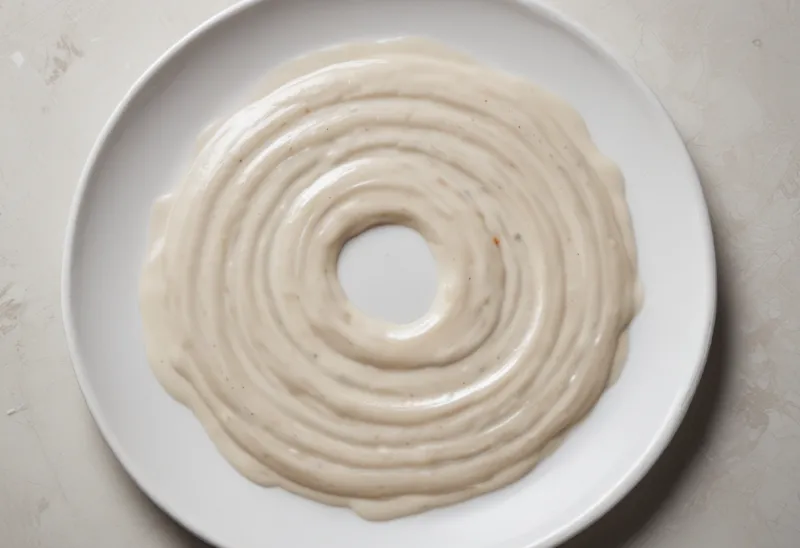
The reason to log them anyway is that the average is doing an unusual amount of concealing. In USDA's own energy table, a single tablespoon under the heading mayonnaise runs from 10 kcal to 99 kcal depending on which product it is2. Same word, same spoon, same white smear on the plate, and a tenfold difference in what it costs you. A category average built from a mustard user and an aioli user describes neither of them. So the condiment question is not "do these add up" — for most people they don't — but "which side of a tenfold range am I on, and how would I know?"
"Mayonnaise" spans a tenfold range at the same tablespoon#
Here is the range, straight from the USDA abridged energy table, all at one tablespoon.
| Product (USDA description) | Weight | Energy |
|---|---|---|
| Mayonnaise, soybean and safflower oil, with salt | 13.8 g | 99 kcal |
| Mayonnaise, regular | 13.8 g | 94 kcal |
| French dressing, home recipe | 14.0 g | 88 kcal |
| Sesame seed dressing, regular | 15.0 g | 66 kcal |
| Mayonnaise type, regular, with salt | 14.7 g | 37 kcal |
| Mayonnaise, imitation, soybean | 15.0 g | 35 kcal |
| Thousand island dressing, reduced fat | 15.0 g | 29 kcal |
| Russian dressing, low calorie | 16.0 g | 23 kcal |
| Mayonnaise, imitation, milk cream | 15.0 g | 15 kcal |
| Fat-free mayonnaise dressing (branded) | 16.0 g | 10 kcal |
Data: USDA National Nutrient Database for Standard Reference, Release 1 — Energy (kcal), abridged list.
Read the weight column, because it is the part that defeats every workaround. The 10-calorie tablespoon weighs 16.0 grams. The 99-calorie tablespoon weighs 13.8. The lighter-calorie product is the heavier spoonful. Weighing your condiment tells you nothing, and neither does looking at it: these are all pale, thick emulsions that spread the same way. Converting those rows to energy density — my arithmetic, not USDA's — puts regular mayonnaise near 680 kcal per 100 g and the fat-free version near 63, which is roughly an elevenfold spread inside one aisle. For where those numbers sit against everything else you eat, see calorie density estimation.
The practical consequence is a multiplication, and multiplications are where small numbers stop being small. Three tablespoons of regular mayonnaise is about 282 calories; three tablespoons of the fat-free version is about 30. That is a 252-calorie difference produced by two decisions — which jar, and how heavy a hand — neither of which leaves any evidence on the plate.
The one category where you set the serving freehand#
Everything else you eat has its quantity decided by something outside you. A packaged snack is portioned by the manufacturer. A restaurant dish is portioned by a kitchen. Even a home-cooked meal is bounded by what fits on the plate and what you served. Condiments are the exception: you decide, by hand, from a squeeze bottle or a ladle, against no reference object at all.
I went looking for a study measuring how much sauce people actually dispense against the label's stated serving, and could not find one worth citing — the numbers that circulate on this come from portion-control marketing rather than from a primary measurement. So treat what follows as reasoning from the structure rather than a finding.
The structure is this: a condiment's calorie count is the product of an unknown density and an unmeasured volume, and both terms are set by choices that feel too small to deliberate over. A tablespoon is roughly the volume of a thumb joint, which means a generous squeeze is easily three or four of them without ever looking like an excess. Because the standard conversion factors price fat at more than twice protein or carbohydrate per gram4 — the reason the emulsified end of the table above sits where it does — a fat-based sauce is the food where the smallest hand movement moves the most energy. This is the same mechanism that makes a dressed salad behave nothing like an undressed one, worked through in estimating salad calories. Condiments are the only food where you are simultaneously guessing the recipe and setting the portion; every other estimate in your day has at least one of the two fixed for you.
Breakfast is where they disappear#
There is one direct measurement of condiments going unlogged, and it is unusually clean because the ground truth was photographic. Forty adults wore automated cameras before each of three dietary recalls, and the omissions were sorted by occasion. Across 265 under-reported foods, snack items dominated the afternoon — but at breakfast, the most frequently under-reported items were condiments3.
Breakfast is the meal most likely to be an assembly rather than a dish: butter goes onto toast, cream goes into coffee, jam goes onto the butter. Each addition is a step in making the food rather than a food in its own right, so it never registers as an item to report. The condiment is not skipped in the log because it was judged unimportant — it was never encoded as a separate thing at all. That is the same failure mode, at a different meal, as the drinks, oils and bites that go missing across the day.
Logging them without weighing them#
Four habits close most of the gap, and none of them require a scale on the table.
Log the product, not the category. "Mayonnaise" is not an entry, because the USDA table shows the word covering a tenfold range. "Hellmann's regular" is an entry. If your kitchen has one jar of each sauce, this is a one-time decision that then applies to every future log.
Count in tablespoons, and count high. The tablespoon is the unit the reference data uses, and it is small enough that a normal serving is usually several. If you think it was one, log two. This is the rare place where deliberately rounding up is well calibrated rather than pessimistic, because the volume is unbounded on only one side.
Give the fat-based ones their own line. Mayonnaise, aioli, creamy dressings, oil, butter. Keeping them separate from the dish means a later correction touches one small number instead of forcing you to rebuild the meal, and it makes the size of the line visible instead of folded into a total.
Ignore the vinegar-based and fermented ones. Mustard, hot sauce, salsa, soy sauce, vinegar. At the population level condiments are about 1 percent of energy1, and that 1 percent is almost entirely the fat-based end of the shelf. Spending attention on the low-density half is how tracking becomes tedious without becoming more accurate.
One last framing that keeps this in proportion. If you use mustard and hot sauce, your condiment line is genuinely negligible and you can stop reading here. If you use mayonnaise, dressings and finishing oils, the same line is plausibly 200 to 400 calories a day, which is the difference between a deficit and maintenance. Both readers are looking at the same shelf in the same supermarket and getting different answers, and that is the whole reason the population average is useless as personal advice. The label conventions that make these products hard to compare are unpacked in the nutrition label reading guide, and the reason a gram of fat costs more than a gram of anything else is in the calorie values of the macros. The broader accounting of where a calorie total drifts is the pillar's job: how accurate calorie counting is.
FAQ#
How many calories do condiments actually add to a day?#
For the average adult, very few: condiments and sauces make up 3.6 to 5.5 percent of reported food items but only about 0.8 to 1.1 percent of energy1. That is roughly 20 calories on a 2,000-calorie day. The figure is misleading as personal guidance, though, because it averages fat-based sauces with vinegar-based ones that carry almost nothing.
Is "light" mayonnaise actually much lower in calories?#
Substantially, yes — this is one of the few reduced-fat swaps with a large real effect. USDA lists regular mayonnaise at 94 kcal per tablespoon, an imitation soybean version at 35, and a fat-free dressing at 102. Swapping regular for fat-free across three tablespoons saves roughly 250 calories, which is my arithmetic on those rows.
Do I need to log ketchup and mustard?#
Usually not, and the distinction is density rather than diligence. Vinegar- and tomato-based condiments sit at the bottom of the range, while fat-based ones sit near 680 kcal per 100 g. Log the fat-based sauces as their own line and let the rest go — that is where the measured 1 percent of energy is actually concentrated1.
Sources#
- Eicher-Miller HA, Boushey CJ. How often and how much? Differences in dietary intake by frequency and energy contribution vary among U.S. adults in NHANES 2007-2012. Nutrients. 2017;9(1):86.
- USDA Agricultural Research Service. National Nutrient Database for Standard Reference, Release 1 — Energy (kcal), abridged list ordered by nutrient content, household measures.
- Gemming L, Ni Mhurchu C. Dietary under-reporting: what foods and which meals are typically under-reported? Eur J Clin Nutr. 2016;70(5):640-641.
- FAO. Food energy — methods of analysis and conversion factors. FAO Food and Nutrition Paper 77, Chapter 3. 2003.
Source: BurnWeek — "The condiment problem: small add-ons, big totals", https://burnweek.fit/blog/calorie-tracking-and-condiments/. Licensed CC BY 4.0: free to quote or reuse with a link to this page.