Fifty calories a day moves your weight, slowly and then less#
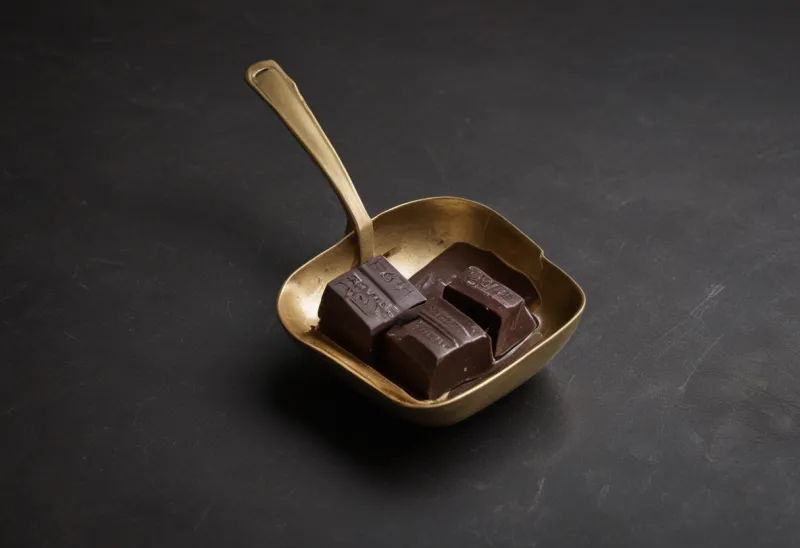
You don't need to dramatically overeat to gain weight, and you don't need a punishing diet to lose it. Sometimes the difference is 50 to 100 calories a day: a small piece of chocolate, a little extra cooking oil, a few bites of dinner. You probably wouldn't notice it. Your appetite might not either. Your bathroom scale certainly won't show it tomorrow.
Kept up for years, 50 calories a day is worth roughly 2 kg of body weight for an average adult with overweight, and most of that arrives within about three years. Then it stops arriving. That answers the more interesting question: if 100 extra calories can make you gain weight, can 100 fewer keep you lean indefinitely? Only until your body has shrunk to match the new intake. How much this gray zone should worry you depends on your goal, and the answer is very different for someone staying healthy than for someone trying to add muscle without adding fat.
The straight line overshoots the first year by more than double#
A common approximation says a kilogram of body fat stores about 7,700 kcal, and dividing by it gives the numbers most calculators show. A panel of energy-balance researchers recommended that the pound-sized version of this rule "should no longer be used," because it implies a linear change that doesn't happen2; where the number comes from and why it breaks has its own page.
The replacement is a rule of thumb from the same research group: for an average overweight adult, every lasting change of 100 kJ a day (about 24 kcal) leads to an eventual weight change of about 1 kg, with half of it arriving in about a year and 95% in about three1. Set the two side by side and the gap is hard to miss.
| Daily difference, kept up | Straight line, 1 month | Straight line, 1 year | Model, 1 year | Model, where it settles |
|---|---|---|---|---|
| ±50 kcal | ±0.2 kg | ±2.4 kg | about ±1 kg | about ±2 kg |
| ±100 kcal | ±0.4 kg | ±4.7 kg | about ±2 kg | about ±4 kg |
| ±200 kcal | ±0.8 kg | ±9.5 kg | about ±4 kg | about ±8 kg |
The model columns are our own arithmetic on that published rule, rounded. It's a population average: the same paper finds that people with more body fat should expect a larger, slower change, so a leaner person should expect less.
The curve flattens because a smaller body costs less to run. Suppose you maintain your weight at 2,500 kcal and start eating 2,400. On day one that's a 100-calorie deficit. If the gap shrinks the way that half-time implies, it's closer to 70 after six months and 50 after a year (our back-of-the-envelope reading, not a measured trajectory). Eventually 2,400 may simply be your new maintenance. Surpluses behave the same way in reverse. For your own numbers, the NIH Body Weight Planner runs a dynamic model of this kind, which beats dividing by 7,700.
Fifty calories is smaller than anyone can measure#
Here is how little 50 kcal looks like, from USDA composition records.
| Food | Weight of 50 kcal |
|---|---|
| Olive oil | 5.7 g |
| Unsalted butter | 7.0 g |
| Dark chocolate, 70-85% cacao | 8.4 g |
| Almonds | 8.6 g |
Data: USDA FoodData Central (olive oil, butter, dark chocolate, almonds); grams are our arithmetic.
It's easy to add that by accident, and just as easy to skip it. Food composition varies, labels are estimates, portions are imperfect, cooking changes water content, and restaurant meals are harder still. Expenditure moves too, with an extra walk or a day spent sitting.
The research tools don't escape this either. Doubly labeled water, the reference method for what free-living people burn, has a precision of about 5%, which the panel translates to an uncertainty of more than 100 kcal a day, and it says the combined error of assessing energy imbalance "can easily reach 1000 kcal/d"2. That consensus conference was funded by a nutrition society and an institute supported by food-industry members, which is worth knowing, though the measurement limits aren't in dispute.
So two kinds of uncertainty sit on top of each other:
- Measurement uncertainty: how many calories did you actually eat and burn?
- Energy-balance uncertainty: is your average intake really above or below your current maintenance?
Weighing every grain of rice removes only part of the first and none of the second, which is why a deficit narrower than your log's noise can't be confirmed from the log alone.
Five days of dieting can still end in a weekly surplus#
The gray zone fools you in a second way. Take two versions of the same week at a maintenance of about 2,500 kcal.
| Day | Small and steady | Strict weekdays, generous weekend |
|---|---|---|
| Monday to Friday, each | −50 | −300 |
| Saturday and Sunday, each | −50 | +1,200 |
| Week total | −350 | +900 |
The second week contains five days that felt like dieting and still finishes in surplus. That doesn't make weekends bad or mean you must eat the same amount daily. It means total energy balance over time matters more than how many days you label as successful, a point the weekend overeating research bears out at more length.
Three goals, three very different needs for precision#
The more precise your body-composition goal, the more valuable measurement becomes. But the gray zone means even precise tracking has to be calibrated against real results. Take an illustrative person weighing 80 kg with a maintenance of 2,500 kcal, and ask what a steady 100-calorie-a-day logging error does to each goal.
| Goal | The signal you're steering by | What a steady 100 kcal error does |
|---|---|---|
| Maintain a healthy weight | Staying within 3% of body weight, about ±2.4 kg | Takes a little over a year to reach the edge of the band |
| Lose fat | About 440 to 880 kcal a day below maintenance, for 0.5-1% of body weight a week | Equals 11-23% of the signal |
| Maximize muscle, minimize fat | About 250 to 500 kcal a day above maintenance | Equals 20-40% of the signal |
The percentages are our arithmetic for this illustrative person, using the sources below and, for the short-run deficit only, 7,700 kcal per kg.
Maintaining a healthy weight: tracking may be unnecessary#
Can you stay lean without counting calories? Yes. Plenty of people rely on stable routines, familiar portions, filling foods and regular activity, and you don't need to know that lunch contains 643 calories. Drift this slow gives you time to catch it. Researchers have proposed defining long-term maintenance as a change of less than 3% of body weight8, and occasional weigh-ins can watch a band that wide. If they can't, that's when counting starts to earn its place.
Losing fat: tracking becomes more useful#
Here the deficit is the instrument, so a fifth of it going missing matters. Tracking also shows when eating less has gone too far. In a meta-regression of resistance-training trials, a deficit of about 500 kcal a day prevented lean-mass gains, and the authors advise people protecting muscle to stay below that9. Among 24 elite athletes training with weights, those losing 0.7% of body weight a week gained 2.1% lean mass while those losing 1.4% stayed flat10. For natural bodybuilders preparing for a contest, a review suggests 0.5-1% a week11.
Protein does some of the protecting. The International Society of Sports Nutrition puts most exercising people at 1.4-2.0 g/kg a day, and says 2.3-3.1 g/kg may be needed by resistance-trained people on a deficit12. That's a society's position, not one trial. The goal isn't to eat as little as possible. It's to eat the right amount for the body you're trying to build and keep.
Maximizing muscle while minimizing fat: precision pays the most#
This is the narrowest target of the three. A narrative review for bodybuilders suggests a surplus of about 10-20% and a gain of about 0.25-0.5% of body weight a week for novice and intermediate lifters, with advanced lifters more conservative13. Another review warns that the specific surplus required "is unknown" and that common estimates have never been validated in people who train14. So nobody can hand you the right number. You have to find it, and how much surplus muscle gain needs goes deeper on that search.
More food isn't a shortcut. When 25 people were overfed about 954 kcal a day in a metabolic ward, body fat rose similarly across low, normal and high protein diets and made up 50% to more than 90% of the excess stored calories, while protein affected lean mass rather than fat15. And in a meta-analysis of 49 trials, protein supplements stopped adding fat-free mass beyond about 1.62 g/kg a day16. Tracking isn't mandatory here either, but the leaner and more experienced you are, the more systematic you may need to be.
Treat your target as an estimate, then let the trend correct it#
Instead of trying to stay exactly 50 calories below maintenance, run a loop:
- Estimate your maintenance from weight, activity and an initial calorie figure.
- Track intake consistently enough to know what you usually eat.
- Watch the weight trend as averages over several weeks, because a single morning mostly measures water.
- Make a modest change when reality disagrees, then reassess.
Suppose you estimate maintenance at 2,500 and consistently eat around 2,400, and after several weeks your average weight hasn't meaningfully moved. Maybe your real maintenance is closer to 2,400. Maybe your log runs low. Maybe the expected change is too small to separate from normal fluctuation. You don't have to know which one yet. You can keep observing, tighten your logging, or make a small adjustment.
A consistent error is the forgiving kind. If your log always misses about the same amount, the trend still corrects your number, because you're calibrating your own measuring stick. Inconsistent logging is what blurs the picture. For body-composition goals, watch waist measurements, strength and training performance as well, since body weight alone can't tell you how much fat or muscle changed.
A 50-calorie difference is tiny, and it may be too small to distinguish from error at all. A 200-calorie difference matters more, without guaranteeing any particular result after a year. You don't need perfect counting. You need a reasonably accurate picture of your habits, enough consistency to see a trend, and a willingness to adjust when reality disagrees.
FAQ#
Will a 100-calorie daily deficit keep making me lighter forever?#
No. Using a published rule of thumb for an average overweight adult, it settles at roughly 4 kg lighter after about three years, by our arithmetic, because a lighter body needs less energy and the deficit closes itself.
Can I find my maintenance calories to within 50 calories?#
Not reliably. Even the reference method for measuring expenditure in daily life carries more than 100 kcal a day of uncertainty. Your best estimate comes from comparing your logged average with your weight trend over several weeks.
Why does gaining muscle lean need closer tracking than losing fat?#
Because the target is smaller. A surplus of 250 to 500 kcal gives a steady 100 kcal error a share of 20-40% for an illustrative 80 kg person, against 11-23% on a typical fat-loss deficit.
How much does eating 50 extra calories a day add up to in a year?#
Straight-line arithmetic says about 2.4 kg, while the dynamic rule of thumb suggests about 1 kg in the first year and about 2 kg eventually. Individual results vary with body size and composition.
Sources#
- Hall KD, Sacks G, Chandramohan D, et al. Quantification of the effect of energy imbalance on bodyweight. Lancet. 2011;378(9793):826-37.
- Hall KD, Heymsfield SB, Kemnitz JW, et al. Energy balance and its components: implications for body weight regulation. Am J Clin Nutr. 2012;95(4):989-94.
- National Institute of Diabetes and Digestive and Kidney Diseases. Body Weight Planner.
- USDA FoodData Central. Oil, olive, salad or cooking.
- USDA FoodData Central. Butter, without salt.
- USDA FoodData Central. Chocolate, dark, 70-85% cacao solids.
- USDA FoodData Central. Nuts, almonds.
- Stevens J, Truesdale KP, McClain JE, et al. The definition of weight maintenance. Int J Obes (Lond). 2006;30(3):391-9.
- Murphy C, Koehler K. Energy deficiency impairs resistance training gains in lean mass but not strength: a meta-analysis and meta-regression. Scand J Med Sci Sports. 2022;32(1):125-137.
- Garthe I, Raastad T, Refsnes PE, et al. Effect of two different weight-loss rates on body composition and strength and power-related performance in elite athletes. Int J Sport Nutr Exerc Metab. 2011;21(2):97-104.
- Helms ER, Aragon AA, Fitschen PJ. Evidence-based recommendations for natural bodybuilding contest preparation: nutrition and supplementation. J Int Soc Sports Nutr. 2014;11:20.
- Jäger R, Kerksick CM, Campbell BI, et al. International Society of Sports Nutrition Position Stand: protein and exercise. J Int Soc Sports Nutr. 2017;14:20.
- Iraki J, Fitschen P, Espinar S, Helms E. Nutrition recommendations for bodybuilders in the off-season: a narrative review. Sports (Basel). 2019;7(7):154.
- Slater GJ, Dieter BP, Marsh DJ, et al. Is an energy surplus required to maximize skeletal muscle hypertrophy associated with resistance training? Front Nutr. 2019;6:131.
- Bray GA, Smith SR, de Jonge L, et al. Effect of dietary protein content on weight gain, energy expenditure, and body composition during overeating: a randomized controlled trial. JAMA. 2012;307(1):47-55.
- Morton RW, Murphy KT, McKellar SR, et al. A systematic review, meta-analysis and meta-regression of the effect of protein supplementation on resistance training-induced gains in muscle mass and strength in healthy adults. Br J Sports Med. 2018;52(6):376-384.
Source: BurnWeek — "The calorie gray zone: how far 50 calories a day can move your weight", https://burnweek.fit/blog/calorie-gray-zone/. Licensed CC BY 4.0: free to quote or reuse with a link to this page.