A log you can make without leaving the table#
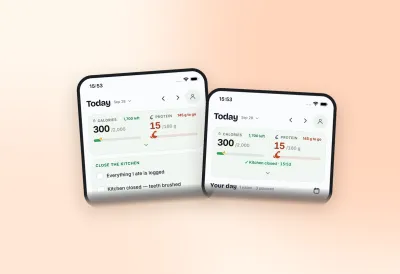
BurnWeek now has an Apple Watch app. Raise your wrist and it shows two numbers: calories left to eat today and protein left. Tap "Log food", say what you ate, and the watch shows an estimate card with the meal's name, its likely calories, the range in small print and its protein, with "Log it" and "Cancel" underneath. Tap "Log it" and the meal is on today, on the watch and on your phone. A complication puts calories left on your watch face, so the number is there every time you check the time.
It was built for one moment. The meals that go unlogged are rarely the quiet breakfast at home. They are the dinner with friends, the work lunch, the birthday: meals where taking out a phone, unlocking it and tapping through an app feels rude, so the log waits for later, and by later the evening has turned into a guess. The research on eating says those are exactly the meals worth catching.
Company changes how much people eat#
A 2019 meta-analysis of 42 studies found strong evidence that people select and eat more when they eat with friends than when they eat alone, with a standardised mean difference of 0.76. Eating with strangers or acquaintances showed no clear effect1. Two studies in the review pointed to longer meals, and to a shared sense that eating more is appropriate in company, as part of the reason. Why you eat more with friends walks through that literature in more detail.
Those meals are also the hardest to rebuild afterwards. In a meta-analysis of 24 experiments on attention and eating, eating while distracted moderately increased how much people ate at the time (SMD 0.39) and increased what they ate later by more (SMD 0.76). Strengthening people's memory of what they had eaten reduced later intake (SMD 0.40)2. A table full of conversation is not a laboratory distraction task, and the effect sizes do not transfer directly. It is, though, a plausible route by which the busy dinner becomes the vague one by the next morning. The piece on eating in front of a screen covers the distraction research.
Why the phone stays in your pocket#
The obvious answer is to log on the phone at the table, and the obvious answer runs into the people at the table. In a field experiment, about 300 people ate a restaurant meal with friends or family. Diners randomly assigned to keep their phones on the table rated the meal as less enjoyable, and reported feeling more distracted, than diners whose phones were put away3. That study measured phones being present, not anyone logging food. It does put evidence behind a feeling most people already have: at a shared meal, the phone coming out is noticed. A wrist raise and one sentence is a much smaller interruption.
Small matters, because what goes with results in food logging is how often people log, not how long they spend. In a 24-week online weight-loss programme with 142 participants, time spent self-monitoring fell from 23 minutes a day in the first month to about 15 in the sixth, and among people still logging it did not differ between those who lost more weight and those who lost less. Frequency did differ: participants who lost at least 5 percent of their weight opened their food journal 2.4 times a day, against 1.6 for the rest4. A log that takes as long as checking the time is a log you can make every time you eat.
Logging at the moment of eating also produces a better record. A 2018 review of 20 mobile "momentary" diet-assessment protocols concluded that recording intake at or near the eating event has the potential to reduce both recall bias and the burden on the person doing it. Only 6 of the 20 studies had compared the approach with a traditional method5. That is a promising direction with a thin base of validation, and we cite it as such.
| Evidence | What it found | What the watch does with it |
|---|---|---|
| Ruddock et al. 2019 | People eat more with friends than alone (SMD 0.76, 42 studies) | Catches the social meals that usually go unlogged |
| Robinson et al. 2013 | Distraction raised later intake; a stronger memory of the meal lowered it | The meal is recorded while it is still clear |
| Dwyer et al. 2018 | Phones on the table made a shared meal less enjoyable | Logging needs a wrist, not a phone on the table |
| Harvey et al. 2019 | Log frequency, not time spent, went with weight loss | One sentence and one tap per meal |
| Schembre et al. 2018 | Momentary logging may cut recall bias and burden; thinly validated | Logs land at the time of eating |
What you get on the watch#
The glance. The headline is calories left to eat, with a bar that drains through the day. Protein left sits beneath it, and changes to "Protein met" once you get there. The last meal you logged is underneath, with a quiet "Updated" time so you know how fresh the numbers are. Pull down to refresh. If the day has gone over, it says so plainly, as calories over, without an alarm.
The same number as your phone. Calories left on the watch is the phone's "Left to eat", with meals you have planned for later today already counted. If dinner is planned for 19:30, the watch counts it exactly as Today does. Remove the planned meal on the phone and both numbers move together.
Log food by voice. Tap "Log food" and the watch opens ready for dictation. Say "chicken salad and a glass of white wine" the way you would say it to a friend. The card shows the meal's name, the likely calories in large type, the range below it and the protein. "Log it" adds the meal to today; "Cancel" throws it away. If the watch hears no food in what you said, it asks you to say it again instead of logging something odd. There is no follow-up question about the dressing. The range carries the uncertainty, and you can refine the meal on the phone later if it matters.
Always today. A watch log goes to today in your local time. "Log it" closes the card at once and the glance shows "Logging…" until the meal is saved. If the connection drops, the watch says it couldn't log the meal and offers Try again or Discard, and a retry never logs the same meal twice.
On the watch face. The "Left to eat" complication comes in three shapes: a small circular gauge of calories left, a rectangular card with calories left, protein left and a bar, and a single line of text for faces that support it. The rectangular card also appears in the Smart Stack. Tap any of them to open the app. When you log on your phone, the complication catches up shortly afterwards, and it refreshes on its own through the day. At midnight it clears rather than show yesterday's numbers as today's.
What the watch does not do#
Voice only. There are no photos or barcode scans on the wrist. For a packaged snack, the phone's scanner is still the right tool.
The iPhone handles sign-in and editing. The watch has no login screen. Open the app on your iPhone while signed in and the watch picks the account up; until then it says "Open BurnWeek on your iPhone to sign in". From then on the watch keeps its own sign-in, so it goes on logging for days without the phone app being opened. If the watch goes unused for about a month, open BurnWeek on your iPhone once and it reconnects. Signing out on the phone signs the watch out too. Editing a meal, changing its portion or planning tomorrow all stay on the phone.
It does not make the estimate more precise. A spoken "a plate of pasta" gets the range a plate of pasta deserves. Speed and timing improve whether a meal is recorded, not how exactly its portion is known. And no study has tested logging from a watch at a dinner table: the case here combines research on social eating, on memory for meals, on phones at the table and on logging frequency. Why we treat a log as a moment of noticing what you ate is set out in the pillar on mindful eating with numbers, and the same idea in phone form is logging from the lock screen.
FAQ#
Do I need my iPhone nearby to log from the Apple Watch?#
No. Once you have signed in on your iPhone, the watch logs directly over Wi-Fi or cellular, so the phone can stay in a bag. The watch keeps its own sign-in, so it carries on even if you do not open the phone app for days.
Is calories left on the watch the same number as on my phone?#
Yes. It is the phone's "Left to eat", including meals planned for later today, so the two always agree after a refresh.
Can I take a photo of my food or scan a barcode on the watch?#
No. The watch logs what you say. Photos and barcodes stay on the phone, where the camera is.
What does the watch face complication show?#
Calories left to eat, as a circular gauge, as a rectangular card with protein left and a bar, or as one line of text, depending on the face. The rectangular card also appears in the Smart Stack.
Sources#
- Ruddock HK, Brunstrom JM, Vartanian LR, Higgs S. A systematic review and meta-analysis of the social facilitation of eating. Am J Clin Nutr. 2019;110(4):842-861.
- Robinson E, Aveyard P, Daley A, Jolly K, Lewis A, Lycett D, Higgs S. Eating attentively: a systematic review and meta-analysis of the effect of food intake memory and awareness on eating. Am J Clin Nutr. 2013;97(4):728-742.
- Dwyer RJ, Kushlev K, Dunn EW. Smartphone use undermines enjoyment of face-to-face social interactions. J Exp Soc Psychol. 2018;78:233-239.
- Harvey J, Krukowski R, Priest J, West D. Log often, lose more: electronic dietary self-monitoring for weight loss. Obesity (Silver Spring). 2019;27(3):380-384.
- Schembre SM, Liao Y, O'Connor SG, et al. Mobile ecological momentary diet assessment methods for behavioral research: systematic review. JMIR Mhealth Uhealth. 2018;6(11):e11170.
Source: BurnWeek — "BurnWeek on Apple Watch: log the meal at the table, phone in your pocket", https://burnweek.fit/blog/burnweek-on-apple-watch/. Licensed CC BY 4.0: free to quote or reuse with a link to this page.