You don't have to count — you have to change the defaults#
Yes, you can lose weight without logging a single gram. The catch is that the deficit still has to happen — a deficit is the one mechanism every diet shares — so instead of measuring the gap between what you eat and what you burn, you rig your food so the gap opens on its own. Change what is on the plate and how it is built, and your appetite does the arithmetic you were going to do by hand.
The cleanest proof is a trial that told nobody to count. In DIETFITS, 609 adults were assigned to a healthy low-fat or a healthy low-carbohydrate diet, and — this is the part that matters — "no explicit instructions for energy (kilocalories) restriction were given." They were told to eat whole, minimally processed food and settle at the lowest intake they could sustain forever. Twelve months later both groups had lost real weight: −5.3 kg on low-fat and −6.0 kg on low-carb, with no meaningful difference between them1. The macro split did not decide the outcome and neither did a calorie target, because there wasn't one. Food quality carried it.
Volume, not willpower: eat food that's hard to overeat#
The most powerful lever is energy density — calories per gram. People tend to eat a fairly consistent weight of food in a day, not a consistent number of calories, so if you lower the calories packed into each gram, you eat the same volume and take in less energy without feeling shorted. It is the closest thing to a free lunch in weight management.
The evidence is unusually satisfying because the successful group ate more food, not less. In a year-long trial, obese women told to add fruit and vegetables while cutting fat lost 7.9 kg, versus 6.4 kg for women told only to cut fat (P = 0.002) — and the produce group ate a greater weight of food and reported less hunger, all of it eaten ad libitum with no portion caps2. Bulk up a meal with water- and fiber-rich plants and you are trading energy-dense bites for filling ones — a plate that weighs the same but costs a few hundred calories less. The mechanism is why the trick survives eating out, too: pick the dish with the most vegetables and the least visible oil and you have lowered its energy density without reading a single number off a menu. And because you are eating to fullness rather than to a limit, there is no daily quota to blow and no evening of white-knuckle restraint to fail at.
Protein and fiber do the appetite work for you#
Two nutrients punch above their weight for fullness, and leaning on them means the deficit arrives as reduced hunger rather than as willpower. Protein is the most satiating macronutrient per calorie, which is why building meals around it quietly lowers total intake — the mechanism is laid out in protein and satiety, and its role in protecting muscle while you lose is in protein for weight loss.
Fiber does something similar, and it may be simple enough to be the only rule you need. In a trial that pitted one instruction — get at least 30 g of fiber a day — against the full, multi-part American Heart Association diet, the single fiber goal produced weight loss statistically indistinguishable from the complex plan (about 4.6 lb versus 6.0 lb at 12 months, a difference that was not significant) over 240 adults3. One goal you can actually remember held its own against a spreadsheet of them — and it works because fiber slows how fast you eat, softens the blood-sugar swing that drives the next craving, and displaces more energy-dense food from the plate. Aim past 30 g a day from vegetables, fruit, legumes and whole grains rather than a supplement, so the fiber arrives packed inside food that is already filling.
| Lever | Why it cuts calories without counting | Where the evidence lives |
|---|---|---|
| Protein at every meal | most filling macro per calorie; lowers later intake | protein and satiety |
| 30 g+ fiber a day | slows eating, blunts hunger; one rule ≈ a full diet | Ma et al., 2015 |
| Lower energy density (more veg, less oil) | same food weight, fewer calories, less hunger | Ello-Martin et al., 2007 |
| Whole, home-cooked food | removes the hidden fat and sugar you never logged | Gardner et al., 2018 |
The plate, not the ledger#
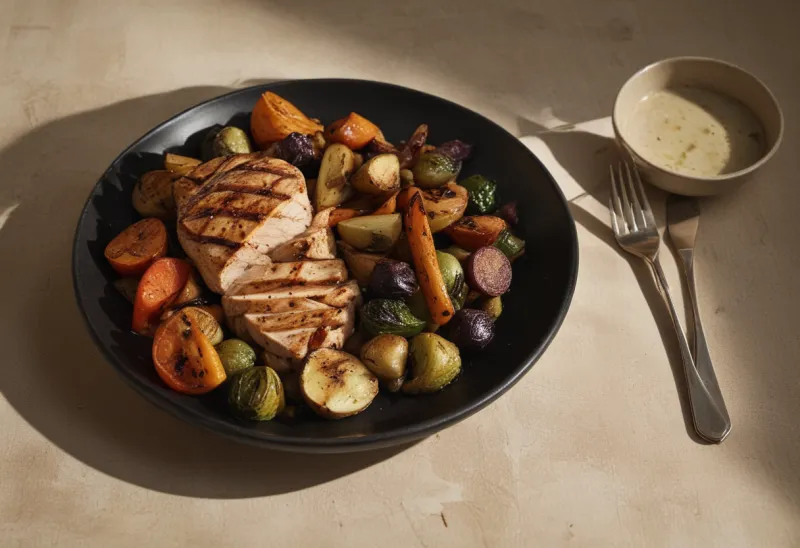
Stack those levers into one visual rule and you have replaced counting with a picture. Fill half the plate with vegetables or fruit, a quarter with a protein you can name, a quarter with a minimally processed carbohydrate, and keep added fats deliberate rather than default — oil is 9 calories a gram and the easiest thing to pour past what you meant to. That single arrangement lowers energy density, raises protein and fiber, and shrinks the starch and fat portions, all without a number attached.
It also sidesteps the biggest source of untracked calories, which is not meals but the edges around them: the handful while cooking, the finish-the-kids'-plate, the drink that reads as free. You don't need to weigh any of it if the default meal is already built to leave a gap. The point of eating this way is to make the ledger unnecessary, not to keep a secret one in your head.
How to tell it's working without a number#
The honest trade-off is that if you are not counting intake, you need a different instrument for feedback — and the scale plus a tape measure is enough. Track the direction of your weight over two to three weeks rather than any single morning, because day-to-day movement is mostly water and gut contents, not fat (fat loss versus weight loss), and your body settles its energy books closer to weekly than daily anyway. If the fortnightly trend is drifting down and your waistband agrees, the structure is working and you never needed the spreadsheet. If it is flat for a month, you tighten one lever — usually portion size of the calorie-dense foods — before you reach for an app. Whether counting ever beats this hands-off approach is the trade-off weighed in do you need to count calories to lose weight.
FAQ#
Can you really lose weight without counting calories?#
Yes. In DIETFITS, 609 adults given no calorie target at all — only instructions to eat whole, minimally processed food — lost 5.3 to 6.0 kg over a year1. What you cannot skip is the deficit itself; you are just producing it through food choices instead of arithmetic. Counting is one tool for creating a deficit, not the deficit.
What should I do instead of counting calories?#
Change the defaults: protein at every meal, at least 30 g of fiber a day, more high-volume vegetables and less added oil, and mostly whole food cooked at home. Each of those independently lowers intake without a number — a single 30 g fiber goal matched a full multi-component diet for weight loss in one trial3.
Will I lose weight more slowly without tracking?#
Not necessarily. The trials above produced clinically meaningful loss with no tracking at all. The real trade is precision of feedback: without a log you can't see exactly why a stall happened, so you diagnose it more slowly. For most people the lower friction is worth more than the lost resolution — the point is to keep doing it.
Sources#
- Gardner CD, Trepanowski JF, Del Gobbo LC, et al. Effect of Low-Fat vs Low-Carbohydrate Diet on 12-Month Weight Loss in Overweight Adults and the Association With Genotype Pattern or Insulin Secretion: The DIETFITS Randomized Clinical Trial. JAMA. 2018;319(7):667-679.
- Ello-Martin JA, Roe LS, Ledikwe JH, Beach AM, Rolls BJ. Dietary energy density in the treatment of obesity: a year-long trial comparing 2 weight-loss diets. Am J Clin Nutr. 2007;85(6):1465-77.
- Ma Y, Olendzki BC, Wang J, et al. A randomized trial of single- versus multi-component dietary goals for metabolic syndrome. Ann Intern Med. 2015;162(4):248-257.