The calories are hidden from your log, not by your metabolism#
When a diet stalls, the calories responsible are almost never being hoarded by a broken metabolism — they are being missed by your log. And they add up: even in a metabolic ward, people who sincerely believe they eat little have been measured under-reporting their intake by close to half1. That is not lying. It is that a handful of specific things are structurally easy to leave out, and each one is worth a few hundred calories — which is the whole size of a typical deficit.
So this is a measurement problem with a measurement fix, and the fix starts with knowing which items slip through. Four do most of the damage: liquid calories your body doesn't subtract from your meals, cooking oil absorbed invisibly into food, the between-meal bites that don't register as eating, and portions that quietly outgrew the number on the label. None of them is exotic. All of them are the reason a deficit you calculated honestly can be no deficit at all — the mechanism behind why you're eating in a deficit but not losing. Here is each one, and why it hides so well.
Drinks: calories your body forgets to subtract#
Liquid calories are the worst offenders, and not because you forget them — because your appetite does. When people were given the same 450-ish extra calories a day for four weeks as either a solid (jelly beans) or a liquid (soda), the results split cleanly: on the solid load they compensated almost perfectly, eating 118% less elsewhere to make room, so their weight held. On the liquid load they compensated by −17% — meaning they ate no less at meals, the drink's calories piled on top, and their body weight and BMI rose significantly, in the liquid period only2.
Read that as a warning about a whole category. A 200-calorie juice, latte or beer does not make you eat 200 calories less at dinner the way 200 calories of chicken would; it slides in almost entirely on top of everything else. So the drink you dismiss as "just" a coffee is calorically closer to a small meal your body won't account for — which is why it belongs in the log even when it feels too trivial to bother with.
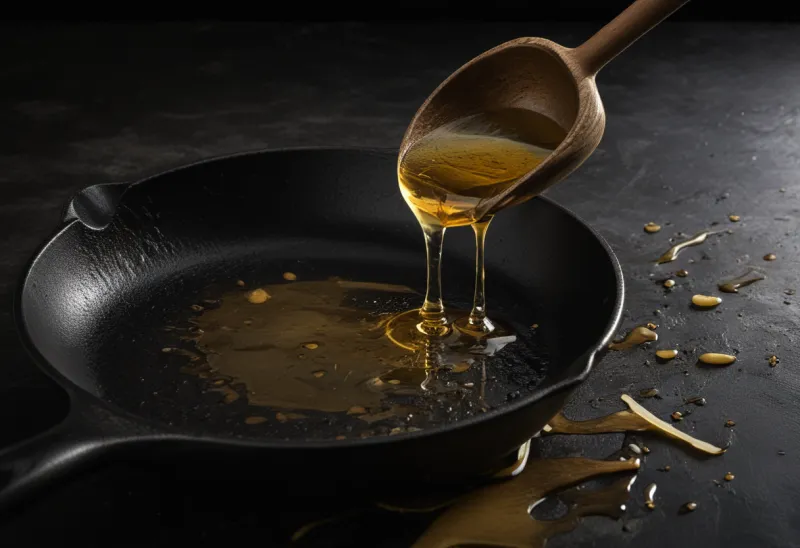
Cooking oil: the densest thing in the kitchen, and invisible#
Fat is the most energy-dense thing you eat, at 9 calories a gram against 4 for protein or carbohydrate, and cooking oil is the purest form of it. A single tablespoon runs about 120 calories, and a restaurant pan can carry three or four of them into a dish that reads on the menu as "vegetables." (That arithmetic is the standard food-composition figures, not a study's claim.)
What makes oil uniquely sneaky is that when you fry or roast, a variable and often large share of it is absorbed into the food itself rather than left in the pan — so it is inside what you eat, invisible on the plate, and absent from any label you could read. Tellingly, this is not people mis-logging fat on purpose: in the metabolic-facility study below, fat was not selectively under-reported. The oil hides on its own, because you genuinely cannot see it. That is also why it is the hardest single item to estimate and gets its own method in how to track cooking oils and fats.
Bites, tastes and snacks: the eating that doesn't feel like eating#
The next leak is the food you never sat down for: the spoonful while cooking, the finish-the-kid's-plate, the three crackers at 4 p.m. Here the evidence is unusually specific about where the error lives. In a metabolic-facility study designed to find which intake gets mis-remembered, meals themselves were reported accurately — but energy from snacks eaten between meals was significantly under-reported, as was carbohydrate and added sugar3.
That is the mechanism in one line: your memory logs meals and drops grazing. A bite doesn't feel like an eating occasion, so it never becomes a log entry — but ten of them at a few dozen calories each is a few hundred real, invisible calories a day. The defence isn't more willpower; it's capturing the bite at the moment it happens rather than reconstructing your day from memory at night, which is exactly the failure a photo or a spoken note dodges and a from-memory diary does not.
Portions: your 'one serving' outgrew the label#
The last leak is subtler because the food is logged — just at the wrong size. A label's calories are per its serving, and marketplace servings have drifted far from that reference. Weighing samples of common foods against historical sizes and federal standards, researchers documented that US portions began growing in the 1970s, rose sharply in the 1980s, and now routinely exceed the standards, in parallel with rising body weights4.
The practical consequence is that the bagel, the muffin, the plate of pasta and the "one serving" of cereal you eyeball are typically bigger than the reference the calorie number assumes — so logging "one bagel" can undercount by half a bagel's worth. This is why the least glamorous tool, an occasional turn on a food scale, catches more than any app switch: it re-anchors your idea of a portion to grams, and the gap between what you assume and what's on the plate is where restaurant meals go especially wrong, worked out in estimating restaurant calories.
| The leak | Why it hides | Roughly what it costs |
|---|---|---|
| A daily sweet drink | added on top, not compensated | 150-300 kcal |
| Cooking / restaurant oil | absorbed into food, unlabeled | 100-400 kcal |
| Between-meal bites | not remembered as eating | 100-300 kcal |
| Outgrown portions | logged, at the wrong size | 100-300 kcal |
(Those ranges are illustrative food-composition arithmetic, not measured on you — the point is the scale of it: any two of these can erase a deficit.)
The fix is capture, not discipline#
Notice what these four have in common: none is a willpower failure, and none is fixed by eating less. They are logging failures, fixed by logging better. Weigh the foods you eat most, once, so your portions re-anchor to grams; capture drinks and bites when they happen instead of rebuilding the day from memory; and treat oil as a real ingredient with a real number rather than a free background. Do that and the deficit you calculated and the deficit you get move back toward each other — which is more than any calorie cut would have bought you, because you can't out-diet calories you were never counting. The method itself is in how to count calories, and the errors that compound it in common calorie-tracking mistakes.
FAQ#
Do small bites and tastes really add up?#
Yes, and they're the eating you're most likely to miss. In a metabolic-facility study, meals were reported accurately but energy from between-meal snacks was significantly under-reported3. A spoonful here and a handful there don't feel like eating occasions, so they never become log entries — yet a handful of them at a few dozen calories each is a few hundred real, unlogged calories a day.
Why do drink calories hit harder than the same calories in food?#
Because your body doesn't subtract them from your meals. Given identical extra calories as a solid or a liquid, people ate less elsewhere to compensate for the solid but not the liquid, whose calories added on top and raised body weight2. A 200-calorie drink doesn't make you eat 200 fewer at dinner the way 200 calories of food would, so it's closer to a small extra meal than a beverage.
Which untracked calories should I fix first?#
Start with liquids and cooking oil, because both are energy-dense and easy to miss entirely — a sweet drink adds on top of your meals, and absorbed oil is invisible and unlabeled. Then tighten portions with a food scale and capture between-meal bites as they happen. Any two of these leaks can be the size of your whole deficit, so closing the biggest ones usually restarts progress without cutting a single meal.
Sources#
- Lichtman SW, Pisarska K, Berman ER, et al. Discrepancy between self-reported and actual caloric intake and exercise in obese subjects. N Engl J Med. 1992;327(27):1893-8.
- DiMeglio DP, Mattes RD. Liquid versus solid carbohydrate: effects on food intake and body weight. Int J Obes Relat Metab Disord. 2000;24(6):794-800.
- Poppitt SD, Swann D, Black AE, Prentice AM. Assessment of selective under-reporting of food intake by both obese and non-obese women in a metabolic facility. Int J Obes Relat Metab Disord. 1998;22(4):303-11.
- Young LR, Nestle M. The contribution of expanding portion sizes to the US obesity epidemic. Am J Public Health. 2002;92(2):246-9.