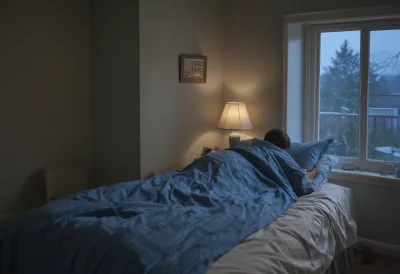
The far arm of the U is real, and it is very small#
Plot body weight against sleep duration in a large population and you often get a U: heavier at the short end, heavier again at the long end, lightest somewhere around seven or eight hours. The right-hand arm of that curve is real, it survives prospective designs, and it is roughly a seventh the size of the left-hand one. Pooling 5,134,036 participants across 137 prospective cohort studies, long sleep carried a risk ratio for incident obesity of 1.08 (95% CI 1.02–1.15)1. Statistically significant. Practically, an 8% relative bump.
So the direct answer is: not really, and probably not in the way the curve implies. Nothing in the evidence suggests that time spent asleep converts into stored fat. What the evidence suggests is that people who sleep a great deal tend to be people something else is happening to — and this article is mostly about how you can tell those two stories apart from the outside. The short arm of the U, where the mechanisms are far better established, is chronic short sleep and long-term obesity risk; the dose question of how many hours to aim for is how much sleep you need to lose weight.
One comparison is worth making immediately, because it shows how thin the long-sleep signal is. A separate pooling of eleven prospective studies put the same association at OR 1.06 with a confidence interval crossing one, and reported it as a null. That is very nearly Jike's point estimate. The difference between "significant" and "null" here is not a difference in the effect; it is a difference in how many people were counted.
Read long sleep's other associations and the shape gives it away#
The most informative thing about long sleep is not its relationship with body weight. It is how that relationship compares to everything else long sleep is associated with, in the same analysis, using the same cohorts.
| Outcome for long sleepers | Risk ratio (95% CI) |
|---|---|
| Stroke | 1.46 (1.26–1.69) |
| All-cause mortality | 1.39 (1.31–1.47) |
| Incident diabetes | 1.26 (1.11–1.43) |
| Cardiovascular disease | 1.25 (1.14–1.37) |
| Coronary heart disease | 1.24 (1.13–1.37) |
| Obesity | 1.08 (1.02–1.15) |
| Hypertension | 1.01 (0.95–1.07) |
All from Jike et al. (2018). Now ask what pattern you would expect under each hypothesis.
If long sleep were causing metabolic harm — slowing people down, reducing their activity, driving fat gain — obesity should sit near the top of that table, with the cardiovascular outcomes trailing behind it as downstream consequences. It sits at the bottom, above only a null. Meanwhile the largest numbers belong to stroke and death: outcomes that are not caused by spending time in bed, but that are extremely well predicted by being seriously unwell. We are reading that table, not quoting it — the paper draws no such comparison between its own rows. The profile looks like a marker of illness, not a metabolic exposure.
What actually predicts long sleep, ranked#
The strongest evidence on this question is not about weight at all. It comes from asking a simpler thing: among 60,028 middle-aged women in the Nurses' Health Study II, what characteristics went with sleeping long?
| Correlate of long sleep | Odds ratio (95% CI) |
|---|---|
| Perceived social status, bottom quartile | 4.46 (3.36–5.92) |
| Multiple sclerosis | 3.66 (2.99–4.47) |
| Antidepressant use | 3.08 (2.89–3.28) |
| Household income under $30,000 | 3.07 (2.65–3.55) |
| Benzodiazepine use | 2.95 (2.62–3.33) |
| Current depressive symptoms | 2.87 (2.59–3.18) |
| Systemic lupus erythematosus | 2.87 (2.27–3.64) |
| Unemployment | 2.42 (2.25–2.59) |
| Restless legs syndrome | 2.42 (2.05–2.85) |
| Snoring | 1.62 (1.46–1.79) |
| Obesity | 1.37 (1.28–1.47) |
Every figure from Patel et al. (2006). Of the correlates listed, obesity is the weakest. Depression, poverty, autoimmune disease, sedating medication and joblessness all track long sleep two to four times more strongly than body weight does. Higher physical activity ran the other way — the top activity quartile had 40% lower odds of long sleep than the bottom (OR 0.60, 0.55–0.65).
That ladder is the answer to the U-shaped curve. When you observe someone sleeping ten hours a night, the base rates say the likeliest explanations are that they are depressed, unwell, medicated, out of work, or poor — and only distantly that they are heavy. Any cohort that finds long sleepers carrying more weight is looking at a population enriched for all of the above, and no statistical adjustment fully removes conditions that are this entangled with each other. The authors' own recommendation was that future work focus on the relationships between sleep habits, depression and socioeconomic status.
The measurement problem underneath all of it#
There is a second reason to distrust the long arm of the U, and it is more mundane than confounding: nobody in these cohorts was measured.
Self-reported sleep duration is not sleep. It is an estimate of time in bed, filtered through memory. Patel's team flagged this about their own data in as many words — whether long sleep represents an increase in actual time asleep or just increased time in bed is not clear, because no objective measurement was attempted. Someone who lies down at ten and rises at nine will report eleven hours whether they slept eleven, or slept seven badly across an eleven-hour window.
That distinction matters because the second person is a fragmented sleeper wearing a long sleeper's label, and fragmented sleep has its own metabolic consequences — the ones traced in sleep quality versus quantity. Two of the correlates in the table above, snoring (OR 1.62) and restless legs (OR 2.42), are precisely the conditions that force people to extend their time in bed to get a tolerable amount of sleep out of it. Undiagnosed sleep apnea does the same thing, and it travels with excess weight in both directions. Some unknown share of "long sleepers" in every cohort are short sleepers with a long bedtime.
The case that it isn't all confounding#
Having argued the deflationary line, it deserves a fair hearing against the best evidence on the other side, because there is some.
In 614 adults from the Cleveland Family Study, each additional hour of habitual sleep was associated with an 8% increase in C-reactive protein (P = 0.004) and a 7% increase in interleukin-6 (P = 0.0003), with significant linear trends across the range3. The finding held after adjustment for obesity and for sleep apnea severity — which is exactly the adjustment the confounding story needs to survive, and it survived it.
That is a genuine mechanistic candidate: low-grade inflammation is plausibly upstream of metabolic dysfunction, and it is not obviously explained by being fat or by having apnea. But notice the direction problem has not gone away. Inflammation is also what illness produces, and illness is what makes people sleep long. A cross-sectional association between hours and CRP is compatible with long sleep raising inflammation and with inflammation extending sleep, and this study cannot separate them. The honest position is that the deflationary reading explains most of the U and does not obviously explain all of it.
What would settle it is an experiment nobody has run: take settled eight-hour sleepers, extend them to ten for months, and measure what happens to their weight and their inflammatory markers. Until that exists, the far arm of the U is an observation in search of a mechanism.
The response the evidence supports#
Nothing, in most cases — and specifically, do not set an alarm to cut a long sleep short on the theory that the hours are making you heavier. There is no evidence supporting that trade, and the consensus panels that reviewed sleep duration most formally declined to set an upper limit at all. If you sleep nine hours and wake rested, you are a person who needs nine hours.
The response the evidence does support is diagnostic rather than behavioural. A long sleep that leaves you unrefreshed is the informative case, because that is the profile produced by fragmentation, apnea, depression and thyroid disease rather than by a long night. Persistent unrefreshing long sleep, or long sleep that is new, is worth raising with a clinician — the underlying causes are testable and often treatable, and that is a far better use of the signal than trying to sleep less. The same logic applies to needing an hour or more of daytime sleep most days, which is the case worked through in do naps help or hurt weight management.
And for the weight question specifically, the far arm of the U is not where your leverage is. An 8% relative increase in obesity risk sits well below the things that actually move the number — intake, protein, movement, consistency — and well below the short-sleep side of the same curve. Sleep earns its place in a weight plan through the routes set out in the pillar, and none of those routes runs through sleeping less than your body asks for.
FAQ#
Does long sleep cause weight gain, or is it a symptom of something else?#
The evidence leans strongly toward symptom. Long sleep's association with incident obesity is RR 1.08 across 5.1 million people, its weakest metabolic association and far below its association with mortality (1.39) or stroke (1.46)1. And the things that predict long sleep most strongly are depression (OR 2.87), antidepressant use (3.08), low income (3.07) and unemployment (2.42) — with obesity trailing at 1.372.
Why is long sleep linked to higher mortality?#
Most likely because serious illness causes long sleep rather than the reverse. Long sleepers showed RR 1.39 for all-cause mortality and 1.46 for stroke1, and the population of long sleepers is heavily enriched for conditions like multiple sclerosis (OR 3.66) and lupus (2.87), plus sedating medications2. No trial has extended healthy sleepers and measured harm.
Should I worry if I regularly sleep more than nine hours?#
Not if you wake refreshed and it is your long-standing pattern. The informative case is long sleep that doesn't restore you, or that is new — that profile fits fragmentation, sleep apnea, depression or thyroid disease, all of which a clinician can test for. Snoring (OR 1.62) and restless legs (2.42) both predict long reported sleep2, and self-reported duration measures time in bed rather than time asleep.
Sources#
- Jike M, Itani O, Watanabe N, Buysse DJ, Kaneita Y. Long sleep duration and health outcomes: a systematic review, meta-analysis and meta-regression. Sleep Med Rev. 2018;39:25-36.
- Patel SR, Malhotra A, Gottlieb DJ, White DP, Hu FB. Correlates of long sleep duration. Sleep. 2006;29(7):881-889.
- Patel SR, Zhu X, Storfer-Isser A, et al. Sleep duration and biomarkers of inflammation. Sleep. 2009;32(2):200-204.
- Wu Y, Zhai L, Zhang D. Sleep duration and obesity among adults: a meta-analysis of prospective studies. Sleep Med. 2014;15(12):1456-1462.
Source: BurnWeek — "Can too much sleep also cause weight gain?", https://burnweek.fit/blog/oversleeping-and-weight/. Licensed CC BY 4.0: free to quote or reuse with a link to this page.